
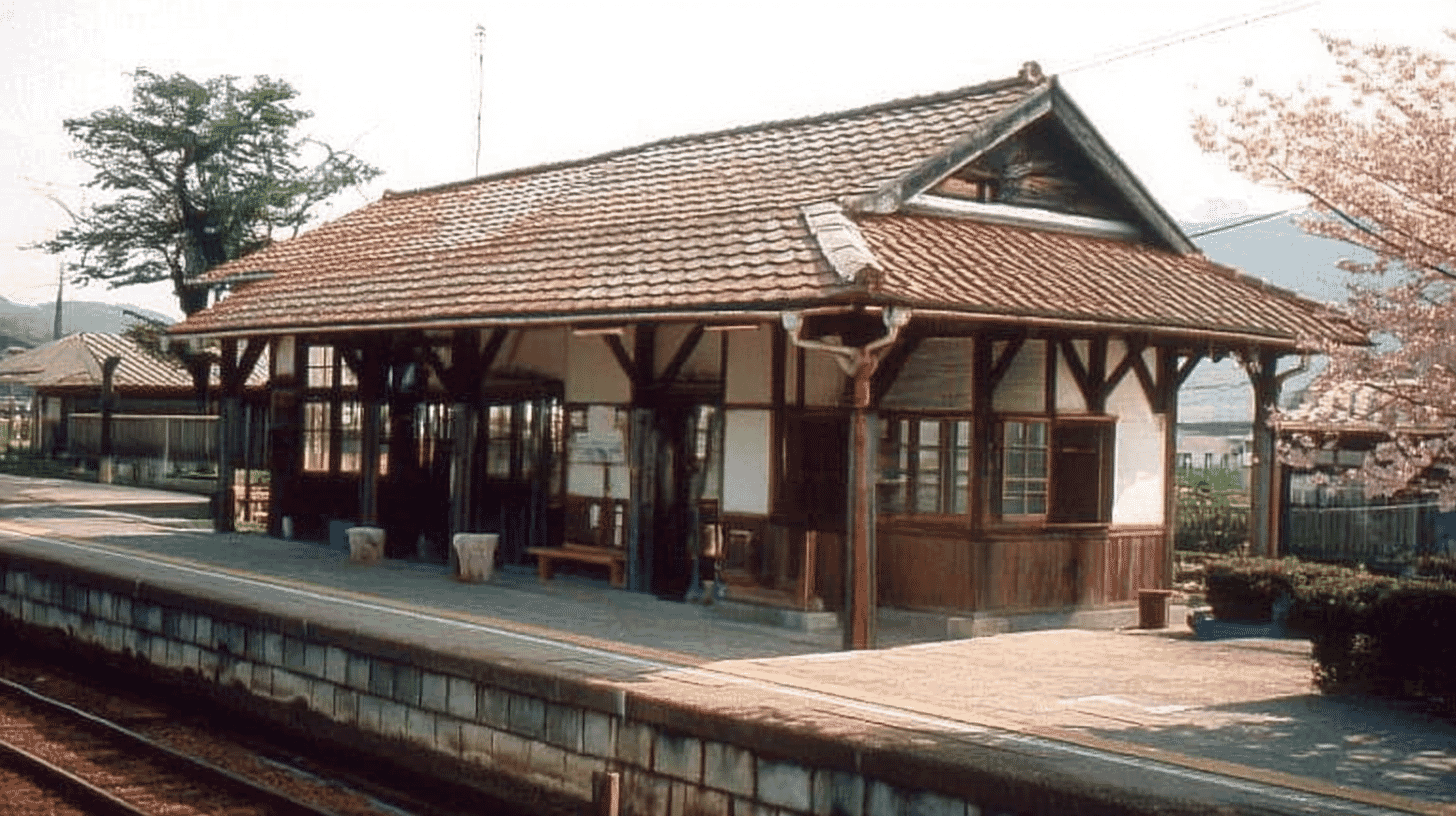
A Timber Station of 1900, Registered in 2006
JR Tsuyama Line (formerly Chugoku Railway) Takebe Station (JR津山線(旧中国鉄道)建部駅駅舎) stands at 403-3 Nakada, Takebe-cho, Kita Ward, Okayama City, Okayama Prefecture, entered on the national register of tangible cultural properties on 2 March 2006. The quantity is one building: timber, single storey, tiled roof, with a footprint of 84 square metres. The Agency for Cultural Affairs gives the date as Meiji, 1900.
The Agency records how it came to open: two years after the Chugoku Railway line between Okayama and Tsuyama began running. The station was not there when the line opened; it was added afterwards.
The reason is set down as well: it is a petitioned station, long familiar to those living along the line. A petitioned station is one established at the request of local people.
A Third of the Building Is Waiting Room
The Agency describes the plan precisely.
A timber single-storey building on a north-south axis, gabled and tiled, seven bays along and three bays deep, with two and a half bays at the south end given to the waiting room.
Of seven bays along, two and a half at the south are the waiting room: rather more than a third of the building. The rest serves the working of the station.
A footprint of 84 square metres is small for a single-storey timber building, and within that a third is given over to waiting. For a station established by petition, space for the people using it has been secured.
Eaves on Three Sides, and One Gable Treated Differently
Two features of the roof and eaves vary by compass direction.
A one-bay penthouse eave is carried down on the east, south and west faces. The north face has none. A penthouse eave hangs below the main roof and makes a sheltered space along the wall.
The other is the treatment of the gable. The roof is gabled throughout, yet the south gable is built as a hip-and-gable. A plain gable ends in a vertical triangle; a hip-and-gable is gabled above and hipped below.
Only the south end of the roof takes a different form. With the waiting room at the south and the eaves running along three faces including the south, it is clear that the south side is treated as the front.
The north-south axis means the ridge runs north and south, the arrangement of a station building set along a line of track.
The Owner Is Recorded as a Town That No Longer Exists
The Agency gives the owner as Takebe Town.
Takebe Town was absorbed into Okayama City in 2007 and no longer exists. Registration came on 2 March 2006, the year before. The location field reads Takebe-cho, Kita Ward, Okayama City, while the owner field remains as it stood at registration.
The owner in the official record does not match the present administrative map. When consulting sources it is worth remembering that the entry records the position at the time of registration.
Registration is a separate mechanism from designation: it works by notification and leaves the owner wide freedom to keep using the building. Keeping the structure while it goes on serving as a station follows from that framework.
Visiting
Takebe is a working station. Its exterior is seen in the ordinary course of using it.
The waiting room is open to passengers. It is not a facility for sightseeing, so it is looked at while waiting for a train.
Comparing the three faces that carry eaves with the north face that does not shows how the directions are treated differently. The hip-and-gable at the south end is easiest to make out from the south.
The station is on the JR Tsuyama Line. The station itself is the registered property.
Q&A
- When was the station built and registered?
- The Agency for Cultural Affairs gives the date as Meiji, 1900. It was entered on the national register of tangible cultural properties on 2 March 2006, as one building of timber, single storey, tiled, with a footprint of 84 square metres.
- Why did it open after the line did?
- The Agency records that it opened two years after the Chugoku Railway line between Okayama and Tsuyama began running, and that it is a petitioned station, long familiar to those along the line. A petitioned station is established at the request of local people, so it was added after the line opened.
- How is the interior arranged?
- The Agency records seven bays along and three bays deep, with two and a half bays at the south end given to the waiting room. That is rather more than a third of the building, the rest serving the working of the station.
- What marks the roof?
- The roof is gabled, but the south gable alone is built as a hip-and-gable. A one-bay penthouse eave runs along the east, south and west faces, with none on the north. Together with the waiting room at the south, this shows the south side treated as the front.
- Why is the owner given as Takebe Town?
- Takebe Town was absorbed into Okayama City in 2007 and no longer exists. Registration came in 2006, the year before, and the owner field remains as it stood then. The location field reads Takebe-cho, Kita Ward, Okayama City.
Basic Information
| Name | JR Tsuyama Line (formerly Chugoku Railway) Takebe Station (JR津山線(旧中国鉄道)建部駅駅舎) |
|---|---|
| Location | 403-3 Nakada, Takebe-cho, Kita Ward, Okayama City, Okayama Prefecture |
| Designation | Registered Tangible Cultural Property (structure) |
| Year Designated | 2006 (2 March), registered |
| Quantity | 1 building |
| Dimensions | Timber, single storey, tiled roof, footprint 84 square metres. On a north-south axis, gabled and tiled, 7 bays along and 3 bays deep, with 2 and a half bays at the south end as the waiting room, a 1-bay penthouse eave on the east, south and west faces, and the south gable built as a hip-and-gable. Built 1900 |
| Owner | Takebe Town, as recorded by the Agency; the town was absorbed into Okayama City in 2007 |
| Public Access | A working station. The exterior and waiting room are seen in the course of using it |
References
- Cultural Heritage Online: Takebe Station building on the JR Tsuyama Line
- https://bunka.nii.ac.jp/heritages/detail/151965
- Okayama Prefecture tourism federation: Takebe Station
- https://okayama-kanko.net/sightseeing/spot/128/
- Agency for Cultural Affairs: the registration system for tangible cultural properties
- https://www.bunka.go.jp/seisaku/bunkazai/shokai/yukei_kenzobutsu/
- Agency for Cultural Affairs, National Cultural Properties Database
- https://kunishitei.bunka.go.jp/
Last verified: 2026.09.04