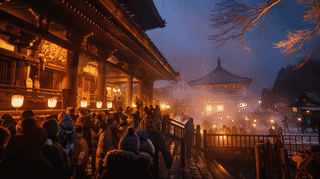
Saidaiji Eyo: Witnessing One of Japan's Most Extraordinary Festivals
On a freezing night in mid-February, deep inside the precincts of Saidaiji Kannon-in Temple in Okayama, the lights of the main hall are extinguished. In the darkness, ten thousand men—wearing nothing but a white loincloth (mawashi) in the depths of winter—press together so tightly that the wooden floor groans beneath them. Then, from a small opening high on the wall called the Gofuku-mado ("Window of Fortune"), a Buddhist priest hurls two short wooden batons known as shingi into the crowd. What follows is one of the most astonishing scenes in all of Japanese folk culture: a roaring, surging tide of bare bodies fighting to seize the sacred wood and become "Fukuotoko"—the Lucky Men of the year.
This is Saidaiji Eyo, the Naked Festival of Saidaiji, designated a National Important Intangible Folk Cultural Property of Japan in 2016. With more than 500 years of unbroken history, it is widely counted among the "Three Greatest Strange Festivals" (Nihon Sandai Kisai) of Japan, and remains one of the most powerful living expressions of Japanese folk Buddhism that international visitors can experience.
Origins: A Five-Hundred-Year-Old Tradition
The origins of Saidaiji Eyo reach back to the Muromachi period. According to temple tradition, in 1510 (Eishō 7), the temple's chief priest Chūa-shōnin distributed paper protective talismans to worshippers on the final day of the New Year prayer rites. So many people thronged to receive them that the priest had no choice but to throw the talismans down into the gathered crowd. Worshippers, desperate to claim one, stripped down to allow themselves freedom of movement and competed for the talismans with a fierce intensity. Over the centuries, the paper protectives evolved into wooden batons, the cleansing of body and spirit before the contest crystallized into a formal ritual of pouring ice water (mizugori), and the event gradually merged with the temple's 14-day New Year prayer rite, the Shushōe.
The festival's name itself carries meaning. "Eyō" (会陽) signifies the auspicious turning point when the harsh and difficult winter passes and the warm sunlight of spring is welcomed in. For the people of Bizen Plain, the night of Saidaiji Eyo has long been the herald of the new season.
Why the Festival Was Designated a National Cultural Property
On March 2, 2016, the Agency for Cultural Affairs designated Saidaiji Eyo as an Important Intangible Folk Cultural Property. The designation recognized several outstanding qualities. First is the festival's historical depth: a New Year prayer ritual transmitted continuously since the early sixteenth century, with documents and oral tradition preserving its evolution. Second is the integrated structure of its rites. Far from being merely the dramatic moment of the wooden baton contest, Eyo unfolds as a sequence beginning nineteen days earlier with the Kotohajime-shiki (the formal commencement ceremony), continuing through the Shingi-tori (collection of the raw wood), the Shingi-kezuri (carving of the batons by hereditary craftsmen), the fourteen days of the Shushōe prayer rite, and culminating in the night of contest itself. Third is the remarkable preservation of the tradition by the local community, organized through the Saidaiji Eyo Preservation Association.
In June 2024, Saidaiji Eyo was further incorporated as a constituent cultural property of the Japan Heritage program "Kitamaebune Ports of Call and Shipowner Settlements," reflecting the historic role of the port town of Saidaiji along the Yoshii River as a trading hub of the Inland Sea.
The Festival's Highlights and What to Watch For
The Sacred Shingi
At the heart of Eyo are the two shingi, cylindrical wooden batons approximately four centimeters in diameter and twenty centimeters long. The wood for them is harvested in a solemn midnight procession from Muryōju-in Temple, four kilometers to the west, where temple representatives in traditional happi coats, straw sandals, gaiters, and sedge hats walk an hour each way carrying paper lanterns. The batons are then carved in a secret rite by hereditary craftsmen and consecrated through the fourteen-day Shushōe prayers. By the night of the festival, they have become objects believed to confer a year of good fortune upon whoever grasps them.
The Approach and Cleansing
From around 8 p.m. on the festival night, the participants—men of all ages from across Japan and increasingly from overseas—gather in the temple precincts. They pour cold water over themselves at the mizugori-ba (cleansing station) to purify body and spirit, then march around the grounds shouting the resounding chant "Wasshoi! Wasshoi!" before pressing into the main hall. Tradition holds that in earlier centuries the roar of the men could be heard across the Seto Inland Sea as far as Shikoku.
The Climax
At 9:59:30 p.m., the lights are cut and one hundred small "edagōō" sticks—a kind of preliminary blessing—are thrown from the Gofuku-mado. Then, at the stroke of 10 p.m., the two shingi are cast down into the dark, roiling crowd. The contest that follows—called the "honoshi"—lasts roughly fifteen minutes. Those who succeed in carrying a shingi past the temple's Niōmon Gate and presenting it at the appraisal station nearby become the Fukuotoko of the year, honored with a certificate and a cash prize from the temple and the festival's "iwainushi" sponsors.
The Setting
Saidaiji Kannon-in itself is a remarkable temple complex even apart from the festival. The vast main hall, rebuilt in 1863, is one of the largest five-bay halls in the prefecture. Other distinguished buildings include the Sanjū-no-tō (three-storied pagoda), the Niōmon Gate, the unusual half-stone, half-wood Sekimon (Stone Gate, a Registered Tangible Cultural Property of Japan), and the hexagonal sutra repository with its rotating bookcase. The temple's bronze bell is a National Important Cultural Property in its own right.
Watching the Festival as a Visitor
For international visitors, Saidaiji Eyo is most often experienced as a spectator. Designated viewing areas are arranged within the temple grounds, and the precinct is illuminated by braziers and food stalls during the early evening, creating a vivid pre-festival atmosphere. Female visitors and those who do not wish to participate can observe the contest from these areas. Women may also take part in the mizugori cleansing ritual by prior application to the temple, a side of the festival less known to outsiders but rich with meaning. Around the festival, the small port town of Saidaiji takes on a celebratory air, with the historic Gofuku-dōri shopping street—lined with early-Showa "kanban" facade architecture—coming alive with visitors.
Men who wish to participate must apply in advance, observe the temple's rules (no alcohol, no tattoos, no footwear other than traditional tabi), and accept that this is a serious religious ritual rather than entertainment. Each year a small number of participants are injured, and the contest is genuinely intense.
Around the Temple
A visit to Saidaiji rewards those who explore beyond the temple gates. The Yoshii River flows just east of the precinct, recalling the days when Saidaiji prospered as one of Bizen Province's most important inland ports. The Saidaiji Cultural Museum, open Sundays, displays artifacts and photographs of the festival's history. The atmospheric Gofuku-dōri street, used as a filming location for Japanese films and dramas, is a short walk from the temple. A larger trip can easily combine Saidaiji with a visit to Okayama Castle and the celebrated Korakuen Garden, both about twenty minutes away by train and bus.
Q&A
- When is Saidaiji Eyo held each year?
- The festival is held on the third Saturday of February every year. The climactic contest for the shingi takes place at 10 p.m. The date was moved from the lunar calendar (originally the 14th day of the first lunar month) to the third Saturday of February in 1962.
- Can foreign visitors participate or watch?
- Foreign visitors are welcome to watch from the designated viewing areas, and the number of foreign participants in the contest itself has been increasing in recent years. Men who wish to participate must apply in advance and follow temple rules. Women and children typically watch from the viewing areas, though women may also apply to take part in the mizugori cleansing ritual.
- What exactly is a "shingi"?
- The shingi are sacred wooden batons, about four centimeters in diameter and twenty centimeters long, carved by hereditary craftsmen and consecrated during the fourteen-day Shushōe prayer rite. Two are thrown from the temple's Gofuku-mado at the climax of the festival, and the men who successfully carry them out become the Fukuotoko, or "Lucky Men of the Year."
- How do I get to Saidaiji Kannon-in?
- From JR Okayama Station, take the JR Akō Line approximately 18 minutes to Saidaiji Station, then walk about 10 minutes to the temple. Alternatively, a Ryōbi Bus from Okayama Tenmaya Bus Center to Saidaiji Bus Center takes about 30 minutes, followed by a 10-minute walk. On the festival night, special trains and direct buses are added to handle the crowds.
- Can I visit Saidaiji at other times of the year?
- Yes. Saidaiji Kannon-in is open daily, and the precincts may be visited freely from outside at any hour. Hall interiors and the Gogyū-sho-den can be viewed from 9 a.m. to 4 p.m. (admission ¥500 for adults, ¥200 for children). The temple also holds the Yomachi Festival in July and the Mizu Festival in August, both lively summer events that are easier for casual visitors than Eyo.
Basic Information
| Name | Saidaiji Eyo (西大寺の会陽) |
|---|---|
| Cultural Property Designation | National Important Intangible Folk Cultural Property (designated March 2, 2016) |
| Venue | Saidaiji Kannon-in Temple (Kinryōzan Saidaiji), 3-8-8 Saidaiji-naka, Higashi-ku, Okayama City, Okayama Prefecture 704-8116 |
| Origin | 1510 (Eishō 7), early sixteenth century, Muromachi period |
| Held On | Third Saturday of February each year (climax at 10 p.m.) |
| Preserving Body | Saidaiji Eyo Preservation Association (Saidaiji Eyo Hozonkai) |
| Religious Affiliation | Kōyasan Shingon-shū Bekkaku Honzan (Special Head Temple of Kōyasan Shingon Buddhism) |
| Principal Image of Temple | Senju Kannon Bosatsu (Thousand-Armed Kannon) — hibutsu (hidden image) |
| Access | 10-minute walk from JR Saidaiji Station (Akō Line); 10-minute walk from Saidaiji Bus Center |
| Telephone | +81-86-942-2058 (Saidaiji Kannon-in) |
References
- Cultural Heritage Online — Saidaiji no Eyo (Agency for Cultural Affairs)
- https://bunka.nii.ac.jp/heritages/detail/375244
- National Cultural Properties Database — Saidaiji no Eyo
- https://kunishitei.bunka.go.jp/bsys/maindetails/302/00000935
- Saidaiji Kannon-in Official Website — About the Eyo Origin
- https://www.saidaiji.jp/eyou/greeting/
- Saidaiji Kannon-in Official Website — Cultural Properties
- https://www.saidaiji.jp/about/cultural-assets/
- Okayama City Higashi Ward — Saidaiji Eyo (Naked Festival)
- https://www.city.okayama.jp/higashiku/0000017681.html
- Okayama Chamber of Commerce and Industry — Saidaiji Eyo
- https://okayama-cci.or.jp/activation/saidaijieyo.html
- Wikipedia (Japanese) — Saidaiji (Okayama)
- https://ja.wikipedia.org/wiki/西大寺_(岡山市)
- Okayama Kanko WEB — Saidaiji Kannon-in
- https://www.okayama-kanko.jp/spot/detail_10183.html
Last verified: 2026.05.07