
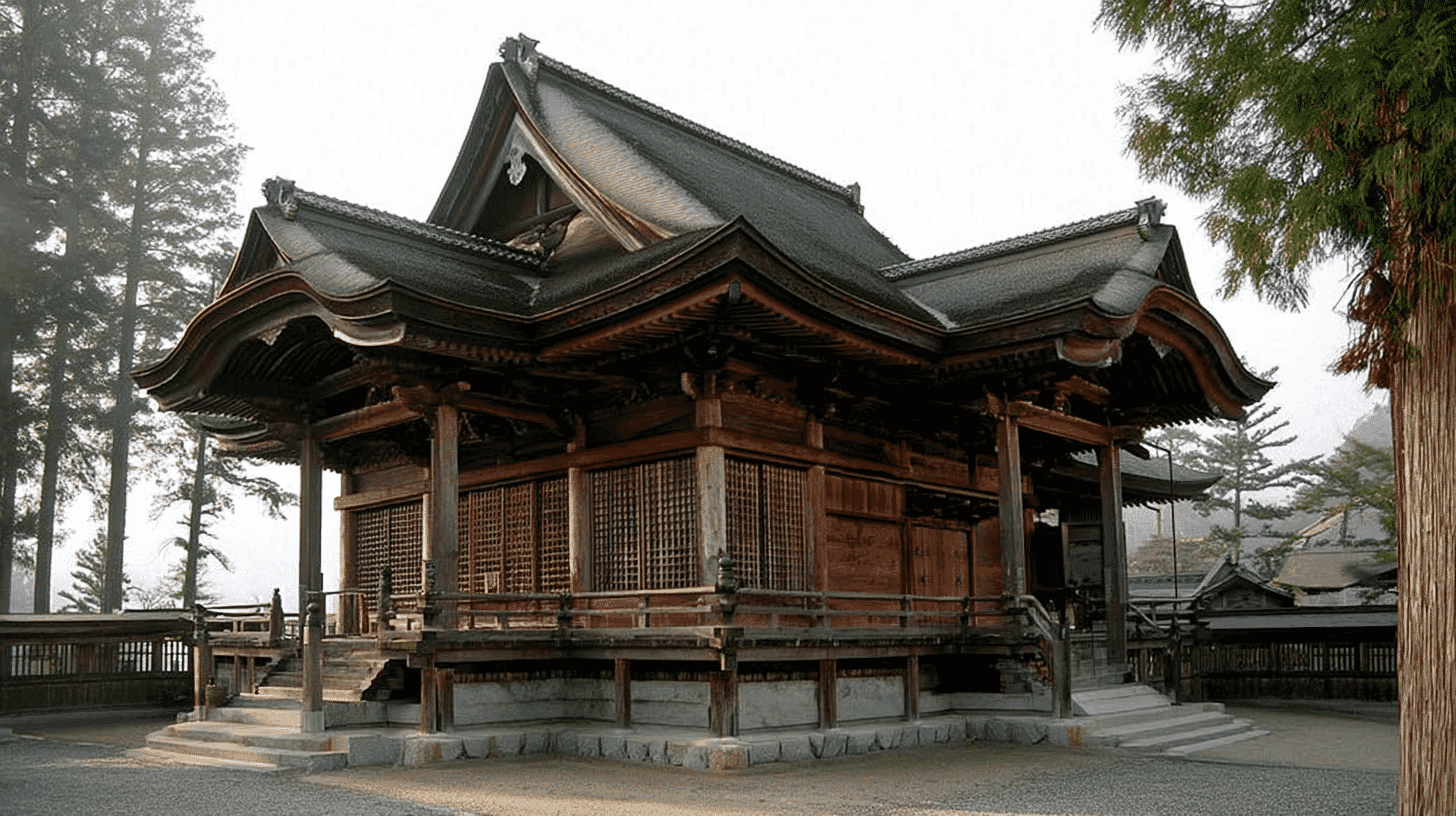
Hip-and-Gable Roof Entered from the Gable End, Designated in 1914
Soja Main Shrine (総社本殿, Soja Honden) is a shrine hall at Soja, Tsuyama City, Okayama Prefecture, designated on 17 April 1914 and now an Important Cultural Property. The quantity is one building, the class religious architecture, and the owner Soja.
The Agency for Cultural Affairs gives the form as three bays by three bays, single storey, hip-and-gable roof, entered from the gable end, with a one-bay porch under an undulating gable, shingled. A hip-and-gable roof entered from the gable end is what settles the shape of this hall.
Most shrine halls are entered from the long side. Entering from the gable end makes the triangular face of the roof the front, so a gable wall stands at the entrance, with the porch projecting one bay from it.
The Sources Give Different Dates
Accounts of when this hall was built do not agree.
The Agency gives the date as early Edo, 1657. The Okayama Prefecture Shrine Agency, however, records that the present hall was built in 1562 by Mori Motonari and thoroughly repaired in 1657 by Mori Nagatsugu, lord of the province.
The Agency's 1657 is the year of that thorough repair. Whether the date is taken from the building or from the repair is where the accounts part, and ninety-five years separate the two.
This article does not choose between them; it follows the Agency's date while recording that the hall is elsewhere said to date from 1562. The Shrine Agency also records a full dismantling and repair in 1932, carried out by the state together with the parishioners.
The Porch Gable Is Also Described Differently
Besides the date, the form of the porch gable is described in two ways.
The Agency gives a one-bay porch under an undulating gable, a curved form rising convex at the centre and falling concave at either end. The Shrine Agency instead describes a triangular dormer gable over the porch as a distinctive feature. A dormer gable is a straight-sided triangle, a different shape entirely.
This article follows the Agency and records the Shrine Agency's account alongside it. The same member is described in two ways.
The roof is shingled, laid with thin split boards rather than tiles or cypress bark.
The Soja of Mimasaka Province
A soja is a shrine at which the deities of a province are enshrined together, established so that the provincial governor need not travel to each shrine in turn.
The Okayama Prefecture Shrine Agency records that the governor of Mimasaka moved the hall to the present site at Kikkozan and, with Onamuchi as principal deity, enshrined together the deities of all sixty-five districts of Mimasaka, beginning with the first-ranked Nakayama Shrine and the second-ranked Takano Shrine, naming it the Soja.
For some five centuries afterwards, successive governors are said to have conducted the administration of the province in accordance with the will of these deities. After the provincial seat fell into disuse in the Kamakura period, the shrine continued to be revered as one of the three great shrines of Mimasaka.
The Shrine Agency records that of all the soja in the country, this one alone received designation in 1914. Soja are numerous; this is the one that was designated.
Visiting
The shrine is at 427 Soja, Tsuyama City. The precinct is open.
The hall stands outdoors, but the interior cannot be entered. The hip-and-gable form entered from the gable end, and the porch, are taken in from outside.
On 10 December a hot-water purification rite unusual among the shrines of this region is performed. The spring festival falls on 10 April and the autumn festival on the second Sunday of October. Conditions differ on festival days, which is worth avoiding for a quiet visit.
The shrine lies about 600 metres west of Tsuyama Technical High School, with parking for fifteen cars.
Q&A
- When was the hall designated?
- On 17 April 1914; it is now an Important Cultural Property. The quantity is one building, the class religious architecture, and the owner Soja. The Agency for Cultural Affairs gives the date as early Edo, 1657.
- Why do the dates differ?
- The Agency gives 1657, while the Okayama Prefecture Shrine Agency records that the hall was built in 1562 by Mori Motonari and thoroughly repaired in 1657. The Agency's date is the year of the repair, and whether the date is taken from the building or the repair is where the accounts part.
- What form does the hall take?
- The Agency gives three bays by three bays, single storey, hip-and-gable roof, entered from the gable end, with a one-bay porch under an undulating gable, shingled. Most shrine halls are entered from the long side; entering from the gable end makes the triangular face of the roof the front.
- What shape is the porch gable?
- The accounts differ. The Agency gives an undulating gable, a curve rising convex at the centre and falling concave at the ends. The Shrine Agency describes a triangular dormer gable, a straight-sided form. The same member is described in two ways.
- What is a soja?
- A shrine at which the deities of a province are enshrined together, established so that the governor need not visit each shrine in turn. The Shrine Agency records that the deities of all sixty-five districts of Mimasaka were enshrined here, beginning with the first- and second-ranked shrines of the province.
Basic Information
| Name | Soja Main Shrine (総社本殿, Soja Honden), also known as Mimasaka Sojagu |
|---|---|
| Location | 427 Soja, Tsuyama City, Okayama Prefecture |
| Designation | Important Cultural Property (structure) |
| Year Designated | 1914 (17 April), designated |
| Quantity | 1 building |
| Dimensions | 3 bays by 3 bays, single storey, hip-and-gable roof, entered from the gable end, 1-bay porch under an undulating gable, shingled. The Agency dates it to early Edo, 1657; the Okayama Prefecture Shrine Agency records building in 1562 and thorough repair in 1657 |
| Owner | Soja |
| Public Access | The precinct is open. The interior of the hall cannot be entered |
References
- Cultural Heritage Online: Soja Main Shrine
- https://bunka.nii.ac.jp/heritages/detail/195680
- Okayama Prefecture Shrine Agency: Soja
- https://www.okayama-jinjacho.or.jp/search/16910/
- Tsuyama tourism association: Mimasaka Sojagu
- https://www.e-tsuyama.com/kankou/check/mimasakasoujagu/
- Agency for Cultural Affairs, National Cultural Properties Database
- https://kunishitei.bunka.go.jp/
Last verified: 2026.09.04