Osaka Nipponbashi Christian Church: A Gothic Gem Hidden in Osaka's Electronics District - Registered Tangible Cultural Property

Discover the historic Osaka Nipponbashi Christian Church, a 1925 Gothic Revival masterpiece and Registered Tangible Cultural Property. Located near Kuromon Market and Den Den Town, this architectural treasure offers a peaceful spiritual retreat in bustling Osaka.

Osaka Nipponbashi Christian Church: A Timeless Gothic Revival Treasure in the Heart of Osaka

Standing gracefully along Sakai-suji Avenue in Osaka's bustling Nipponbashi district, the Osaka Nipponbashi Christian Church presents a striking contrast to the surrounding electronics stores and modern commercial buildings. This Gothic Revival masterpiece, completed in 1925 during the Taisho era, serves as a testament to Japan's architectural embrace of Western styles while maintaining its unique cultural identity. Designated as a Registered Tangible Cultural Property in 2000, this historic church offers visitors a glimpse into Japan's religious and architectural heritage.

Historical Background and Architectural Journey

The church's origins trace back to June 1903, when Sadakichi Kawabe established the "Osaka Dendo-kan" (Osaka Mission Hall) in a rented house near Tamamizu Bridge in Osaka's Minami district. This modest beginning laid the foundation for what would become one of Osaka's most architecturally significant religious structures. Throughout its history, the church has undergone various denominational changes, joining and leaving different Christian organizations, ultimately becoming an independent church in 2013.

The current building, designed by architect Shigekazu Yamanaka and constructed by Okamoto Construction Company in 1925, represents a remarkable achievement in early 20th-century Japanese church architecture. Okamoto Construction was notably associated with many projects by William Merrell Vories, the renowned American architect who significantly influenced Western-style architecture in Japan. The building combines reinforced concrete with brick construction, covering an area of 342 square meters, demonstrating the advanced construction techniques of the Taisho period.

Architectural Features and Gothic Design Elements

The church's facade exemplifies Gothic Revival architecture adapted to Japanese urban context. The most distinctive feature is the arrangement of pointed arch windows - five consecutive Gothic arches grace the third floor, creating a rhythmic pattern that draws the eye upward. The main entrance features a pointed arch design typical of Gothic architecture, while the lower level incorporates circular windows on both sides, adding visual variety to the composition.

What makes this building particularly noteworthy is how it integrates Gothic verticality within the constraints of a dense urban environment. Unlike standalone Gothic cathedrals with their soaring spires and flying buttresses, this church presents a relatively flat facade that harmoniously blends with the streetscape along Sakai-suji Avenue. This architectural compromise demonstrates the skillful adaptation of Western religious architecture to Japanese urban planning principles.

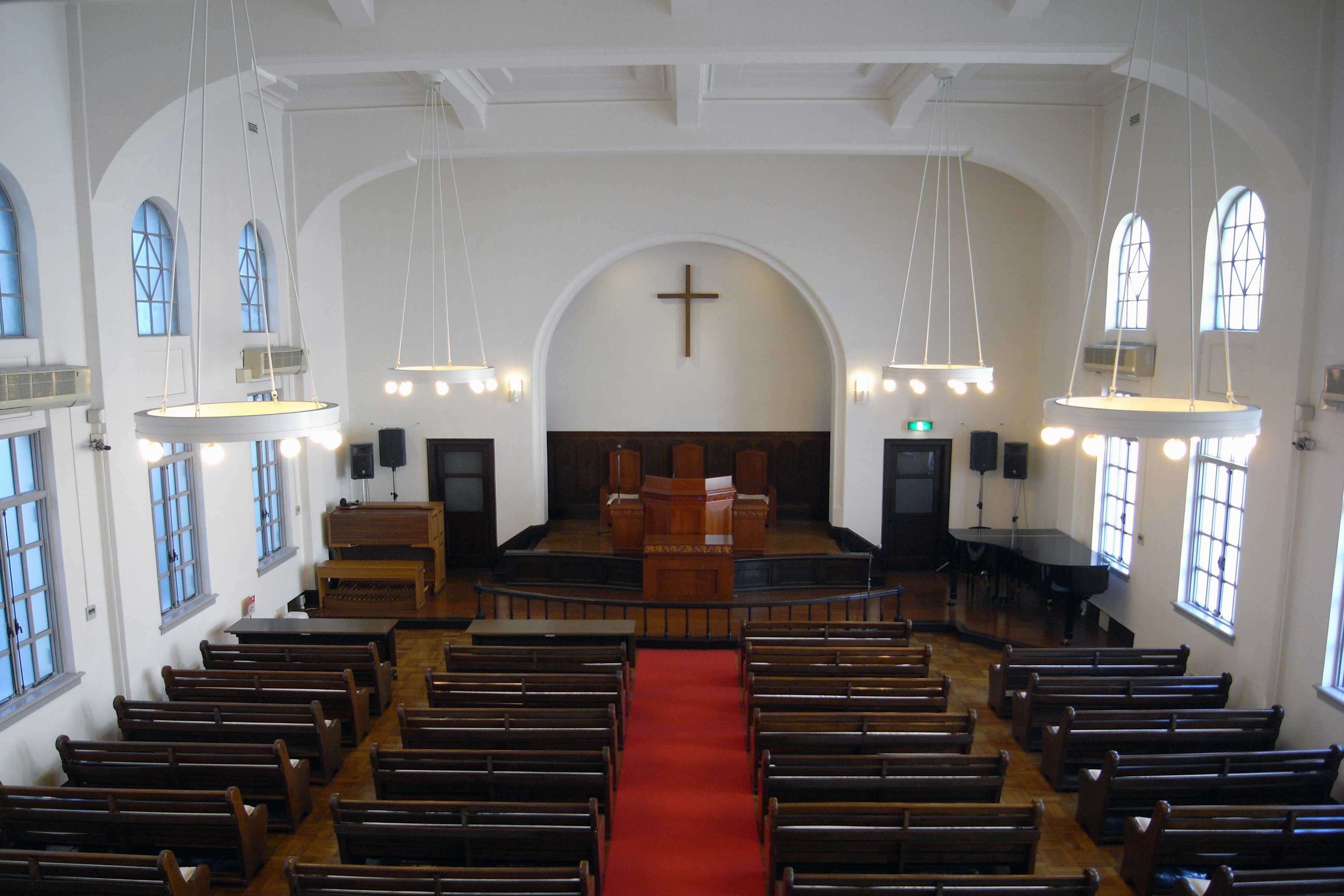
The 2001 major renovation restored the building to its original splendor while incorporating modern amenities. Barrier-free access and elevator systems were installed, and a decorative iron entrance facade featuring leaf motifs was added, enhancing both functionality and aesthetic appeal. The interior preserves original architectural elements including the ceiling structure, pulpit design, glass windows, flooring, and seating arrangements, all of which authentically represent the architectural style of the 1920s.

Cultural and Historical Significance

The designation as a Registered Tangible Cultural Property recognizes the church's importance as a rare example of Taisho-era Gothic Revival architecture in Japan. During a period when Japan was actively modernizing and adopting Western technologies and styles, religious architecture served as one of the primary vehicles for architectural experimentation and cultural exchange. This church stands as a physical manifestation of Japan's complex relationship with Western culture during the early 20th century.

The building's survival through World War II, numerous earthquakes, and rapid urban development makes it particularly valuable as a historical document. Its continuous use as an active place of worship for over 95 years demonstrates the enduring relevance of historic religious architecture in contemporary Japanese society. The church serves not only its congregation but also as a cultural landmark that enriches Osaka's architectural diversity.

Exploring the Vibrant Nipponbashi District

The church's location in Nipponbashi offers visitors a unique opportunity to experience the fascinating contrasts of modern Osaka. Just steps away from this serene religious space lies Den Den Town, Western Japan's largest electronics district, often compared to Tokyo's Akihabara. This area has evolved from a post-war electronics market into a vibrant hub for anime, manga, gaming, and otaku culture, attracting enthusiasts from around the world.

A five-minute walk north brings you to Kuromon Market, known as "Osaka's Kitchen," where over 150 shops have been serving fresh seafood, produce, and local delicacies since the Edo period. This historic market, dating back to 1822-1823, offers an authentic taste of Osaka's renowned food culture, from street food stalls to traditional restaurants frequented by professional chefs.

The nearby Otaroad (Ota Road), running parallel to Den Den Town's main street, has transformed into a paradise for anime and manga fans. Once a furniture district, it now houses countless shops selling figures, cosplay costumes, trading cards, and various otaku merchandise. The annual Nipponbashi Street Festa, one of Japan's largest cosplay events, draws over 250,000 visitors and more than 10,000 cosplayers, transforming the area into a colorful celebration of Japanese pop culture.

Visitor Information and Practical Details

The church welcomes visitors who wish to appreciate its architectural beauty and historical significance. Located at 1-20-4 Nipponbashi, Chuo-ku, Osaka, it is easily accessible via multiple transportation options. The nearest stations include Nipponbashi Station on the Osaka Metro Sakaisuji and Sennichimae lines (5-minute walk), Kintetsu Nipponbashi Station (3-5 minutes walk), and Namba Station on various lines (5-10 minutes walk).

When visiting, please observe appropriate etiquette as this is an active place of worship. Photography of the exterior is generally permitted, but always ask for permission before photographing the interior or during service times. The church occasionally hosts special events and concerts that showcase the acoustics of the Gothic-style sanctuary, offering another dimension to appreciate this architectural gem.

The best time to visit is during weekday mornings when the area is less crowded, allowing for better appreciation of the architectural details. The interplay of light through the Gothic windows is particularly beautiful during morning hours. Combining a visit to the church with exploration of Kuromon Market (best visited before 5 PM when many shops close) and Den Den Town creates a full day of experiencing Osaka's diverse cultural offerings.

📍 Plan Your Visit to Osaka
Find tours, activities & transport passes near Japan Free Methodist Church, Osaka Nipponbashi Christ Church
[ USJ Tickets Osaka Castle & Dotonbori Food Tours ]

Frequently Asked Questions

QCan non-Christians visit the church?
AYes, the church welcomes visitors of all faiths who wish to appreciate its architectural and historical significance. Please be respectful of ongoing religious activities and follow any posted guidelines.
QWhat makes this church architecturally unique in Japan?
AIt's one of the few surviving examples of Taisho-era Gothic Revival architecture, featuring distinctive pointed arch windows arranged in a flat facade that harmoniously integrates with the urban streetscape - a uniquely Japanese adaptation of Western Gothic style.
QHow can I combine visiting the church with other Nipponbashi attractions?
AStart your morning at Kuromon Market for breakfast, visit the church during midday when lighting is optimal, then explore Den Den Town and Otaroad in the afternoon. The entire area is walkable within 10-15 minutes.
QIs the church accessible for people with disabilities?
AYes, during the 2001 renovation, barrier-free access and elevator systems were installed, making the church accessible to visitors with mobility challenges.

Basic Information

Official Name Osaka Nipponbashi Christian Church (Former Japan Free Methodist Church Osaka Nipponbashi Christian Church)
Address 1-20-4 Nipponbashi, Chuo-ku, Osaka City, Osaka Prefecture
Year of Construction 1925 (Taisho 14)
Architect Shigekazu Yamanaka
Construction Okamoto Construction Company
Structure Reinforced concrete and brick construction, 2 stories, 342㎡
Cultural Property Status Registered Tangible Cultural Property (Registered April 28, 2000)
Access 5 min walk from Osaka Metro Nipponbashi Station, 10 min walk from Namba Station

References

Cultural Heritage Online - Agency for Cultural Affairs
https://bunka.nii.ac.jp/heritages/detail/192629
Osaka Nipponbashi Christian Church Official Website
https://osaka-nipponbashi-church.or.jp/about
Wikipedia - Osaka Nipponbashi Christian Church
https://ja.wikipedia.org/wiki/大阪日本橋キリスト教会
Osaka Cultural Properties Navigation
https://osaka-bunkazainavi.org/bunkazai/大阪日本橋キリスト教会

Last verified: 2025.11.08

Nearby heritages