
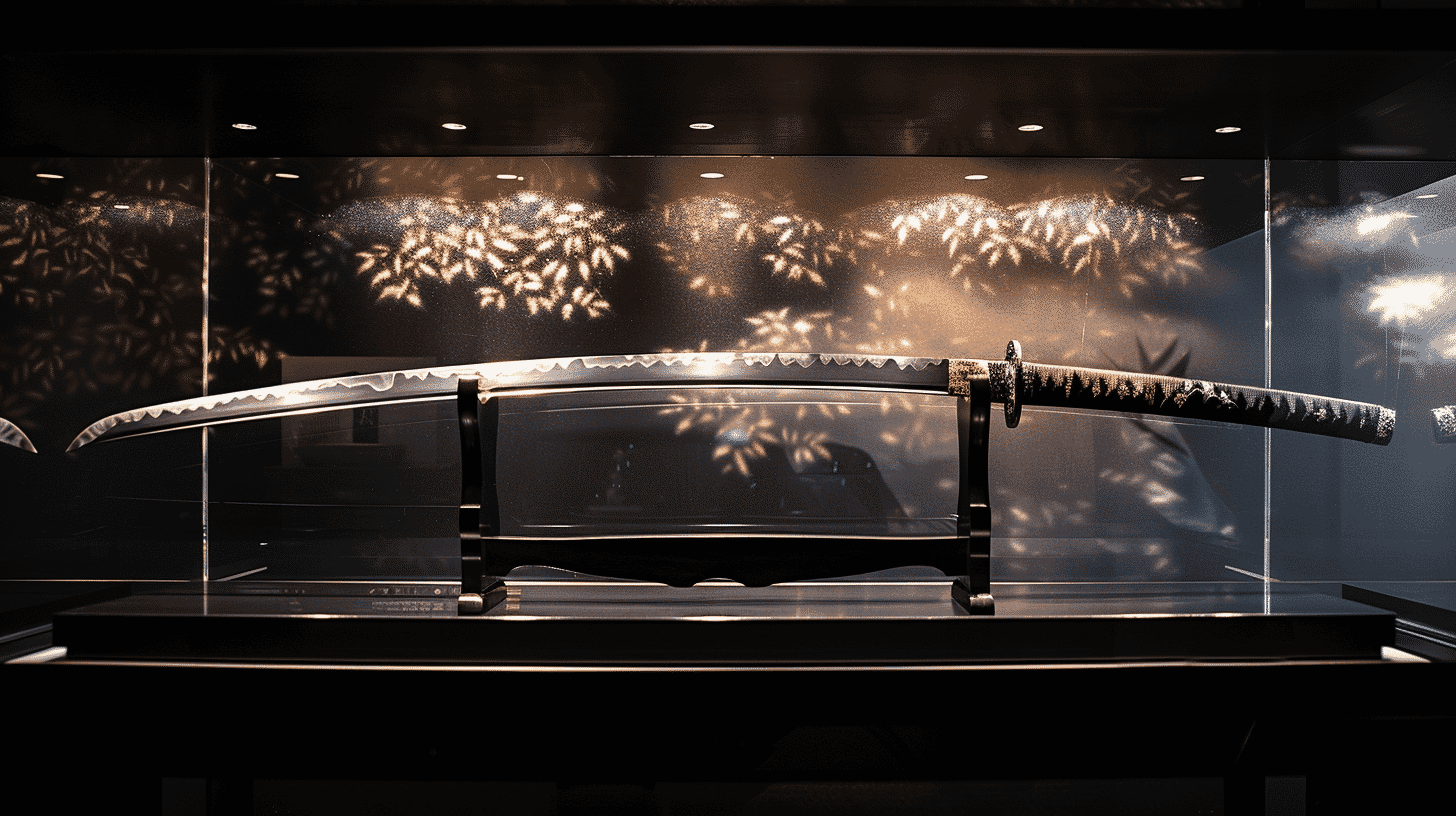
A Tachi Signed Sukekane, National Treasure since 1957
Tachi (signed Sukekane) (太刀〈銘助包〉) is a Kamakura-period long sword in Osaka Prefecture, designated a National Treasure in 1957, on 19 February. It had become an Important Cultural Property on 16 December 1931. The quantity is one sword, the category applied arts, and the designation number 00212.
The Agency for Cultural Affairs gives the maker as Sukekane and the period as Kamakura. Both the year field and the Western year field are blank, so no specific year is recorded, and the commentary runs to a single line: a work of the Kamakura period.
Descriptions placing the sword in the Genryaku era, 1184 to 1185, or in the late Heian period appear elsewhere, but the Agency's period field reads Kamakura. This article follows the Agency.
The Recorded Form
Cultural Heritage Online describes the sword as follows.
Ridged in section with a pitched back and the curvature set toward the hilt. The ground shows a fine wood-grain pattern with an undulating reflection standing in it. Within the edge the line runs straight with small irregularity mixed in, the misty crystalline band deep, granular crystals gathering, and legs running out. The point turns in a shallow irregularity and returns slightly. A golden line runs on the front. A straight groove is cut through on both faces. The tang is unaltered, the end rounded, the file marks slanting, with two peg holes.
An unaltered tang means it has not been worked on. It has not been shortened, and this is why the signature survives and the maker's name can be read.
The blade is 73.3 centimetres long with a curvature of 2.4 centimetres. Curvature set toward the hilt is a mark of the older tachi.
The Vocabulary of Edge and Ground
The terms in that description are the technical vocabulary of sword appreciation.
A fine wood-grain pattern describes how the forging shows in the surface of the steel. An undulating reflection is a pale shadow-like figure standing in the ground. Both concern the metal itself rather than the hardened edge.
The misty band and the granular crystals are two ways the particles of the hardened edge appear: the first runs together like haze, the second reads as individual grains. Both are recorded here, so the edge carries the two together.
A golden line is a linear activity within the edge, and legs are streaks running from the edge pattern toward the cutting edge. The point is described as turning in a shallow irregularity and returning slightly.
The straight groove is a long channel carved into the blade and cut through on both faces, lightening the sword and serving as ornament at once.
The Records of Designation Differ
Accounts of the Important Cultural Property designation do not agree.
The Agency's National Cultural Properties Database gives 16 December 1931. Cultural Heritage Online, recording the same sword, gives 29 August 1950 and leaves the National Treasure field blank.
Two databases in the same Agency system differ by nineteen years on the earlier designation and disagree on whether the later one is recorded at all. This article follows the National Cultural Properties Database and notes the discrepancy.
The date 29 August 1950 is when National Treasures under the older law transferred as a body to Important Cultural Property status on the coming into force of the Law for the Protection of Cultural Properties. The Cultural Heritage Online entry may be recording that transfer.
Seeing It
The Agency records the owner as a private individual and leaves both the location field and the holding institution field blank. The present place of keeping cannot be read from the official record.
A National Treasure in private hands is not necessarily shown on any regular footing. Seeing it means waiting for a loan to an exhibition.
Swords repay comparison: the differences emerge when works by the same smith or the same school are set side by side. If several appear together in a museum's sword display, the recorded terms for ground and edge give something to look for.
The prefecture recorded is Osaka. Any planned showing would be announced through museums there or through special sword exhibitions.
Q&A
- When was this sword designated?
- It became an Important Cultural Property on 16 December 1931 and a National Treasure in 1957, on 19 February. It is listed as one sword in the applied arts category under designation number 00212, with the maker given as Sukekane and the period as Kamakura.
- From what date is it?
- The Agency for Cultural Affairs gives the period as Kamakura and leaves both year fields blank, with a single line of commentary. Descriptions placing it in the Genryaku era or the late Heian period appear elsewhere, but the Agency's field reads Kamakura.
- What form does the sword take?
- Ridged in section with a pitched back and curvature toward the hilt, 73.3 centimetres long with a curvature of 2.4 centimetres. The ground shows a fine wood-grain pattern with an undulating reflection; the edge runs straight with small irregularity, deep misty band and gathering crystals. A golden line runs on the front and a straight groove is cut through both faces.
- What does an unaltered tang mean?
- That the tang has not been worked on or shortened. This is why the signature survives and the maker's name can be read. The end is rounded, the file marks slant, and there are two peg holes.
- Can the sword be seen?
- The Agency records the owner as a private individual and leaves the location and holding institution fields blank, so the present place of keeping cannot be read from the official record. A National Treasure in private hands is not shown on any regular footing; seeing it means waiting for a loan to an exhibition.
Basic Information
| Name | Tachi (signed Sukekane) (太刀〈銘助包〉) |
|---|---|
| Location | Osaka Prefecture (the Agency's location field is blank) |
| Designation | National Treasure (applied arts), designation no. 00212 |
| Year Designated | 1931 (16 December), Important Cultural Property; 1957 (19 February), National Treasure |
| Quantity | 1 sword |
| Dimensions | Blade 73.3 cm long, curvature 2.4 cm. Ridged section, pitched back, curvature toward the hilt. Fine wood-grain ground with an undulating reflection; edge straight with small irregularity, deep misty band, gathering crystals. Golden line on the front, straight groove cut through both faces. Tang unaltered with 2 peg holes. Kamakura period |
| Owner | A private individual (as recorded by the Agency) |
| Public Access | Not shown on any regular footing; seeing it means waiting for a loan to an exhibition |
References
- Agency for Cultural Affairs, National Cultural Properties Database: Tachi signed Sukekane
- https://kunishitei.bunka.go.jp/bsys/maindetails/201/508
- Cultural Heritage Online: Tachi signed Sukekane
- https://bunka.nii.ac.jp/db/heritages/detail/198563
- Agency for Cultural Affairs: the system for National Treasures and Important Cultural Properties (fine and applied arts)
- https://www.bunka.go.jp/seisaku/bunkazai/shokai/yukei_bijutsu/
- Agency for Cultural Affairs: introduction to cultural properties
- https://www.bunka.go.jp/seisaku/bunkazai/shokai/
Last verified: 2026.09.04