
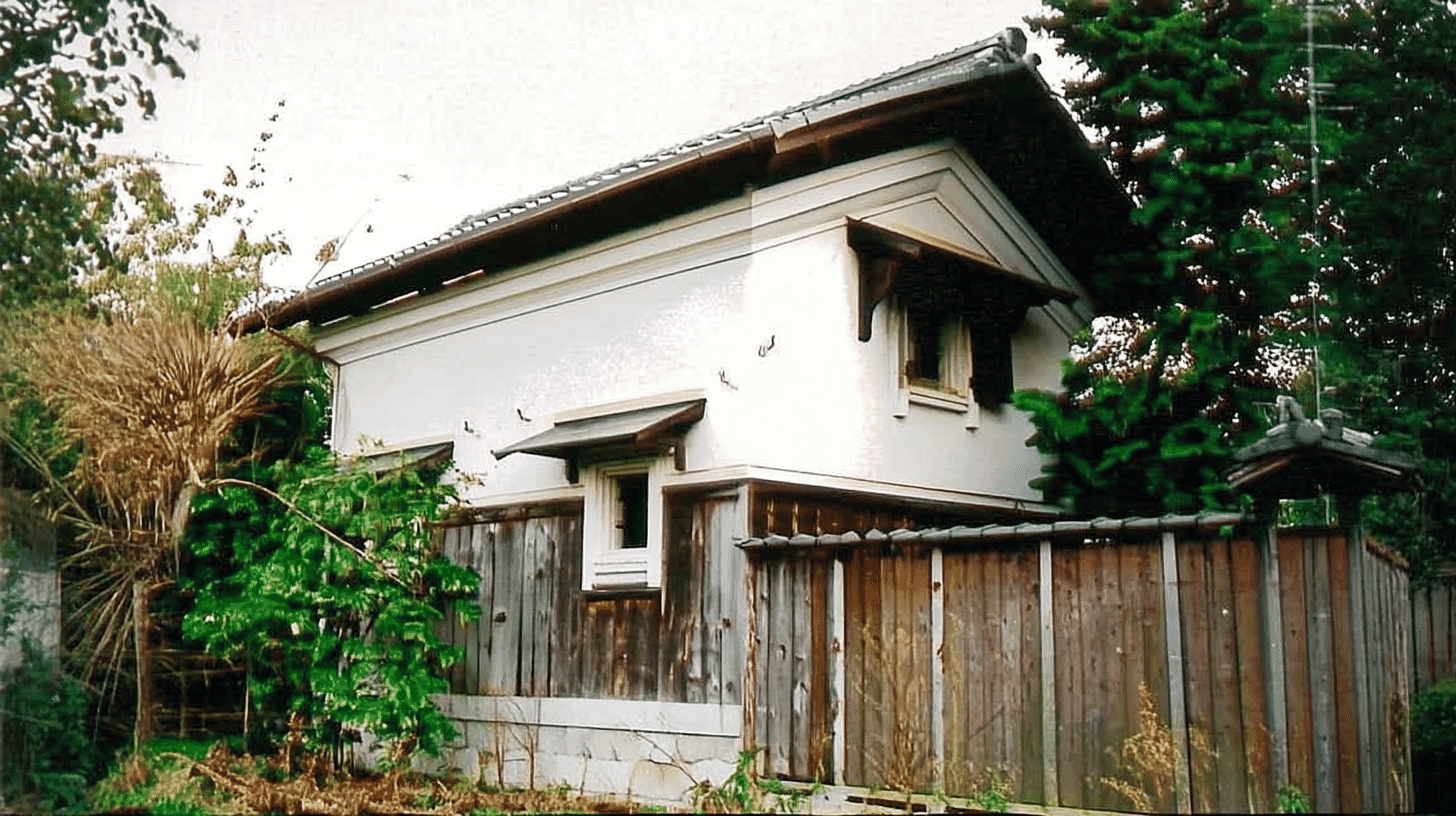
One Storehouse, a Registered Tangible Cultural Property since 2007
Furukawa Family Residence Storehouse (古川家住宅蔵, Furukawa-ke Jutaku Kura) stands at 919 Shijukuin, Toyosato Town, Inukami District, Shiga Prefecture, a Showa-period building entered on the register of tangible cultural properties on 31 July 2007. It is a registered property rather than a designated one.
The quantity is one building. The owner is a foundation.
The structure is of earthen construction, two-storeyed, tiled, with a floor area of 34 square metres. The date field reads early Showa, and the year field 1926 to 1988.
Windows on a Different Face at Each Storey
The windows above and below do not face the same way.
The Agency records a window on the west face at the first storey and one on the south face at the second, set there to give accent to the outward form.
The lower window looks west and the upper south. They are not ranged one above the other on a single face, but turned to different sides by storey.
At the Kasuga Shrine moshiden, the rear half of each side is boarded and the rest carries glass doors. At the Kannonshoji Jizo hall, the central bay is a half-shutter and the flanking bays cusped windows.
Those divide within one face. Here the division runs across storey and face together.
The Agency calls it an accent to the outward form: the placing of the windows is spoken of for its effect from outside.
A Doorway Opening onto a Corridor, Not the Open Air
The way into the storehouse does not face outdoors.
The Agency records that its doorway opens onto the corridor on its eastern side.
On the same grounds, the annex joins the west veranda of the guest room wing by a corridor 7 and a half bays long. It is onto that corridor that this doorway opens.
The Ikinariya storehouse has a lean-to across its south face making a space before the doors. The west storehouse at the former Takahashi residence opens its doorway on the side facing the main house.
Both of those open to the open air. This one opens onto a roofed passage.
Goods may be moved in and out without getting wet. The storehouse stands towards the west of the centre of the grounds, behind the line of the dwelling.
A Separate Roof, on Footings of Dressed Stone
Both the roof and what the building stands on are recorded.
The Agency gives it as 3 and a half bays across and 2 and a half deep, on a north-south ridge, gabled and roofed in pantiles of the separate-roof type.
That type sets a further roof above the earthen structure, so the tiles do not rest directly on the earthen walls.
The Ikinariya storehouse is pantiled in the same type, as is the north storehouse at the former Takahashi residence. Storehouses take this form again and again.
Of the footings, the record notes that it stands on a base of dressed stone, squared and laid up in courses.
The outer walls are finished in white plaster, with vertical boarding at the lower part: plaster above, boards below.
Visiting
The storehouse stands at 919 Shijukuin, Toyosato Town, Inukami District, Shiga Prefecture, owned by a foundation.
At 34 square metres it is third of the 4 buildings on the grounds. The main house covers 142 square metres, the annex 65 square metres and the guest room wing 25 square metres.
The veranda of the annex runs along the garden side as far as the east of this building. Seen from the garden, it stands beyond the end of that veranda.
A storehouse is built to hold goods, and is not made to be opened to visitors.
A foundation owns it, so opening and hours follow the owner's arrangements. Check before travelling.
Q&A
- When was the storehouse registered?
- On 31 July 2007, as a registered tangible cultural property. It is registered rather than designated, and the quantity is one building.
- Where are the windows?
- One on the west face at the first storey and one on the south at the second, set there to give accent to the outward form.
- Where is the doorway?
- It opens onto the corridor on the eastern side, a roofed passage rather than the open air.
- What is the roof like?
- Gabled and roofed in pantiles of the separate-roof type, which sets a further roof above the earthen structure so the tiles do not rest on the earthen walls.
- How are the walls finished?
- In white plaster, with vertical boarding at the lower part: plaster above and boards below.
Basic Information
| Name | Furukawa Family Residence Storehouse (古川家住宅蔵, Furukawa-ke Jutaku Kura) |
|---|---|
| Location | 919 Shijukuin, Toyosato Town, Inukami District, Shiga Prefecture |
| Designation | Registered tangible cultural property (structure, domestic architecture); registered rather than designated; 4 buildings on the same grounds were registered on the same day |
| Year Designated | 2007 (31 July), registered |
| Quantity | 1 building |
| Dimensions | Earthen construction, 2-storeyed, tiled, with a floor area of 34 square metres. Three and a half bays across and 2 and a half deep, on a north-south ridge, gabled and roofed in pantiles of the separate-roof type. Its doorway opens onto the corridor on the east. It stands on a base of dressed stone, with outer walls in white plaster and vertical boarding below. A window opens on the west face at the first storey and on the south at the second. The date field reads early Showa and the year field 1926 to 1988 |
| Owner | A foundation |
| Public Access | Built to hold goods; opening follows the owner's arrangements |
References
- Cultural Heritage Online: the Furukawa storehouse
- https://bunka.nii.ac.jp/heritages/detail/119647
- Cultural Heritage Online: the Furukawa annex
- https://bunka.nii.ac.jp/heritages/detail/182786
- Agency for Cultural Affairs, National Cultural Properties Database
- https://kunishitei.bunka.go.jp/
- Toyosato Town
- https://www.town.toyosato.shiga.jp/
Last verified: 2026.09.13
