
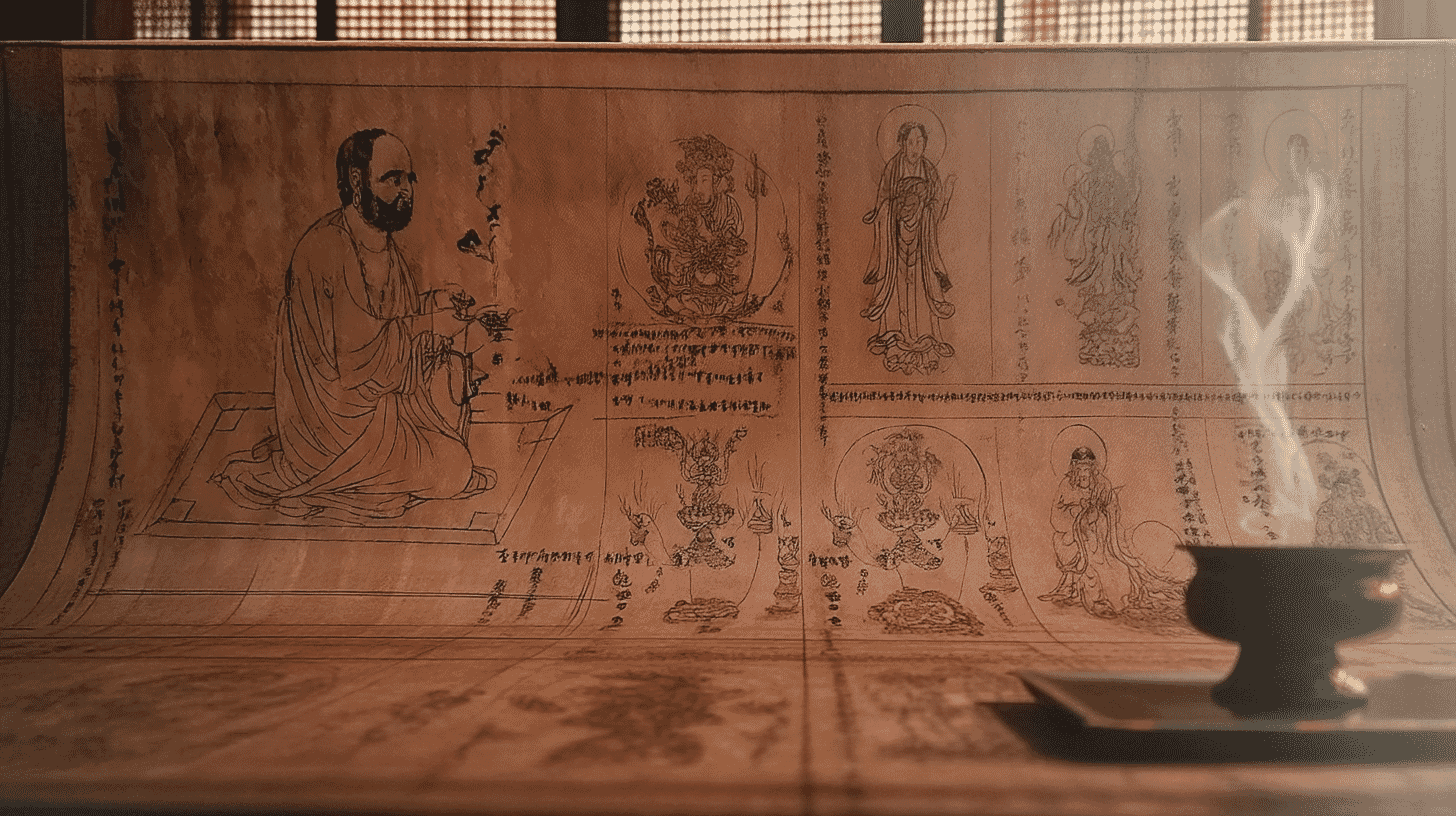
One Scroll, National Treasure since 1953
Gobu Shinkan (Ink on Paper; opening of the scroll missing) (紙本墨画五部心観, Shihon Bokuga Gobu Shinkan) is a set of iconographic drawings owned by Onjoji in Shiga Prefecture, designated a National Treasure on 31 March 1953. The quantity is one scroll, the category painting, the country Japan. Nothing is designated as an appendage.
The Agency for Cultural Affairs leaves the field for designation as an Important Cultural Property blank, so the work went to National Treasure without that earlier step, the fourteenth such case among the properties covered here.
The commentary reads: a work of the Heian period. This is the ninth one-sentence commentary among the properties covered here.
Loss Written into the Title
The title repays attention: Gobu Shinkan, opening of the scroll missing.
The bracketed phrase states that the beginning of the scroll has been lost. Damage to the work is written into its name.
Other titles do the same. Designation number 00072, a painting of an outing beneath blossoms, is recorded with the note that two panels of the right screen are missing. Loss again sits inside the name.
With the screens of pines and flowering plants, an empty slot before a slash showed that no artist was recorded. What a title conveys is not only what is present. It also conveys what is gone.
For the Choju Jinbutsu Giga, the omissions and disturbed order appeared nowhere in the record for the work itself, only in the record for a detached fragment. Where loss is written into the title, the state of the thing can be read without chasing other records.
Complete and Incomplete under One Number
The designation number shows the structure.
This scroll is number 00073, sub-number 02. Under the same 00073, sub-number 01 is Gobu Shinkan, the complete scroll, also one scroll and also owned by Onjoji.
One designation number, two scrolls divided by sub-number: 01 the complete one, 02 the one lacking its opening.
The complete scroll takes the earlier number. Two scrolls carrying the same text are recorded apart because their states differ, yet gathered under a single listing.
The summer landscape and the autumn and winter landscapes were recorded as having formed one set, yet listed as separate properties. Here the reverse holds: two scrolls share one number.
How Sub-Numbers Work
Among the properties covered here, sub-numbers have almost always been 00.
The screens of pines and flowering plants are 00042 sub-number 00; the Saigyo scrolls are 01218 sub-number 00. A sub-number of 01 or 02 marks a listing that covers more than one object.
This is a different device from a quantity greater than one. The sixteen arhat scrolls count sixteen hanging scrolls within a single property and use no sub-number. These two scrolls each have their own record, of one scroll apiece, and share only the number.
Whether things are gathered or kept apart is expressed through two mechanisms: quantity and sub-number.
The Agency does not record why these two scrolls were divided by sub-number. The difference in their condition is the likely reason, but the record does not say.
Seeing It
Onjoji, in Otsu City, Shiga Prefecture, owns the scroll. It is a temple holding, not an object kept on permanent display.
Work on paper is vulnerable to light and is usually shown only for short periods. Being a long scroll, it can hardly be opened out in full for display.
The complete scroll and this one hold separate records, so the two will not necessarily be shown together.
Conditions of access can change, so check with Onjoji before travelling.
Q&A
- When was the scroll designated?
- On 31 March 1953, as a National Treasure. The quantity is one scroll, the category painting, the owner Onjoji, and the designation number 00073 sub-number 02, with nothing designated as an appendage.
- What does opening of the scroll missing mean?
- That the beginning of the scroll has been lost. The damage is written into the title itself, as with designation number 00072, whose title records that two panels of the right screen are missing.
- Is there a complete scroll as well?
- Yes. Under the same designation number 00073, sub-number 01 is the complete scroll, also of one scroll and also owned by Onjoji. Complete and incomplete are divided by sub-number under one listing.
- What is a sub-number?
- A number used when one listing covers more than one object. Among the properties covered here it has almost always been 00. It differs from a quantity greater than one: the sixteen arhat scrolls count sixteen within one property and use no sub-number.
- Can it be seen?
- It is a temple holding and not on permanent display. Work on paper is vulnerable to light, a long scroll can hardly be opened out in full, and the two scrolls will not necessarily be shown together.
Basic Information
| Name | Gobu Shinkan, ink on paper, opening of the scroll missing (紙本墨画五部心観, Shihon Bokuga Gobu Shinkan) |
|---|---|
| Location | Shiga Prefecture; the owner is Onjoji |
| Designation | National Treasure (painting), designation no. 00073 sub-number 02; nothing designated as an appendage. Sub-number 01 is the complete scroll |
| Year Designated | 1953 (31 March), National Treasure |
| Quantity | 1 scroll |
| Dimensions | The Agency's commentary reads only: a work of the Heian period, with neither dimensions nor contents recorded. The title states that the opening of the scroll is missing. The country is Japan and the period Heian |
| Owner | Onjoji |
| Public Access | A temple holding, not on permanent display; a long scroll can hardly be opened out in full |
References
- Agency for Cultural Affairs, National Cultural Properties Database: the scroll lacking its opening
- https://kunishitei.bunka.go.jp/heritage/detail/201/76
- Agency for Cultural Affairs, National Cultural Properties Database: the complete scroll
- https://kunishitei.bunka.go.jp/heritage/detail/201/77
- Cultural Heritage Online: Gobu Shinkan, opening of the scroll missing
- https://bunka.nii.ac.jp/db/heritages/detail/125274
- Miidera: introduction to the work
- https://miidera-museum.jp/unesco/contents/gobushinkan/
Last verified: 2026.09.05