
From a Relic Cavity in the Foundation Stone, National Treasure since 1952
Objects Deposited in the Pagoda Foundation Stone of Sufukuji (崇福寺塔心礎納置品, Sufukuji To Shinso Nochihin) are the finds from the site of Sufukuji at Shigasato, Otsu City, Shiga Prefecture, designated a National Treasure in 1952, on 22 November. They had become an Important Cultural Property on 5 September 1944. The quantity is recorded as a single lot, the category archaeological materials, and the designation number 00005.
The Kyoto National Museum records that excavation of the pagoda site in 1938 recovered, from a relic cavity in the side of the central foundation stone, a relic container together with the outer containers holding it and the various ornamental objects that accompanied them.
The central foundation stone carries the central pillar of a pagoda. A cavity was cut into its side and the relic container placed within. The deposit was made at the very base of the building, in the stone that meets the ground.
Containers Within Containers
The museum sets out how the containers are arranged.
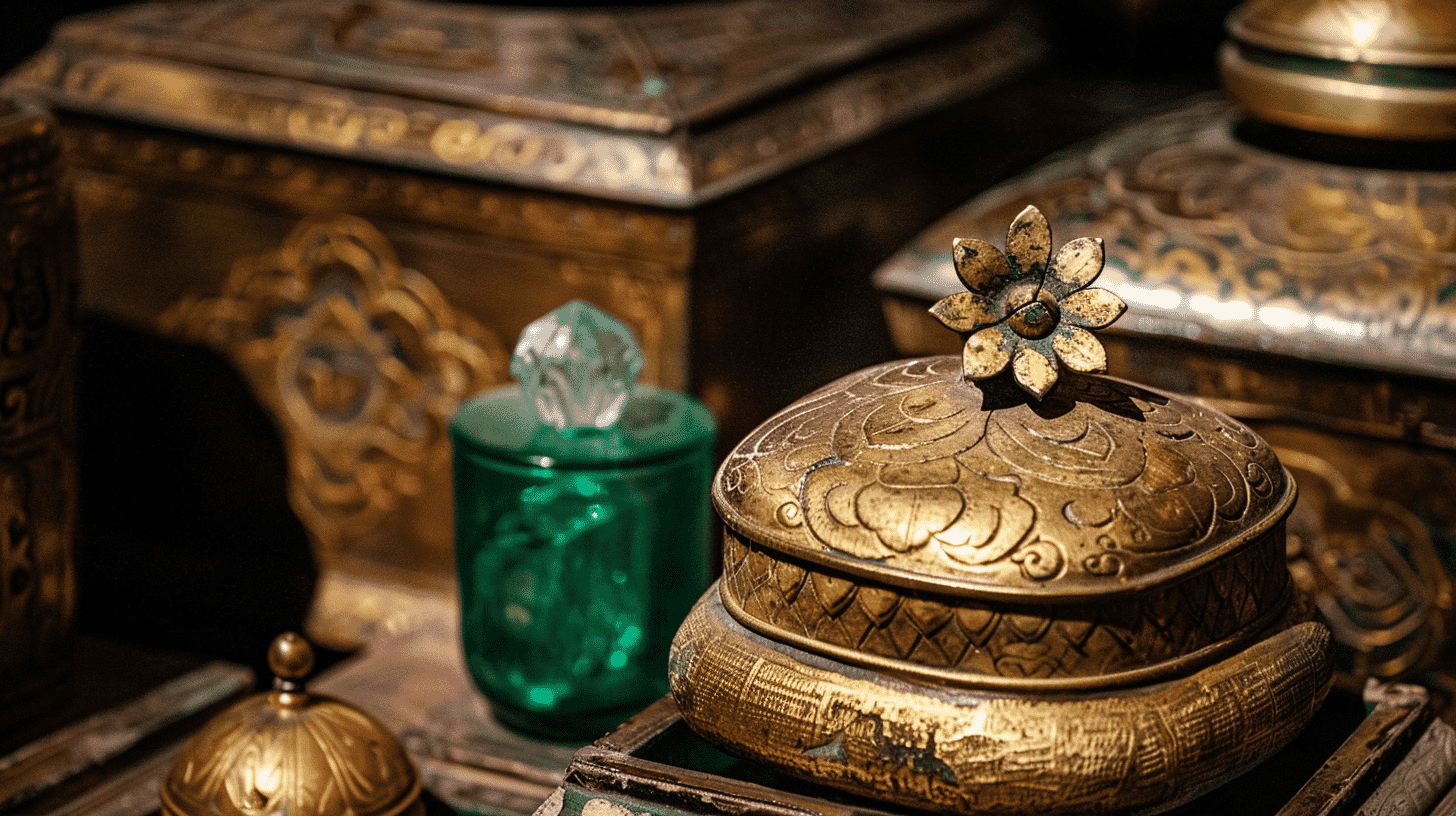
The relic container is a small green glass jar with lids of gold and silver, holding three crystal relics. The outer containers are boxes of gold, silver and gilt bronze fitted one within another. The relic container stands 3.0 centimetres high.
From the inside outward: green glass, then gold, silver and gilt bronze, four layers in all. The crystal grains lie innermost and the boxes grow larger outward. What sits at the centre is smallest and wrapped in the most precious material.
The ornamental objects accompanying them include amethyst, glass beads, round beads of hard stone, plain silver coins, an iron mirror backed in gilt bronze, and bronze bells. The plain silver coins are uninscribed silver pieces, held to have circulated in seventh-century Japan.
The Records Differ on the Period
Accounts of the date of this deposit do not agree.
The Agency for Cultural Affairs gives the period as Nara and leaves both year fields blank, with a single line of commentary, material of the Nara period. The Kyoto National Museum gives the Asuka period, the later seventh century.
The Nara period is conventionally taken to begin in 710, which does not overlap with the later seventh century. Given that Sufukuji was founded in the reign of Emperor Tenji, around 668, the later seventh century sits closer to the building of the pagoda. This article does not choose between them and records that the accounts vary.
The Agency leaving the year fields blank suggests that no firm date from an inscription or similar evidence has been established.
Built to Guard the Capital at Otsu
The museum describes the temple thus: Sufukuji was founded to guard the capital at Otsu, in the reign of Emperor Tenji.
Its halls and pagoda were laid out across three ridges separated by valley streams. Rather than ranging a precinct on level ground, buildings were placed ridge by ridge, an arrangement that follows the terrain.
The capital at Otsu was established in Omi by Emperor Tenji and abandoned after a short time. The temple too was lost, and only its site remains. The capital went; what was placed in the foundation stone stayed in the ground.
The site of Sufukuji is a national Historic Site, a designation separate from that of the deposit.
Seeing Them
The objects belong to Omi Jingu and are deposited at the Kyoto National Museum. Owner and holding institution are different, which is worth noting when consulting sources.
The Agency's database leaves both the location field and the holding institution field blank, so the present place of keeping cannot be read from the official record.
The Kyoto National Museum presents the objects among its notable holdings, but not necessarily on permanent display. Whether and when they are shown depends on the museum's programme, so check before travelling. At 3.0 centimetres high, the relic container is a small thing.
The site of Sufukuji is at Shigasato in Otsu City. The museum is about seven minutes on foot from Keihan Shichijo Station.
Q&A
- When were these objects designated?
- They became an Important Cultural Property on 5 September 1944 and a National Treasure in 1952, on 22 November. The quantity is a single lot, the category archaeological materials, under designation number 00005. They come from the site of Sufukuji at Shigasato, Otsu City.
- Where exactly were they found?
- The Kyoto National Museum records that excavation of the pagoda site in 1938 recovered them from a relic cavity in the side of the central foundation stone. That stone carries the central pillar of a pagoda, and a cavity cut into its side held the relic container.
- How are the containers arranged?
- The relic container is a small green glass jar with lids of gold and silver, holding three crystal relics, and the outer containers are boxes of gold, silver and gilt bronze fitted one within another. From the inside outward that gives four layers, and the relic container stands 3.0 centimetres high.
- From what period do they date?
- The accounts differ. The Agency for Cultural Affairs gives the period as Nara and leaves the year fields blank; the Kyoto National Museum gives the Asuka period, the later seventh century. The Nara period is conventionally taken to begin in 710, so the two do not overlap, and this article records the variance rather than choosing.
- Where can they be seen?
- They belong to Omi Jingu and are deposited at the Kyoto National Museum, which presents them among its notable holdings but not necessarily on permanent display. Whether and when they are shown depends on the museum's programme. The Agency's database leaves the location and holding institution fields blank.
Basic Information
| Name | Objects Deposited in the Pagoda Foundation Stone of Sufukuji (崇福寺塔心礎納置品, Sufukuji To Shinso Nochihin) |
|---|---|
| Location | Shiga Prefecture (the Agency's location field is blank); found at the site of Sufukuji, Shigasato, Otsu City |
| Designation | National Treasure (archaeological materials), designation no. 00005; the site of Sufukuji is a separate national Historic Site |
| Year Designated | 1944 (5 September), Important Cultural Property; 1952 (22 November), National Treasure |
| Quantity | A single lot |
| Dimensions | The relic container is a small green glass jar with lids of gold and silver, 3.0 centimetres high, holding 3 crystal relics. The outer containers are boxes of gold, silver and gilt bronze fitted one within another. Ornamental objects include amethyst, glass beads, round beads of hard stone, plain silver coins, an iron mirror backed in gilt bronze and bronze bells |
| Owner | Omi Jingu (deposited at the Kyoto National Museum) |
| Public Access | Not necessarily on permanent display; whether and when they are shown depends on the museum's programme |
References
- Kyoto National Museum, notable holdings: the Sufukuji foundation stone deposit
- https://www.kyohaku.go.jp/jp/collection/meihin/kouko/item08/
- Agency for Cultural Affairs, National Cultural Properties Database: the Sufukuji foundation stone deposit
- https://kunishitei.bunka.go.jp/heritage/detail/201/836
- Omi Jingu official site
- https://oumijingu.org/pages/112/
- Kyoto National Museum official site
- https://www.kyohaku.go.jp/
Last verified: 2026.09.04