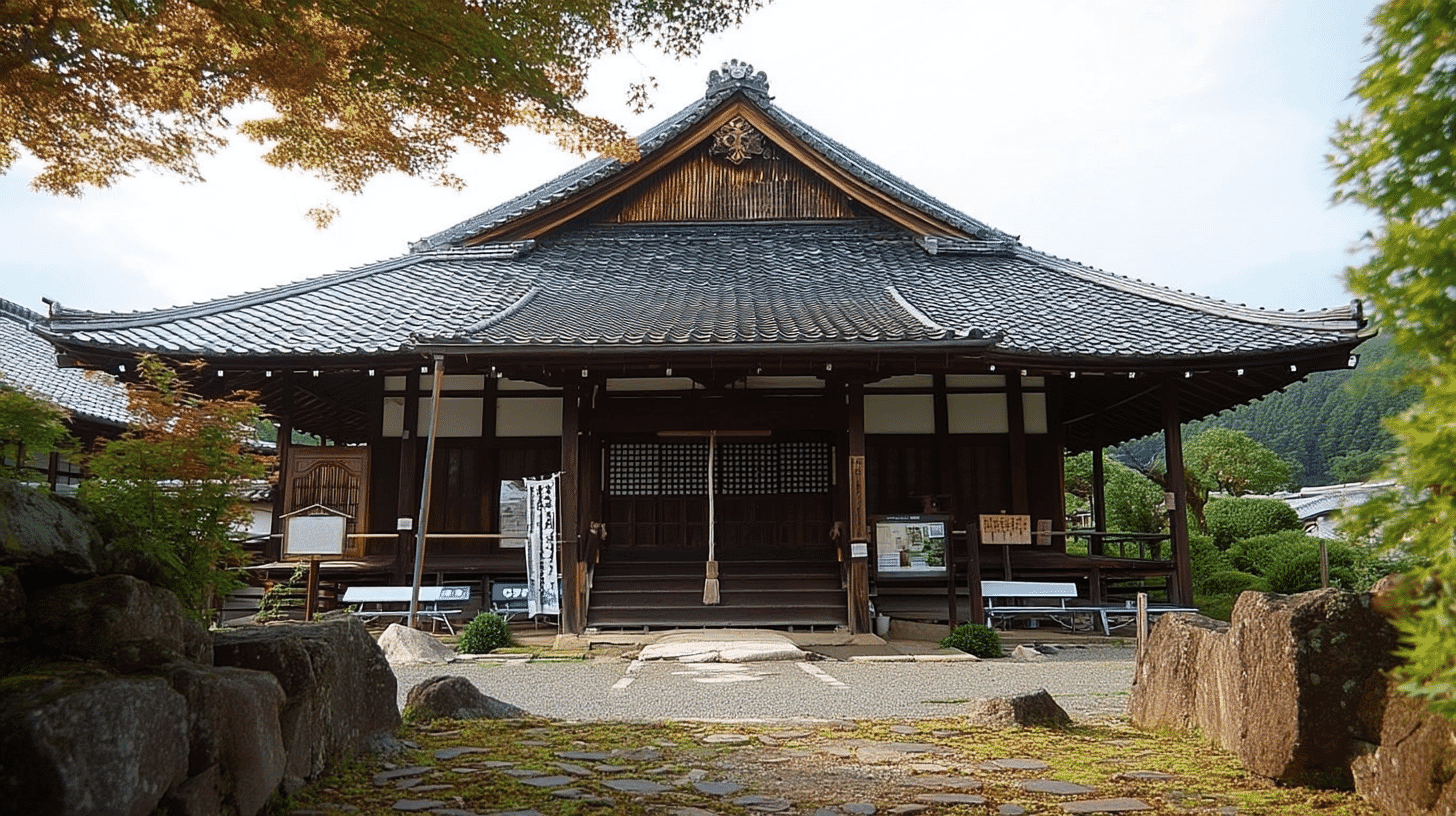
Seianji Guest Hall: A Hidden Gem of Momoyama-Era Architecture in Otsu, Lake Biwa

Discover the Seianji Guest Hall, an Important Cultural Property of Japan near Lake Biwa. Explore Momoyama-era architecture, Hasegawa school paintings, and legendary Ano-shu stone walls in Sakamoto, Otsu.

A Forgotten Palace at the Foot of Mount Hiei

Nestled in the historic Sakamoto district of Otsu City, just a short walk from the shores of Lake Biwa, stands an architectural treasure that has quietly preserved the splendor of Japan's Momoyama period for over four centuries. The Seianji Guest Hall, known locally as "Momoyama Goten" (Momoyama Palace), offers visitors a rare opportunity to step into a world where samurai warlords, master painters, and legendary stonemasons converged to create something extraordinary.

Unlike the crowded temples of nearby Kyoto, Seianji Temple remains a serene sanctuary where the past speaks through whispered brushstrokes on gilded sliding doors and the patient arrangement of moss-covered stones. This is a place where history breathes.

The Story Behind the Name

Seianji Temple's origins are shrouded in the mists of ancient Japan. According to temple tradition, the site once housed the Takaho-no-miya Imperial Palace, mentioned in the ancient chronicles. After falling into disuse over the centuries, the temple was revived in 1486 by Sugiwaka Seian, a retainer of the powerful Asakura clan of Echizen Province (present-day Fukui Prefecture). Impressed by the spiritual significance of the location, Sugiwaka undertook the temple's restoration and eventually entered religious life there himself, giving the temple his own name.

The temple would later enjoy the patronage of some of Japan's most famous historical figures, including Akechi Mitsuhide, the warrior who would eventually bring down Oda Nobunaga, and Toyotomi Hideyoshi, the great unifier of Japan. A war drum said to have been bestowed by Mitsuhide himself remains among the temple's treasured possessions.

Why Was It Designated an Important Cultural Property?

The Seianji Guest Hall was designated as a national Important Cultural Property by the Japanese government in recognition of its exceptional architectural and artistic value. Several factors contributed to this distinguished status:

Architectural Significance

The Guest Hall represents a masterful example of early Edo period temple architecture, dating to the early 17th century. The building features a distinctive dual-roof design: an elegant irimoya-zukuri (hip-and-gable) roof on the south side and a practical kirizuma-zukuri (gabled) roof on the north, both covered with traditional sangawara tiles. This architectural configuration places it in dialogue with other significant guest halls in the region, including those at Saikyoji Temple and Shojuraigoji Temple.

Fushimi Castle Legacy

According to tradition, the Guest Hall was constructed using materials salvaged from the dismantled Fushimi Castle, the magnificent fortress built by Toyotomi Hideyoshi overlooking Kyoto. This connection to one of Japan's most important castles of the Momoyama period earned the building its evocative nickname "Momoyama Goten" (Momoyama Palace).

Hasegawa School Masterpieces

Perhaps the most striking feature of the Guest Hall is its collection of polychrome fusuma (sliding door) paintings attributed to the Hasegawa school, one of the most influential painting lineages in Japanese art history. The vibrant flower-and-bird compositions that adorn the jodan-no-ma (upper room) and tsugi-no-ma (adjoining room) showcase the bold colors and decorative exuberance that defined the Momoyama aesthetic. The production date of these paintings provides crucial evidence for dating the building's construction to the early 17th century.

Highlights and Must-See Features

The Legendary Ano-shu Stone Walls

Before you even enter the temple grounds, you'll be greeted by magnificent stone walls that seem to have grown organically from the earth itself. These are the work of the famed Ano-shu, a guild of master stonemasons who called this very region home. The Ano-shu became legendary after their stone walls proved indestructible during Oda Nobunaga's attempt to burn Mount Hiei; impressed, Nobunaga employed them to build his revolutionary Azuchi Castle, and their techniques went on to influence castle construction across Japan. The walls at Seianji are considered among the finest examples of their craft, displaying the characteristic "wild face" (nozura-zumi) technique that uses uncut natural stones fitted together with almost supernatural precision.

The Scenic Garden

Facing the Guest Hall is a karesansui (dry landscape) garden designated as a Scenic Beauty by Shiga Prefecture. Dating from the early Edo period, the garden was designed to represent the Seiju Raigo, the scene of Amida Buddha and his heavenly retinue descending to welcome the faithful into the Pure Land. From the broad engawa (veranda) of the Guest Hall, visitors can contemplate a carpet of soft moss stretching to an artificial hill (tsukiyama) adorned with camellia and oak hedges. Stone arrangements are placed with studied asymmetry, while a "dry waterfall" composition suggests a cascade tumbling down the hillside. Elegant stepping stones lead to a ceremonial sandal-removal platform, adding a touch of refined luxury.

The Eleven-Faced Kannon

Housed in a modern treasure hall (Kannon-do), the temple's wooden Eleven-Faced Kannon Standing Statue is itself designated as an Important Cultural Property. This graceful image, carved during the Heian period, features the unusual iconography of four arms and achieved international literary fame through its appearance in Nobel Prize-winning author Inoue Yasushi's novel "Stars and Festivals." The statue is only viewable during special opening periods in May, June, October, Golden Week, and the New Year's holidays.

Exploring the Surroundings

Seianji Temple is ideally situated for exploring the historic Sakamoto district, one of Japan's designated Important Preservation Districts for Groups of Traditional Buildings. The entire neighborhood is characterized by the distinctive Ano-shu stone walls that line its quiet lanes.

Hiyoshi Taisha Shrine

Just a 15-minute walk away stands Hiyoshi Taisha, the head shrine of over 3,800 Hie shrines throughout Japan. Dating back approximately 2,100 years, this atmospheric shrine complex spreads across the forested slopes of Mount Hachioiji. The shrine is particularly famous for its autumn foliage, with some 3,000 maple trees creating spectacular displays in November.

Saikyoji Temple

The mother temple of the Tendai Shinsei sect to which Seianji belongs, Saikyoji features its own magnificent guest hall (also built with Fushimi Castle materials) and is closely associated with Akechi Mitsuhide, whose family graves rest in the temple precincts.

Mount Hiei and Enryakuji Temple

The sacred mountain that has shaped this region's history for over 1,200 years rises directly behind Sakamoto. The Sakamoto Cable Car provides convenient access to Enryakuji Temple, the headquarters of the Tendai Buddhist school and a UNESCO World Heritage Site.

Kyu-Chikurin-in Garden

This former retirement residence of Enryakuji monks features one of Sakamoto's most beautiful gardens, famous for its "reflection table" where the garden appears mirrored in a polished tabletop.

📍 Plan Your Visit to Shiga
Find tours, activities & transport passes near Seianji Temple Guest Hall
[ Hikone Castle & Lake Biwa Cruise Experiences ]

Q&A

QDo I need to make a reservation to visit Seianji Temple?
AThe temple grounds and Guest Hall can generally be visited without reservation during regular opening hours. However, viewing the Important Cultural Property Eleven-Faced Kannon statue is limited to specific periods: every Saturday in May, June, and October, as well as during Golden Week and the first three days of the New Year. For visits outside these periods or for group tours, advance contact with the temple is recommended.
QIs there English language support available at the temple?
AWritten information in English is available through multilingual signage provided by Otsu City. The temple itself is a quiet contemplative space where the art and architecture speak for themselves. The city's official PDF guides in English, Chinese, and Korean can be downloaded in advance from the Otsu City website.
QHow long should I plan for a visit?
AA thorough visit to Seianji Temple, including the Guest Hall, garden, and treasure hall (when open), takes approximately 30 to 45 minutes. If combining with nearby attractions such as Hiyoshi Taisha Shrine and Saikyoji Temple, plan for a half-day excursion through the Sakamoto district.
QWhat is the best season to visit?
AEach season offers its own charm. Spring brings cherry blossoms to the surrounding neighborhood, while the moss garden is at its most verdant in the rainy season of early summer. Autumn paints the Sakamoto district in spectacular colors, particularly in mid-November. The special Kannon viewings in May, June, and October make these months particularly rewarding for art enthusiasts.
QIs photography permitted inside the Guest Hall?
APhotography policies may vary, so please inquire at the temple upon arrival. Generally, photography without flash is often permitted in temple gardens and exterior areas, while interior photography of cultural properties may be restricted to preserve the delicate fusuma paintings and other artworks.

Basic Information

Official Name Zuiouzan Seianji Temple Guest Hall (瑞應山盛安寺 客殿)
Designation Important Cultural Property of Japan (Building)
Construction Period Early 17th century (Late Momoyama to Early Edo period)
Architectural Style South: Irimoya-zukuri (hip-and-gable); North: Kirizuma-zukuri (gabled); Sangawara tile roofing
Religious Affiliation Tendai Shinsei-shu (Branch temple of Saikyoji)
Address 1-17-1 Sakamoto, Otsu City, Shiga Prefecture, Japan 520-0113
Access (Train) 5-minute walk from Ano Station on the Keihan Ishiyama-Sakamoto Line
Access (Car) 10 minutes from Shimo-Sakamoto IC on the Kosei Road
Parking Available for approximately 7 vehicles
Admission Fee 300 yen (270 yen for groups of 10 or more)
Open Hours Open year-round (Kannon viewing: Saturdays in May, June, October; Golden Week; January 1-3)
Contact Tel: 077-578-2002

References

Seianji Guest Hall - Otsu City Official Website (Multilingual Signage Data)
https://www.city.otsu.lg.jp/bz/a/03/15/60674.html
Seianji Temple - Shiga Prefecture Official Tourism Website (Biwako Visitors Bureau)
https://www.biwako-visitors.jp/spot/detail/436/
Seianji Temple - Otsu City Museum of History Encyclopedia
https://www.rekihaku.otsu.shiga.jp/db/jiten/data/048.html
Seianji Temple - Wikipedia (Japanese)
https://ja.wikipedia.org/wiki/%E7%9B%9B%E5%AE%89%E5%AF%BA
Ano-shu Stone Walls - Otsu City Museum of History Encyclopedia
https://www.rekihaku.otsu.shiga.jp/db/jiten/data/050.html
Ano-shu - Wikipedia (Japanese)
https://ja.wikipedia.org/wiki/%E7%A9%B4%E5%A4%AA%E8%A1%86

Last verified: 2026.01.27

Nearby heritages