
A Myth Performed Once a Year
Aofushigaki Shinji (蒼柴垣神事) is a rite held every 7 April at Miho Shrine in Mihonoseki, Matsue City, Shimane Prefecture, selected on 5 November 1973 as an Intangible Folk Cultural Property Requiring Documentation. No protecting body is designated for it.
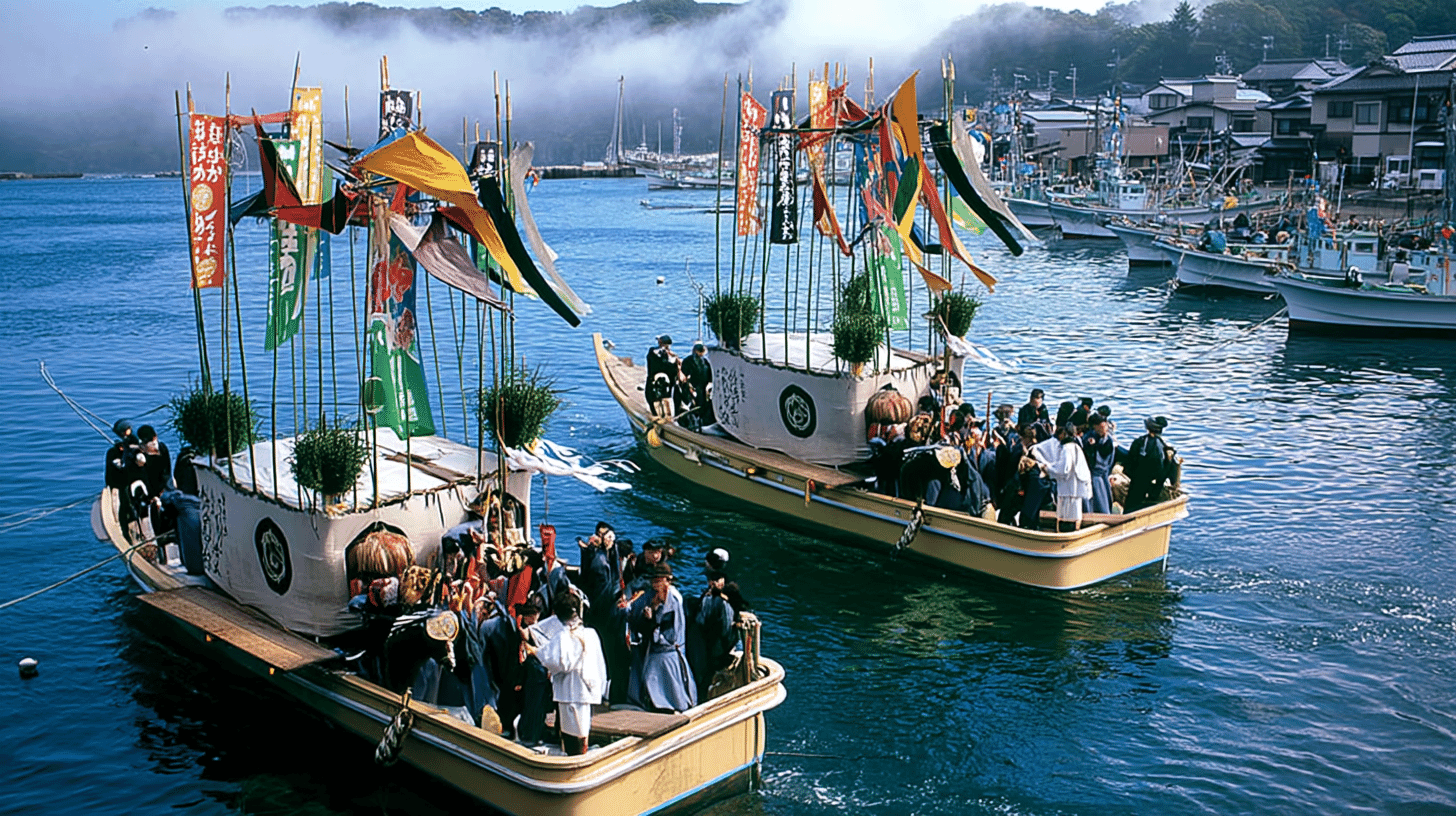
The Agency for Cultural Affairs describes it briefly: a rite held each April at Miho Shrine, said to derive from the myth in which the deity Kotoshironushi ceded the land at imperial command and departed. Two sacred boats fenced about with brushwood make a procession across the water, after which the selection of the next hosts, a celebratory dance and a ritual sumo are performed.
The source is the land-ceding myth of the Kojiki. When Okuninushi was asked to hand over the country, he consulted his son Kotoshironushi, who was fishing off the cape at Miho. Kotoshironushi agreed, made a gesture called ama-no-sakate, turned the boat he was in into a sacred enclosure of green brushwood, and hid himself inside it. In the older language, to hide is to die, so the episode has long been read as the death and rebirth of a god.
The rite performs that scene again each year in order to renew the spirit of the deity. Renewal, not performance, is the object, and that is what separates it from a festival staged as entertainment.
The Toya and a Year of Purification
At the centre of the rite stand the toya, two married couples drawn by lot from particular family lines and appointed as the first and second hosts.
From selection until the main day, a full year later, they hold to a strict regime. Every night at the hour of the rat they enter the sea to purify themselves, a practice called shiokaki. They eat no chicken and no eggs, and husband and wife sleep apart. If either meets another person on the nightly walk, the purification is considered broken and begins again from the start.
On the day itself the toya withdraw to a ritual hall, fast and meditate, and enter a state of possession. The husband boards the sacred boat in white robes and a black hood, the wife in red with her face covered. For the duration they serve as vessels for the deity.
Rites involving possession that continue into the present are not numerous. Here the year of bodily preparation and the fasting and seclusion of the day are not preliminaries to the rite: they are the rite.
Ten Days of Observances
The main day is 7 April, but the sequence begins on 31 March and runs to 8 April.
On the evening of 31 March a crier announces through the harbour that the festival begins tomorrow. Preparations and observances follow from 1 to 6 April, and on the sixth the two sacred boats are made ready. Posts of unstripped timber and sakaki branches are set at the four corners, and curtains bearing the shrine crest are hung with sacred rope. These are the boats fenced with brushwood that the Agency's description mentions.
On 7 April the boats carrying the toya circle the harbour, surrounded by fishing vessels flying their catch banners. After the procession on the water, the party enters the worship hall of Miho Shrine for the hohei, in which the possessed toya raise the ritual wand to left and right. The spirit of the great deity is renewed at that moment.
The selection of the next hosts, the celebratory dance and the ritual sumo follow. That selection sets the toya for the coming year, so the cycle closes without a break.
Selection Rather Than Designation
This rite is not designated an Important Intangible Folk Cultural Property. It is selected, under the longer heading of an Intangible Folk Cultural Property Requiring Documentation.
Designation asks that a practice be preserved. Selection is aimed at recording it. Where continuation looks difficult because the people who carry a practice are dwindling, the state produces film and written reports so that its content survives even if the practice does not. The note on the Agency's page that its description reflects the situation at the time of selection follows from that purpose.
That no protecting body is named follows too. There is no preservation society; the parish organisation of Mihonoseki carries the rite. Drawing the toya by lot from family lines places the burden on the community as a whole rather than on an appointed group.
Seeing It
The rite is open on 7 April each year. The record on Cultural Heritage Online reflects the position at the time of selection, so confirm the date with the Matsue City board of education or with Miho Shrine before travelling.
The procession takes place within the harbour and can be watched from the shore. The hohei in the worship hall is the core of the rite, and whether visitors may attend depends on how the day is run. The toya are in a state of possession, so keep your distance. Ask the shrine about photography.
A related rite, the Morotabune Shinji, is held at the same shrine every 3 December. It also draws on the land-ceding myth and forms a pair with this one. Seeing both makes clear that a single myth is performed across two seasons.
From JR Matsue Station the bus takes about 75 minutes by way of the Mihonoseki terminal. By car from central Matsue it is about 40 minutes via National Route 431 and Prefectural Route 2. Enquiries go to Miho Shrine on 0852-73-0506.
- 📍 Plan Your Visit to Shimane
- Find tours, activities & transport passes near Aofushigaki Shinji
- [ Izumo Taisha Shrine & Adachi Museum Gardens ]
Q&A
- What is Aofushigaki Shinji?
- A rite held every 7 April at Miho Shrine in Matsue City, Shimane Prefecture, said to derive from the Kojiki myth in which Kotoshironushi ceded the land and departed. Two boats fenced with brushwood process across the harbour, followed by the selection of the next hosts, a celebratory dance and a ritual sumo. It was selected by the state on 5 November 1973.
- What do the toya of Aofushigaki Shinji do?
- Two married couples drawn by lot from particular family lines keep a year of purification: nightly immersion in the sea at the hour of the rat, no chicken or eggs, husband and wife sleeping apart, and a fresh start if either meets anyone on the nightly walk. On the day they fast in seclusion and enter a state of possession, serving as vessels for the deity.
- What is the difference between selection and designation here?
- This rite is selected as an Intangible Folk Cultural Property Requiring Documentation rather than designated an Important Intangible Folk Cultural Property. Designation asks that a practice be preserved; selection aims at recording it in film and reports so that its content survives even if the practice does not.
- When is Aofushigaki Shinji held, and can it be watched?
- It is open on 7 April, with observances running from 31 March to 8 April. The procession takes place within the harbour and can be watched from the shore. Because the record dates from the time of selection, confirm the date with the Matsue City board of education or Miho Shrine on 0852-73-0506.
- How does Aofushigaki Shinji relate to the Morotabune Shinji?
- Both are held at Miho Shrine and both draw on the land-ceding myth. The Morotabune Shinji falls on 3 December and forms a pair with this rite. Seeing both makes clear that a single myth is performed across two seasons.
Basic Information
| Name | Aofushigaki Shinji (蒼柴垣神事) |
|---|---|
| Location | 608 Mihonoseki, Mihonoseki-cho, Matsue City, Shimane Prefecture (Miho Shrine) |
| Designation | Intangible Folk Cultural Property Requiring Documentation (selected); intangible folk cultural property |
| Year Designated | 1973 (5 November), selected |
| Quantity | 1 rite (no protecting body designated) |
| Dimensions | Procession by 2 sacred boats fenced with brushwood. 2 host couples, first and second. Observances run about 10 days around the main day |
| Owner | Miho Shrine and the parish of Mihonoseki (no protecting body designated) |
| Public Access | Open on 7 April each year. The procession can be watched from the shore. Confirm the date with the Matsue City board of education or Miho Shrine |
References
- Cultural Heritage Online: Aofushigaki Shinji
- https://bunka.nii.ac.jp/heritages/detail/200136
- Agency for Cultural Affairs newsletter: festivals series
- https://www.bunka.go.jp/prmagazine/rensai/matsuri/matsuri_027.html
- Matsue City: traditional culture transmission
- https://www.city.matsue.lg.jp/soshikikarasagasu/bunkasportsbu_bunkashinkoka/bunkaryoku/2/traditionalculturecouncil/17864.html
- Shimane Tourism Navi: Aofushigaki Shinji
- https://www.kankou-shimane.com/destination/21556
- Miho Shrine official site
- https://mihojinja.or.jp/
Last verified: 2026.09.02