
Rebuilt in 1583: The Oldest Taisha-zukuri Standing
Kamosu Shrine Main Hall (神魂神社本殿, Kamosu-jinja Honden) at Obacho in Matsue City, Shimane Prefecture, was rebuilt in 1583, designated an Important Cultural Property on 7 April 1900, and raised to National Treasure status on 29 March 1952. The quantity is one building, and the Agency for Cultural Affairs records its structure as taisha-zukuri with a shingled roof.
The Agency states the building's place in a single line: it is the oldest surviving example of taisha-zukuri, a form found only in the province of Izumo, the eastern half of what is now Shimane Prefecture. Taisha-zukuri is thought to have developed from raised-floor buildings, and this hall is where the form survives in its earliest state.
The name is read Kamosu. Shrine tradition holds that Amenohohi-no-mikoto, ancestral deity of the Izumo Kokuso priestly line, descended here and founded the shrine, and that twenty-five generations of Izumo Kokuso served it thereafter. Of the district itself, Obacho, the Agency notes that the Izumo Kokuso anciently lived there. The principal deity is Izanami-no-Okami, with Izanagi-no-Okami enshrined alongside.
How It Differs from Izumo Taisha
The best-known taisha-zukuri is the main hall of Izumo Taisha, and the Agency for Cultural Affairs sets the two side by side. It closely resembles the Izumo Taisha hall, the commentary says, but the frontage is somewhat longer than the depth, and the columns are thick in proportion to the scale, so it is considered to preserve an older form of taisha-zukuri.
That can be checked on the ground. Frontage and depth are both two bays, but they are not equal. Because the frontage runs longer, the plan does not come out square. The Izumo Taisha hall of 1744 is square in plan; this one, 161 years older, has not reached that. The thickness of the columns reads more clearly once you know how small the building is.
The roofing differs too. Izumo Taisha uses cypress bark; this hall is shingled with boards. The thickness and the texture are not the same, so anyone visiting both should compare the roof surfaces.
The ridge-bearing columns at the centre of the front and rear project well beyond the wall plane, a feature shared with the shinmei-zukuri of Ise and regarded as belonging to the older tradition. All nine columns are round and stand on foundation stones, with the sacred central pillar at the middle. The floor sits higher than the walls above it, a proportion that reverses the relationship at Izumo Taisha and is likewise taken as a mark of the older form.
Me-zukuri: The Seat Reversed
A taisha-zukuri hall is divided internally by the central pillar, with the seat of the deity set to one side. There are two arrangements. The Izumo Taisha version is called o-zukuri and the Kamosu version me-zukuri, and the two are mirror images.
The finials on the roof follow suit. Those at Kamosu are cut horizontally at the tips, the form called me-chigi, and three katsuogi billets lie across the ridge. These are not ornament. They have long been read as marks of the character of the deity enshrined, and the me-zukuri plan and me-chigi finials answer to Izanami-no-Okami as principal deity.
Anyone who has stood at the Yatsuashi gate of Izumo Taisha will have been told that the deity there faces west. At Kamosu the direction reverses. Visiting the two National Treasures in succession makes it possible to grasp, from the buildings rather than from words, that a single architectural form holds two types.
The Painted Interior, and the Days the Doors Open
The interior is not normally open. What it holds, however, is on record.
The beams and columns inside are finished in red lacquer, and the ceiling carries nine auspicious clouds painted in five colors, known as the yakumo. A dragon among clouds covers the central beam. Eight paintings cover the wall panels, attributed by shrine tradition to Kano Sanraku and Tosa Mitsuoki. The attribution rests on the shrine's own account; the national record names no painters.
The front doors are painted as well. The moon door on the left carries a full moon, the sun door on the right the sun and a scene of court dance. These can be glimpsed only when the doors are opened on festival days. Dates change from year to year, so anyone visiting for this should contact the shrine office in advance. The office also sells postcards of the paintings.
Visiting
The precinct is open and there is no admission charge. The shrine office runs roughly from 9:00 a.m. to 5:00 p.m. The hall stands inside a fence and is viewed from outside. Photography is not generally restricted, though it is worth asking at the office about the area inside the fence and during festivals.
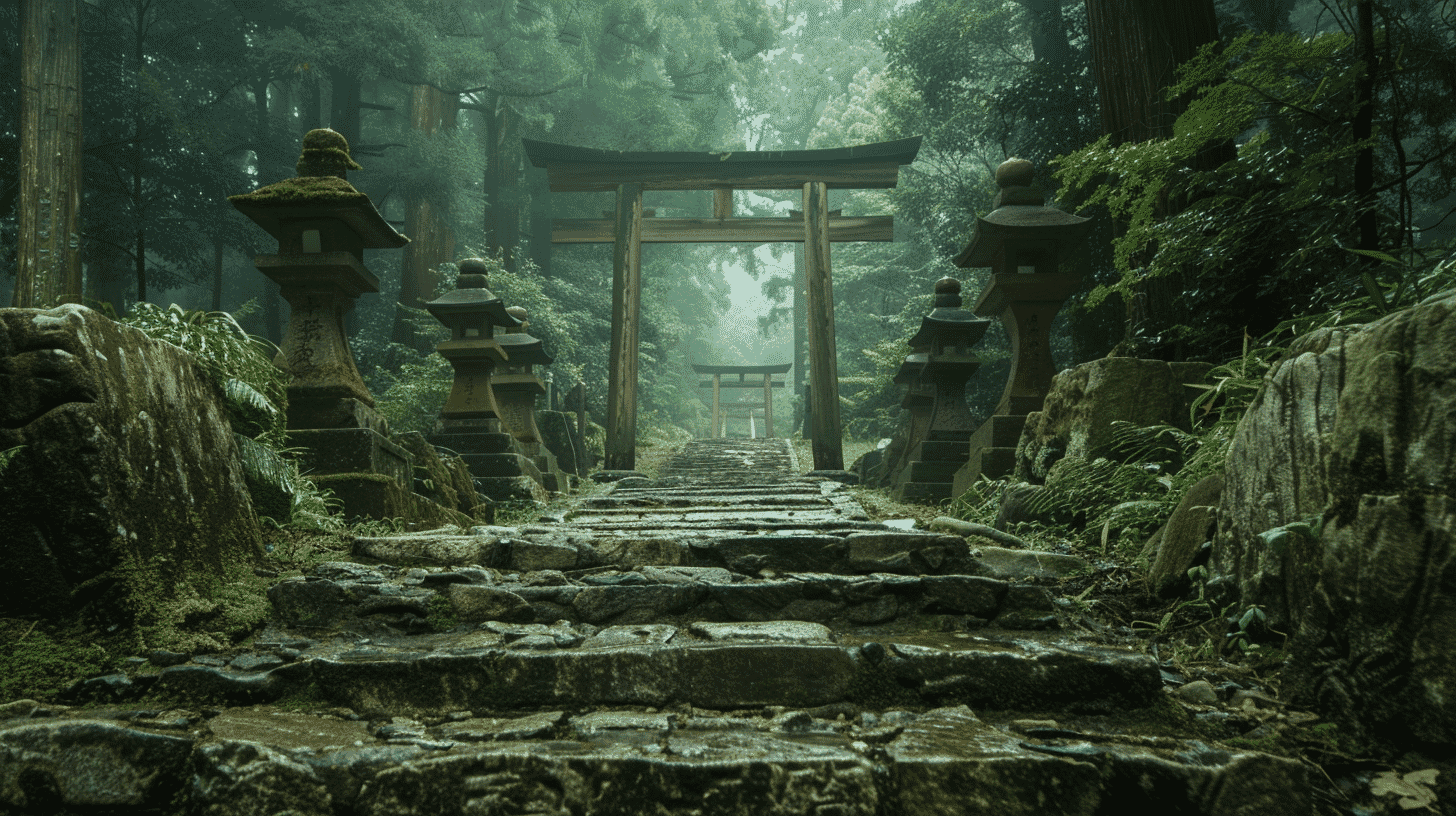
The approach begins with a stair built from stacked natural stones. The steps are of uneven height, so watch your footing and wear shoes you can walk in. Deep woods surround the precinct, and there is nothing like the crowd at Izumo Taisha. Early morning is quiet, and it is the hour when the roof of the hall and the outline of the forest read together.
From JR Matsue Station the municipal bus takes about 25 minutes. Parking is free, with room for around 150 vehicles. Enquiries go to the shrine on 0852-21-6379.
The subordinate Kifune Inari Ryojinja Main Hall stands in the same precinct and carries a separate designation as an Important Cultural Property. The Yakumotatsu Fudoki no Oka park is close by and displays finds from the Okadayama tumulus among others.
- 📍 Plan Your Visit to Shimane
- Find tours, activities & transport passes near Kamosu Shrine Main Hall
- [ Izumo Taisha Shrine & Adachi Museum Gardens ]
Q&A
- When was Kamosu Shrine Main Hall built and designated?
- It was rebuilt in 1583. It became an Important Cultural Property on 7 April 1900 and a National Treasure on 29 March 1952. The quantity is one building, recorded as taisha-zukuri with a shingled roof.
- Why is Kamosu Shrine Main Hall a National Treasure?
- Because it is the oldest surviving example of taisha-zukuri, a form found only in the old province of Izumo. The Agency for Cultural Affairs notes that it closely resembles the Izumo Taisha hall but has a longer frontage relative to its depth and columns thick in proportion to its scale, preserving an older form.
- How does Kamosu Shrine Main Hall differ from Izumo Taisha Main Shrine?
- Its frontage runs longer than its depth so the plan is not square, its columns are thick for its size, and its roof is shingled where Izumo Taisha uses cypress bark. The floor also sits higher than the walls above it, reversing the proportion at Izumo Taisha and marking an older form.
- What does me-zukuri mean at Kamosu Shrine Main Hall?
- A taisha-zukuri hall is divided by the central pillar with the seat of the deity set to one side, and there are two arrangements. The Izumo Taisha version is o-zukuri, the Kamosu version me-zukuri, and they are mirror images. The roof finials are cut horizontally as me-chigi, with three katsuogi billets.
- Can the interior of Kamosu Shrine Main Hall be seen?
- Not normally. Inside are red-lacquered beams and columns, a ceiling of nine clouds in five colors, and eight wall paintings. The moon and sun painted on the front doors can be glimpsed only when the doors open on festival days; dates vary, so contact the shrine office in advance.
Basic Information
| Name | Kamosu Shrine Main Hall (神魂神社本殿, Kamosu-jinja Honden) |
|---|---|
| Location | 563 Obacho, Matsue City, Shimane Prefecture |
| Designation | National Treasure (structure), religious architecture |
| Year Designated | 1900 (7 April), Important Cultural Property; 1952 (29 March), National Treasure |
| Quantity | 1 building |
| Dimensions | Taisha-zukuri, shingled roof; two bays across the front and two in depth, the frontage somewhat longer; ridge-bearing columns projecting beyond the wall plane; nine round columns with the sacred central pillar at the middle. Momoyama period, 1583 |
| Owner | Kamosu Shrine |
| Public Access | Precinct open, no admission charge. Shrine office roughly 9:00 a.m. to 5:00 p.m. The hall stands inside a fence and is viewed from outside; the interior is closed and the door paintings are visible only on festival days |
References
- Cultural Heritage Online: Kamosu Shrine Main Hall
- https://bunka.nii.ac.jp/heritages/detail/146648
- Shimane Tourism Navi: Kamosu Shrine
- https://www.kankou-shimane.com/en/destinations/9298
- Matsue Tourism Association
- https://www.kankou-matsue.jp/
- Yakumotatsu Fudoki no Oka
- https://www.yakumotatu-fudokinooka.jp/
Last verified: 2026.09.05