
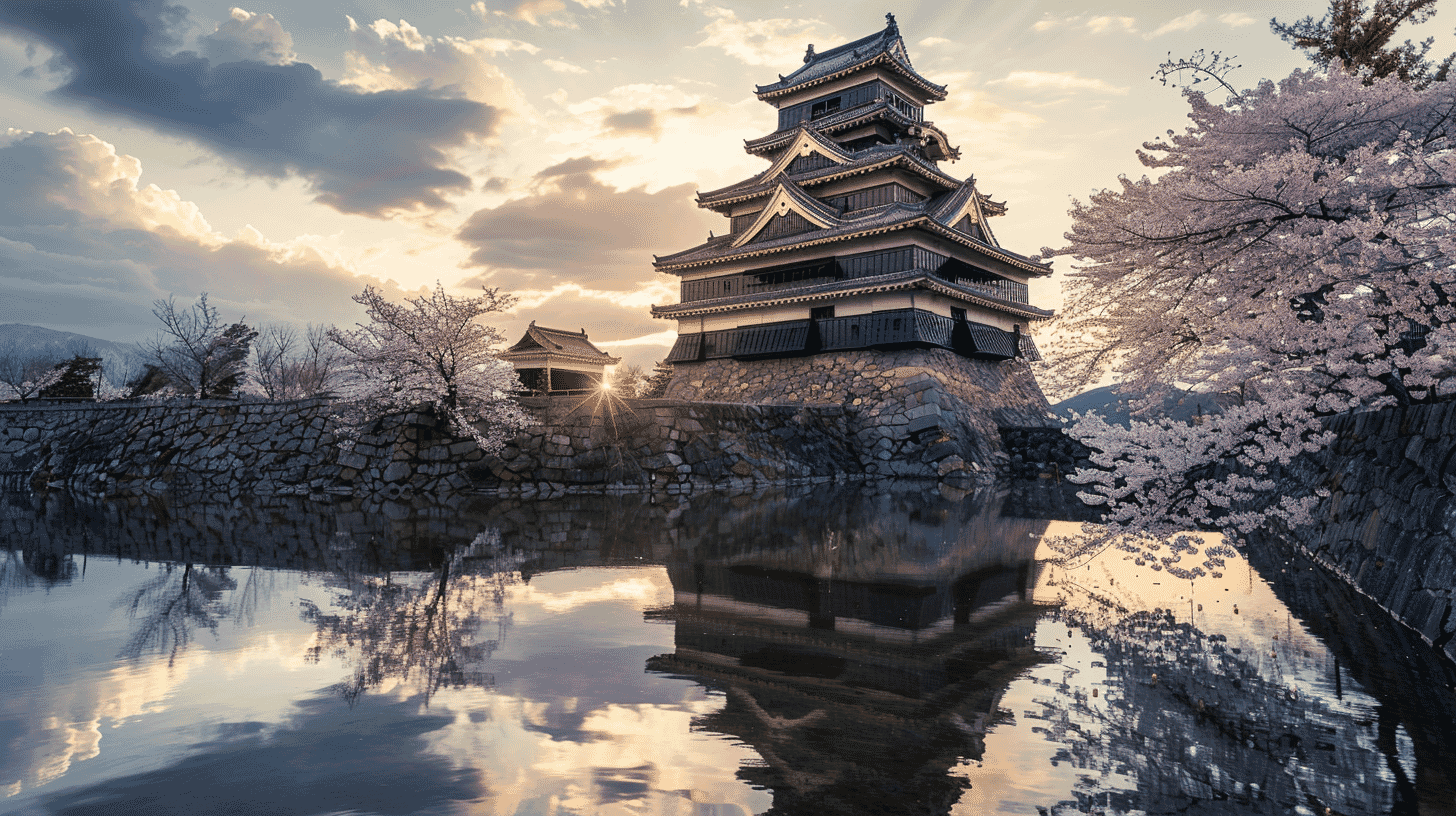
Completed in 1611: The Only Four-Tier, Five-Storey Keep in the Chugoku Region
Matsue Castle Tower (松江城天守, Matsuejo Tenshu) stands at 1-5 Tonomachi, Matsue City, Shimane Prefecture, was completed in 1611, and was designated an Important Cultural Property on 13 May 1935 and a National Treasure on 8 July 2015. The quantity is one building, with two prayer tablets, four house-protection tablets and three foundation deposits registered as attached property. It belongs to the city of Matsue.
The Agency for Cultural Affairs describes it as the only grand four-tier, five-storey keep surviving in the Chugoku region. The exterior reads as four tiers, the interior holds five storeys with a basement, and an entrance turret projects on the south face. The roofs are all covered in formal tile.
Matsue Castle is a hilltop-and-plain castle raised on Kamedayama in the centre of the city. The Horio family, who became lords of Izumo and Oki in 1600, began building in 1607 and had the castle largely complete by 1611. The present tower dates from that campaign.
Through-Columns and Cladding Boards
What earned the designation is not the tower's age but its construction.
The frame makes heavy use of toshibashira, columns running the height of two storeys. The building stands about 30 metres over five floors and a basement, and that load is distributed by columns threaded alternately through every second floor. The great keep at Himeji, built a few years earlier, carried multiple levels on single enormous columns; Matsue reaches the same height by combining shorter members. The Agency for Cultural Affairs treats this as a distinctive architectural feature and judges the tower to be of extremely high value as a work representing the peak of early modern castle building.
The columns themselves are worked. Many carry tsutsumi-ita, boards fixed around the outside with nails, cramps and iron bands. The technique reinforces a column when a single thick timber is not available. Both the through-columns and the cladding boards follow one principle: achieving height without depending on outsized timber.
The citation reaches beyond technique. It closes by noting that the tower shows how Japanese castle culture developed from the medieval mountain fortress, built for defence, into the tall structure that anchored an early modern city, and that this carries deep significance for cultural history.
The Rediscovered Tablets: National Treasure, Then Not, Then Again
This tower lost National Treasure status once.
Designated under the old law in 1935, it became an Important Cultural Property when the Cultural Properties Protection Law took effect in 1950 and the categories were reorganised. It stayed at that rank for 65 years.
What restored it were two prayer tablets that had gone missing. When Kido Hisashi surveyed the tower in 1937 he recorded two tablets on the fourth floor, one inscribed with the year corresponding to 1611. The repair report made no mention of them and their whereabouts were unknown.
Matsue searched. In May 2012, while examining ridge tablets held at Matsue Shrine as part of the groundwork for a city history, staff found the two. Finding them was not enough: it was pointed out that a column with nail holes matching those in the tablets had to be identified. In November of that year the tablets were confirmed to have been fixed to two through-columns in the basement, and by June 2013 pale marks in the shape of the tablets had been found on the columns, fixing their exact position.
The Agency's commentary records that the completion date of 1611 became clear from the two recently rediscovered tablets. With the date documented and the through-column construction understood, the tower was gazetted as a National Treasure on 8 July 2015.
Timber Carried from Toda Castle
The members of the tower carry assembly marks, and the Agency for Cultural Affairs notes that these fall into two distinct systems. Members used on the second floor and below, stamped with a weight motif and the character for wealth, are thought to come from Toda Castle in what is now Yasugi City.
Toda was the Horio family's seat before they moved to Matsue. When building began here in 1607, timber from the old castle was carried over and worked into the new tower. The split in the marking systems is understood as the trace of that transfer.
It is worth holding this in mind while looking up at the columns. Some of the timber on the lower floors was not felled at Matsue. Moving a castle meant moving the wood as well as the seat of power.
Visiting
The tower opens from 8:30 a.m. to 6:30 p.m. between April and September, with last admission at 6:00 p.m., and from 8:30 a.m. to 5:00 p.m. between October and March, with last admission at 4:30 p.m. It does not close for holidays.
Admission was revised in July 2026. Adults pay 1,200 yen and primary and junior high school students enter free. Groups of 30 or more pay 960 yen for adults. Visitors holding a disability certificate and one carer enter free. Entry to the main enclosure is free, so viewing the stone walls and the exterior of the tower costs nothing.
Inside, the tower keeps the arrangement of a surviving keep: the stairs are steep and narrow. Travel light and wear shoes you can climb in. The castle park also has sloping paths.
From JR Matsue Station the Lakeline bus takes about 10 minutes to the Kokuho Matsuejo (Otemae) stop, then a two-minute walk. Paid parking is available at Otemae and elsewhere.
Q&A
- When was Matsue Castle Tower built and designated?
- The Horio family began building in 1607 and the castle was largely complete by 1611. The tower became an Important Cultural Property on 13 May 1935 and a National Treasure on 8 July 2015, with two prayer tablets, four house-protection tablets and three foundation deposits as attached property.
- Why was Matsue Castle Tower designated a National Treasure?
- For its construction: heavy use of columns running the height of two storeys, with cladding boards fixed around them by nails, cramps and iron bands. The Agency for Cultural Affairs judges it of extremely high value as a work representing the peak of early modern castle building, and significant for how castle culture moved from mountain fortress to urban anchor.
- Why did Matsue Castle Tower lose National Treasure status?
- It was designated under the old law in 1935, then reclassified as an Important Cultural Property when the Cultural Properties Protection Law took effect in 1950 and the categories were reorganised. It held that rank for 65 years before being designated again in 2015.
- What are the prayer tablets of Matsue Castle Tower?
- Two wooden tablets inscribed with the year corresponding to 1611, documenting when the tower was finished. Long missing, they were rediscovered at Matsue Shrine in 2012 and confirmed by matching nail holes to have been fixed to two through-columns in the basement. They were the decisive evidence for the 2015 designation.
- What does it cost to enter Matsue Castle Tower, and when is it open?
- Adults pay 1,200 yen and school students enter free, following a revision in July 2026; groups of 30 or more pay 960 yen. The tower opens 8:30 a.m. to 6:30 p.m. from April to September and 8:30 a.m. to 5:00 p.m. from October to March. Entry to the main enclosure is free.
Basic Information
| Name | Matsue Castle Tower (松江城天守) |
|---|---|
| Location | 1-5 Tonomachi, Matsue City, Shimane Prefecture |
| Designation | National Treasure (structure); the castle grounds are a National Historic Site |
| Year Designated | 1935 (13 May), Important Cultural Property; 2015 (8 July), National Treasure |
| Quantity | 1 building; 2 prayer tablets, 4 house-protection tablets and 3 foundation deposits as attached property |
| Dimensions | Four tiers outside, five storeys and a basement inside, about 30 m high. Entrance turret on the south face, all roofs in formal tile. Frame uses columns running two storeys, with cladding boards fixed by nails, cramps and iron bands. Built 1611 |
| Owner | City of Matsue |
| Public Access | No closing days. Adults 1,200 yen, school students free. Entry to the main enclosure is free. Opening hours vary by season |
References
- Cultural Heritage Online: Matsue Castle Tower
- https://bunka.nii.ac.jp/heritages/detail/195610
- Matsue City: the National Treasure designation of Matsue Castle Tower
- https://www.city.matsue.lg.jp/soshikikarasagasu/bunkasportsbu_matsuejo_shiryochosaka/rekishi_bunkazai/2/tensyu/2714.html
- Matsue City: admission and opening hours for cultural facilities around the castle
- https://www.city.matsue.lg.jp/soshikikarasagasu/bunkasportsbu_bunkashinkoka/21684.html
- Shimane Prefecture: the National Treasure designation of Matsue Castle Tower
- https://www.pref.shimane.lg.jp/life/bunka/bunkazai/event/kokuhou/
- Matsue Castle official site
- https://www.matsue-castle.jp/
Last verified: 2026.09.28