
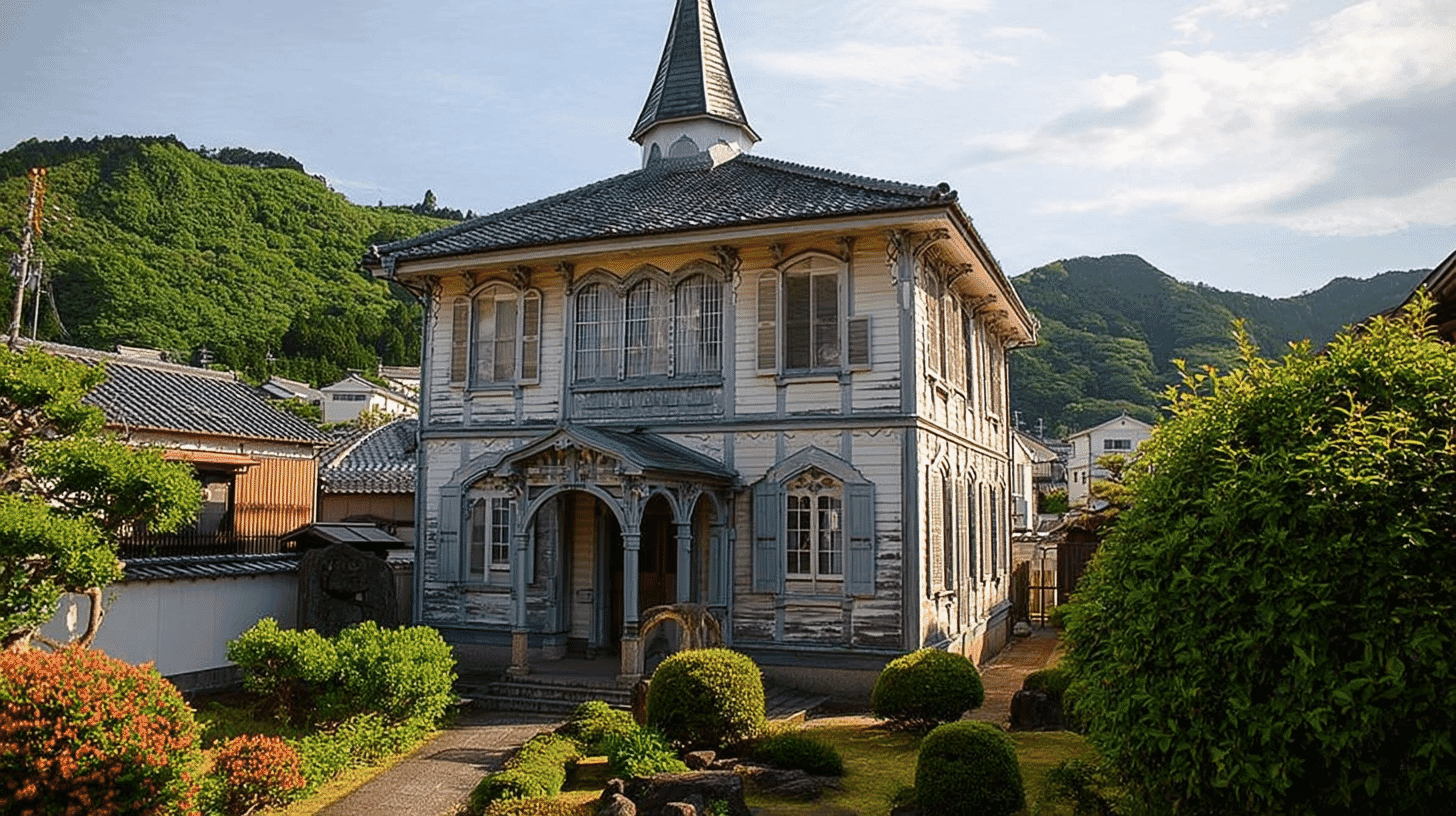
A Priest's House of 1917, on the National Register
Tsuwano Catholic Church Priest's House (津和野カトリック教会神父館) is a two-storey timber building at Ushiroda in Tsuwano, Kanoashi District, Shimane Prefecture, entered on the national register of tangible cultural properties on 10 September 2010. The registration number is 32-0156 and the quantity is one building. The criterion applied was contribution to the historic landscape of the country. It belongs to the Catholic Diocese of Hiroshima.
A point of terminology first. Registration is not designation. Designation as an Important Cultural Property carries strong controls, with permission required before any change to the fabric. Registration works by notification and assumes the owner will keep the building in use. The system covers buildings over fifty years old across a wide range, and this house sits in that category.
The record itself is inconsistent about the date. The Agency for Cultural Affairs gives 1917 in its Western-calendar field, while the era field reads Showa 6, which corresponds to 1931. The two do not agree. 1917 is Taisho 6. The adjoining church was rebuilt in 1929, so which building the Showa 6 date refers to cannot be told from the record. This article follows the Western-calendar field and notes the discrepancy.
Structure: Different Cladding on Each Floor
The Agency records the structure in one line: two-storey timber, slate roof, floor area 69 square metres. The building is reported as 13 metres along the front and 5.4 metres in depth.
The roof is slate, a material still new for provincial building in the Taisho period. Neither tile nor shingle was chosen.
The walls are finished differently on each floor. The upper storey is clad in weatherboard; the ground floor carries a boarded dado with painted plank walling above. Varying the treatment between floors both protects the base, where rain strikes hardest, and adjusts how the elevation reads from the front.
Inside, the ground floor holds an office, a reception room and a dining room; the upper floor has three rooms. One building carries both the work and the living of the resident priest, separate from the church itself. The house faces west, onto a Japanese garden.
Why There Is a Church in This Town
Tsuwano is an inland castle town in the San'in region, and a Catholic church is a conspicuous thing to find here. The reason lies in the fourth Urakami incident.
Between 1867 and the first years of Meiji, hidden Christians from the Urakami district of Nagasaki were exiled across the country. One hundred and fifty-three were sent to Tsuwano and confined at Otome Pass nearby. They were tortured to force recantation, and thirty-seven died.
When the notice boards banning Christianity came down in 1873, this place became one that held the memory of those deaths. The church and the priest's house stand on that memory. That the registration criterion is contribution to the historic landscape covers more than the quality of the building: the presence of church buildings on this ground is itself part of the landscape.
The House and the Church
The priest's house adjoins the church building of Tsuwano Catholic Church, which is also on the national register. It was rebuilt in 1929 by the German priest Schäfer.
The church takes a Gothic form, but its interior is floored with tatami. Worshippers sit on matting rather than in pews, so the style and the use pull against each other. Together with the priest's house facing a Japanese garden, this corner of the town shows Western building adjusted to Japanese habits of use.
The two buildings are twelve years apart and differ in style and purpose. The registration criterion is the same for both: contribution to the historic landscape of Tsuwano. Seeing the house beside the church makes that judgement easier to read than seeing either alone.
Visiting
The house remains in use by the church and the interior is not open to the public. The exterior can be seen from within the church grounds, which are open roughly from 8:00 a.m. to 5:00 p.m.
The church is a place of worship, so keep quiet while looking, and avoid the hours of Mass and other services. Ask the church on 0856-72-0251 about photography.
The house faces Tonomachi-dori, about ten minutes on foot from JR Tsuwano Station. The same street carries the white plaster walls and water channels of the old samurai quarter, so the effect of a Western-style building within that townscape can be judged directly. Walking the street is the quickest way to see what contribution to the historic landscape means here.
- 📍 Plan Your Visit to Shimane
- Find tours, activities & transport passes near Tsuwano Catholic Church Priest's House
- [ Izumo Taisha Shrine & Adachi Museum Gardens ]
Q&A
- When was the Tsuwano Catholic Church Priest's House built and registered?
- The Agency for Cultural Affairs gives 1917 in its Western-calendar field. Registration followed on 10 September 2010, under number 32-0156, for one building. The era field of the same record reads Showa 6, or 1931, which does not agree; the adjoining church was rebuilt in 1929, so the reference is unclear.
- How does registration differ from designation?
- Registration is not designation. Designation as an Important Cultural Property requires permission before any change to the fabric; registration works by notification and assumes the owner keeps the building in use. The system covers buildings over fifty years old across a wide range.
- What is the structure of the priest's house?
- Two-storey timber with a slate roof and a floor area of 69 square metres, reported as 13 metres along the front and 5.4 metres deep. The upper storey is clad in weatherboard, the ground floor carries a boarded dado with painted plank walling above.
- Why is there a Catholic church in Tsuwano?
- Because of the fourth Urakami incident. Between 1867 and the early Meiji years, hidden Christians from Nagasaki were exiled across the country; 153 were sent to Tsuwano and confined at Otome Pass, where 37 died under torture meant to force recantation. The church and house stand on that memory.
- Can the priest's house be visited?
- It remains in use and the interior is closed. The exterior can be seen from within the church grounds, open roughly 8:00 a.m. to 5:00 p.m. Ask the church on 0856-72-0251 about photography. It is about ten minutes on foot from JR Tsuwano Station.
Basic Information
| Name | Tsuwano Catholic Church Priest's House (津和野カトリック教会神父館) |
|---|---|
| Location | Ro 66-7 Tonomachi, Ushiroda, Tsuwano Town, Kanoashi District, Shimane Prefecture |
| Designation | Registered Tangible Cultural Property (structure), registration no. 32-0156, criterion: contribution to the historic landscape |
| Year Designated | 2010 (10 September), registered |
| Quantity | 1 building |
| Dimensions | Timber, 2 storeys, slate roof, floor area 69 sq m. 13 m along the front, 5.4 m deep. Floor 2 in weatherboard, floor 1 with a boarded dado and painted plank walling above. Built 1917 |
| Owner | Catholic Diocese of Hiroshima |
| Public Access | Interior closed. Exterior visible from the church grounds, open roughly 8:00 a.m. to 5:00 p.m. Ask the church about photography |
References
- Agency for Cultural Affairs, National Cultural Properties Database: Tsuwano Catholic Church Priest's House
- https://kunishitei.bunka.go.jp/bsys/maindetails/101/00008364
- Cultural Heritage Online: Tsuwano Catholic Church Priest's House
- https://bunka.nii.ac.jp/heritages/detail/209236
- Shimane Tourism Navi: Tsuwano Catholic Church
- https://www.kankou-shimane.com/destination/20244
- Agency for Cultural Affairs, Japan Heritage portal
- https://japan-heritage.bunka.go.jp/ja/stories/story013/spot/
Last verified: 2026.09.02