
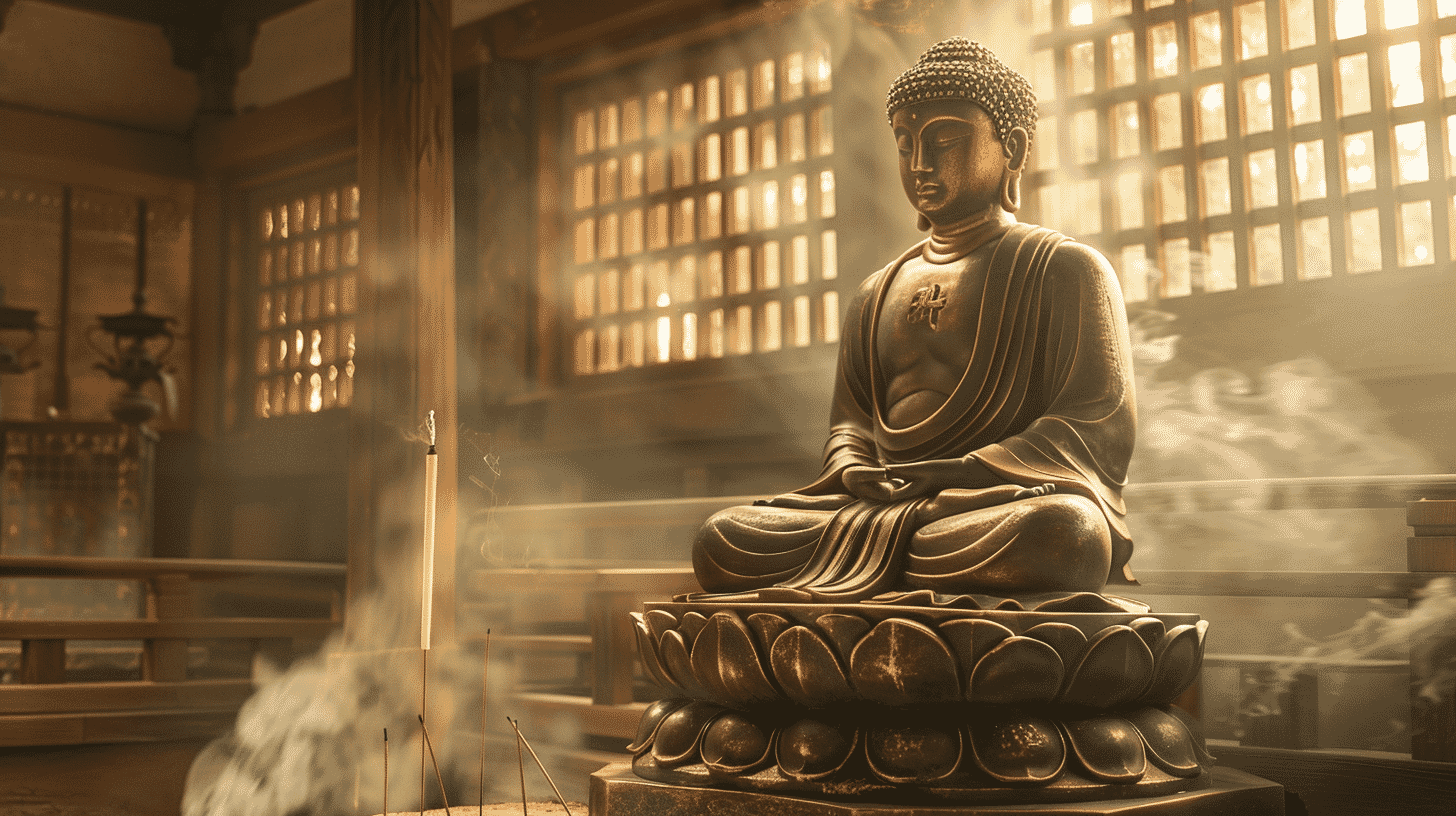
A Hakuho Buddha of the Late Seventh Century, National Treasure since 2017
The Bronze Statue of Shaka Nyorai Seated on a Chair (銅造釈迦如来倚像, Dozo Shaka Nyorai Izo) is a gilt bronze Buddha of the Asuka period owned by Jindaiji in Chofu City, Tokyo, designated a National Treasure on 15 September 2017. It had been listed as a National Treasure under the earlier system on 14 April 1913. The quantity is one figure, the category sculpture, and the designation number 00133. It is commonly called the Hakuho Buddha.
The Agency for Cultural Affairs writes: the bright expression suggesting a youth, and the robe that clings to the body, revealing the swell of the modelling while its folds are drawn in flowing lines, show clearly the character of what is called a Hakuho Buddha, and the work appears to date from the later seventh century or its close. Taking in the style of the early Tang while reaching an unusual freshness of expression, it is a fine work of the sculpture of its time.
Izo means seated on a chair with both feet hanging forward. It is a third form, neither standing nor seated cross-legged, and is not common among images of a Nyorai. The character i in the name refers to that posture.
What a Hakuho Buddha Is
Hakuho is a period term used in art history for the later Asuka period. It is not a division of political history, so the Agency records the era as Asuka and speaks within its commentary of what is called a Hakuho Buddha.
Three features are named. A bright expression suggesting a youth. A robe clinging to the body so that the swell of the modelling shows through. Folds drawn in flowing lines. All three describe how the figure looks rather than naming a style, written in the language of observation.
The judgement follows: taking in the style of the early Tang while reaching an unusual freshness of expression. Continental style was absorbed, and the work went beyond it. Reception and attainment are set out as two stages, and that is the point of the citation.
Chofu City records that on grounds of style the figure may have been cast in the same workshop as the Yumetagai Kannon at Horyuji, a National Treasure, and the Koyakushi of Shinyakushiji, an Important Cultural Property. This is a suggestion rather than an established finding.
Found Beneath an Altar Platform
The figure was forgotten for a long time.
Cultural Heritage Online records that the bronze Shaka of Jindaiji was handed down as the principal image from the founding of the temple, but that after the halls burned in 1865 its existence was forgotten. In 1909 Shibata Tsunee, an assistant in the anthropology department of the faculty of science at Tokyo Imperial University, and others found it beneath the altar platform of the Ganzandaishi hall, and in 1913 it was listed as a National Treasure under the earlier system.
After the fire the figure lay under that platform for 44 years. Its finder was not a scholar of Buddhist art but an assistant in an anthropology department. Four years after the discovery it was listed, and 104 years after that, in 2017, it was designated under the present law.
In 1915 the 82nd abbot Gyobun had a plain wood shrine made for it. Later the eighth Kuriyama Zenshiro of the restaurant Yaozen, which had close ties with the temple, led an offer to donate a shrine worthier of the figure, and one was presented in 1932. It was made by the Nara lacquer artist Yoshida Hoshun at the request of the painter Yasuda Yukihiko, one of the donors.
Its Place in Eastern Japan
Chofu City sets out the figure's standing on two counts.
First, among National Treasure Buddhist figures in the Kanto region, it is the second to have been handed down in one place at one temple, after the great Buddha of Kotokuin at Kamakura. The condition is a National Treasure that stayed with its temple rather than entering a museum.
Second, since it was made nearly 550 years before the Kamakura great Buddha of the mid thirteenth century, it is the oldest National Treasure Buddhist figure in eastern Japan.
Hakuho Buddhas are numerous in Nara and few in Kanto. Why this one is here is unsettled: one view holds it was made in the capital region and brought east, another that immigrant families settled in Musashino could have cast it locally. This article does not decide between them.
Visiting
The figure is enshrined in the Shakado. It can be seen from 9:00 a.m. to 5:00 p.m. at no charge. Photography of the figure is prohibited.
It is lent out for special exhibitions from time to time, appearing at the Tokyo National Museum in 2021 and the Nara National Museum in 2025. Check the temple's notices before travelling.
The right hand forms the gesture of reassurance, with the tips of the middle and ring fingers lost. The head is not covered in the snail-shell curls usual for a Nyorai but carved in low relief. The figure stands 83.9 centimetres in total height, 59.3 centimetres seated.
From Chofu Station on the Keio Line the bus takes about 15 minutes to the Jindaiji stop. Buses also run from Kichijoji and Mitaka stations on the JR Chuo Line.
Q&A
- When was the Jindaiji bronze Shaka designated a National Treasure?
- On 15 September 2017. The Council for Cultural Affairs recommended it on 10 March that year and it was gazetted in Ministry of Education notice 112 on 15 September. It had been listed under the earlier system on 14 April 1913. The quantity is one figure in the sculpture category.
- What does izo mean?
- Seated on a chair with both feet hanging forward. It is a third form, neither standing nor seated cross-legged, and is not common among images of a Nyorai. The Jindaiji figure is 83.9 centimetres in total height and 59.3 centimetres seated.
- Why was the figure designated?
- The Agency for Cultural Affairs found that its bright youthful expression, its robe clinging to the body to reveal the modelling, and its flowing folds show clearly the character of a Hakuho Buddha, and judged it a fine work of its time, taking in early Tang style while reaching an unusual freshness of expression. It dates from the later seventh century or its close.
- How was the figure rediscovered?
- Its existence was forgotten after the temple halls burned in 1865. In 1909 Shibata Tsunee, an assistant in the anthropology department at Tokyo Imperial University, and others found it beneath the altar platform of the Ganzandaishi hall, 44 years after the fire. It was listed as a National Treasure four years later.
- Can the figure be seen?
- It is enshrined in the Shakado and can be seen from 9:00 a.m. to 5:00 p.m. at no charge, with photography prohibited. It is sometimes lent to special exhibitions, so check the temple's notices before travelling. From Chofu Station on the Keio Line the bus takes about 15 minutes.
Basic Information
| Name | Bronze Statue of Shaka Nyorai Seated on a Chair (銅造釈迦如来倚像), commonly the Hakuho Buddha |
|---|---|
| Location | 5-15-1 Jindaiji Motomachi, Chofu City, Tokyo (Jindaiji) |
| Designation | National Treasure (sculpture), designation no. 00133 |
| Year Designated | 1913 (14 April), National Treasure under the earlier system; 2017 (15 September), National Treasure |
| Quantity | 1 figure |
| Dimensions | Total height 83.9 cm, seated height 59.3 cm. Seated on a chair with both feet hanging forward. Right hand in the gesture of reassurance, tips of middle and ring fingers lost. Head carved in low relief rather than snail-shell curls. Asuka period |
| Owner | Jindaiji |
| Public Access | Enshrined in the Shakado. 9:00 a.m. to 5:00 p.m., no charge. Photography prohibited. Sometimes lent for special exhibitions |
References
- Chofu City: the Jindaiji Hakuho Buddha designated a National Treasure
- https://www.city.chofu.lg.jp/100200/p073023.html
- Cultural Heritage Online: the shrine and fittings for the Jindaiji Shaka Nyorai figure
- https://online.bunka.go.jp/heritages/detail/398935
- Jindaiji official site
- https://www.jindaiji.or.jp/
- Chofu City Tourism Association: Jindaiji
- https://csa.gr.jp/contents/16328
Last verified: 2026.09.03