
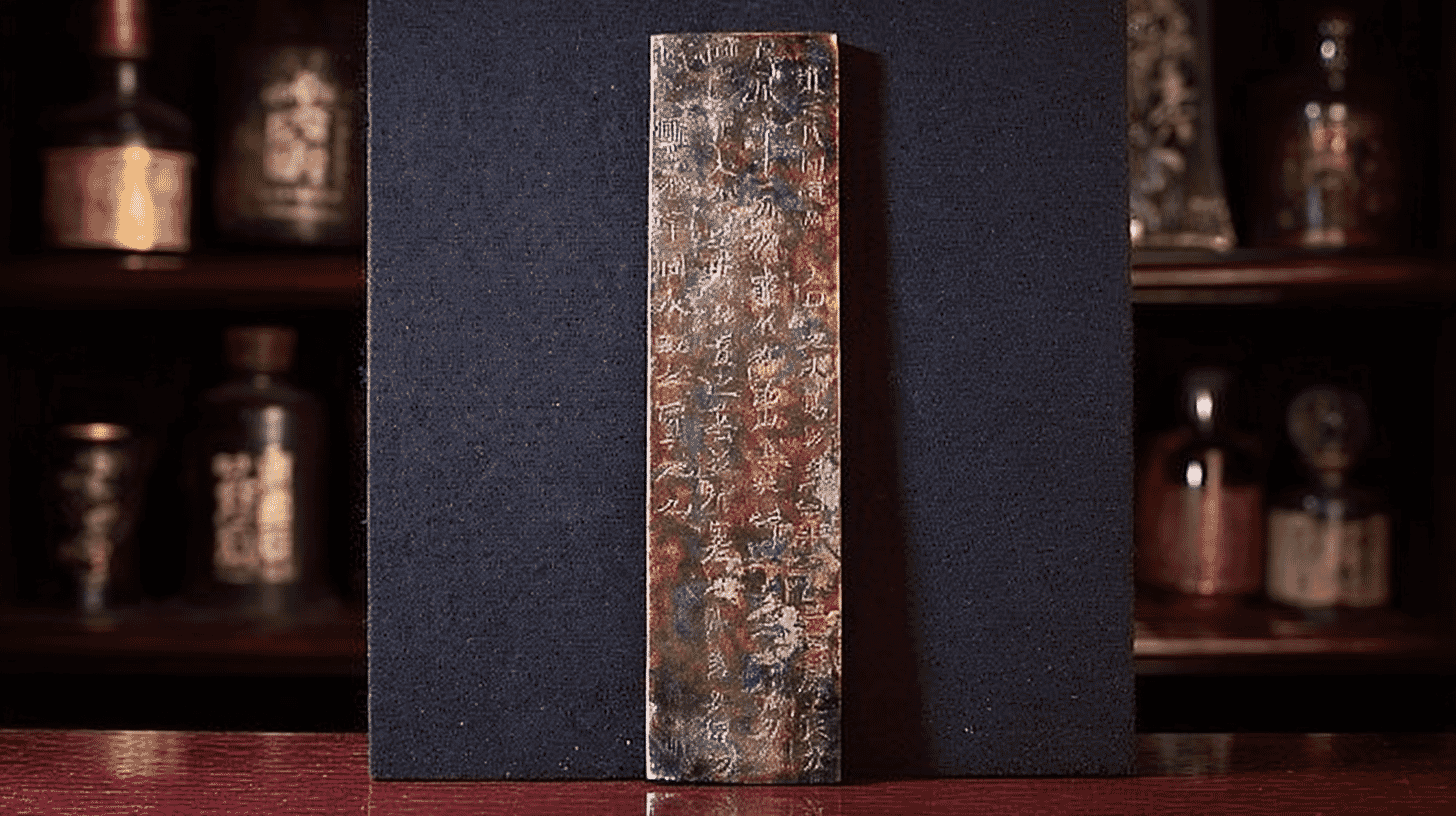
An Epitaph of 668, National Treasure since 1961
The Copper Epitaph of Funashi Ogo (銅製船氏王後墓誌, Dosei Funashi Ogo Boshi) is an inscribed copper plate held by the Mitsui Memorial Museum at Nihonbashi Muromachi, Chuo Ward, Tokyo, designated a National Treasure in 1961, on 27 April. It had become an Important Cultural Property on 31 March 1953. The quantity is one plate, the category archaeological materials, and the designation number 00026.
The Agency for Cultural Affairs gives a single line of commentary: material of the Nara period. No words of assessment are recorded, and what the entry yields is limited to the quantity, the date and the place of finding.
The note of provenance records the inscription and the find spot: buried at Matsuokayama in the twelfth month of the year of the earth dragon, found at Matsuokayama, Kokubu, Kashiwara City, Osaka Prefecture. That cyclical year corresponds to 668, and the inscription carries it.
The Period Field and the Date Do Not Agree
The Agency's database carries a record that does not agree with itself.
The period field reads Nara, while the fields for the year and for the Western year both read 668. The Nara period is conventionally taken to begin with the removal of the capital to Heijokyo in 710, forty-two years later; 668 falls in the Asuka period. The commentary likewise says material of the Nara period.
That the cyclical year in the inscription corresponds to 668 is not in question. The discrepancy lies in the period label, which does not match the date. This article follows the date and records that the label differs.
The year 668 was the seventh year of the reign of Emperor Tenji, the era of the Otsu palace at Omi.
What the Inscription Records
An epitaph is a plate recording the career of the person buried and placed with them in the grave. Characters are cut into copper and the plate is interred at the burial.
The phrase quoted in the note states that in the twelfth month of that year the burial took place at Matsuokayama, after the period of temporary enshrinement that preceded interment. The month and the place of burial are set down in the inscription itself.
Kashiwara City records that Funashi Ogo belonged to the Funashi, a clan descended from immigrants from Paekche, and that the inscription sets out his career. A written record of an individual of immigrant descent, recovered from that person's own grave, is what this plate amounts to.
Matsuokayama, where it was found, lies at Kokubu in Kashiwara City, Osaka Prefecture. It is the site of a burial mound, and the plate came from there. A museum in Tokyo now holds it, so the find spot and the place of keeping are far apart.
Epitaphs as Evidence
Written material carrying an explicit date is not plentiful from ancient Japan.
Wooden tablets and inscriptions on metal and stone survive, but epitaphs recording a person's career and the year of burial are fewer still. Besides this one, the copper epitaph of Mino no Okimaro and a handful of others are known.
What makes an epitaph valuable is that the year of writing cannot shift. It is not a later copy but a plate made at the burial and interred then. The cyclical year in the inscription is the year at which it was cut.
Against the Agency's single line of commentary, the low designation number, 00026, marks an early entry among archaeological materials. It became an Important Cultural Property in 1953 and a National Treasure in 1961.
Seeing It
The Mitsui Memorial Museum holds the plate. It is not on permanent display, and whether and when it is shown depends on the museum's programme.
Opening hours and admission vary with the exhibition, so check the museum's information before travelling. If the object itself is the purpose of the visit, confirm that it is on show.
The Matsuokayama burial mound where it was found is at Kokubu Ichiba in Kashiwara City, Osaka Prefecture. The plate is not there, but the mound remains. Object and find spot lie in different prefectures, so seeing both means two journeys.
The museum is about one minute on foot from Mitsukoshimae Station on the Tokyo Metro Ginza and Hanzomon lines, on the seventh floor of the Mitsui Main Building.
Q&A
- When was the epitaph designated?
- It became an Important Cultural Property on 31 March 1953 and a National Treasure in 1961, on 27 April. It is listed as one plate in the category of archaeological materials under designation number 00026. The cyclical year in the inscription corresponds to 668.
- Why does the period field read Nara?
- The database gives the period as Nara while the year fields both read 668. The Nara period is conventionally taken to begin in 710, forty-two years later, so the label does not match the date. This article follows the date and records that the label differs.
- What is an epitaph of this kind?
- A plate recording the career of the person buried, interred with them. The phrase quoted in the Agency's note states that the burial took place at Matsuokayama in the twelfth month of the year, after the period of temporary enshrinement, so the month and place of burial are set down in the inscription itself.
- Where was it found?
- The Agency's note records it as found at Matsuokayama, Kokubu, Kashiwara City, Osaka Prefecture. Kashiwara City records that Funashi Ogo belonged to a clan descended from immigrants from Paekche. The Mitsui Memorial Museum in Tokyo now holds it, so find spot and place of keeping are far apart.
- Can the epitaph be seen?
- The Mitsui Memorial Museum holds it, but not on permanent display; whether it is shown depends on the museum's programme. Hours and admission vary with the exhibition, so check before travelling. The museum is about one minute on foot from Mitsukoshimae Station.
Basic Information
| Name | Copper Epitaph of Funashi Ogo (銅製船氏王後墓誌, Dosei Funashi Ogo Boshi) |
|---|---|
| Location | 2-1-1 Nihonbashi Muromachi, Chuo Ward, Tokyo (Mitsui Memorial Museum, 7th floor of the Mitsui Main Building) |
| Designation | National Treasure (archaeological materials), designation no. 00026 |
| Year Designated | 1953 (31 March), Important Cultural Property; 1961 (27 April), National Treasure |
| Quantity | 1 plate |
| Dimensions | An inscribed copper plate. The inscription records burial at Matsuokayama in the twelfth month of a cyclical year corresponding to 668. Found at Matsuokayama, Kokubu, Kashiwara City, Osaka Prefecture |
| Owner | Mitsui Memorial Museum |
| Public Access | Not on permanent display; whether and when it is shown depends on the museum's programme. Hours and admission vary with the exhibition |
References
- Agency for Cultural Affairs, National Cultural Properties Database: Copper Epitaph of Funashi Ogo
- https://kunishitei.bunka.go.jp/heritage/detail/201/859
- Cultural Heritage Online: Copper Epitaph of Funashi Ogo
- https://bunka.nii.ac.jp/heritages/detail/178482
- Kashiwara City: the epitaph of Funashi Ogo
- https://www.city.kashiwara.lg.jp/docs/2016081400033/
- Mitsui Memorial Museum official site
- https://www.mitsui-museum.jp/
Last verified: 2026.09.04