
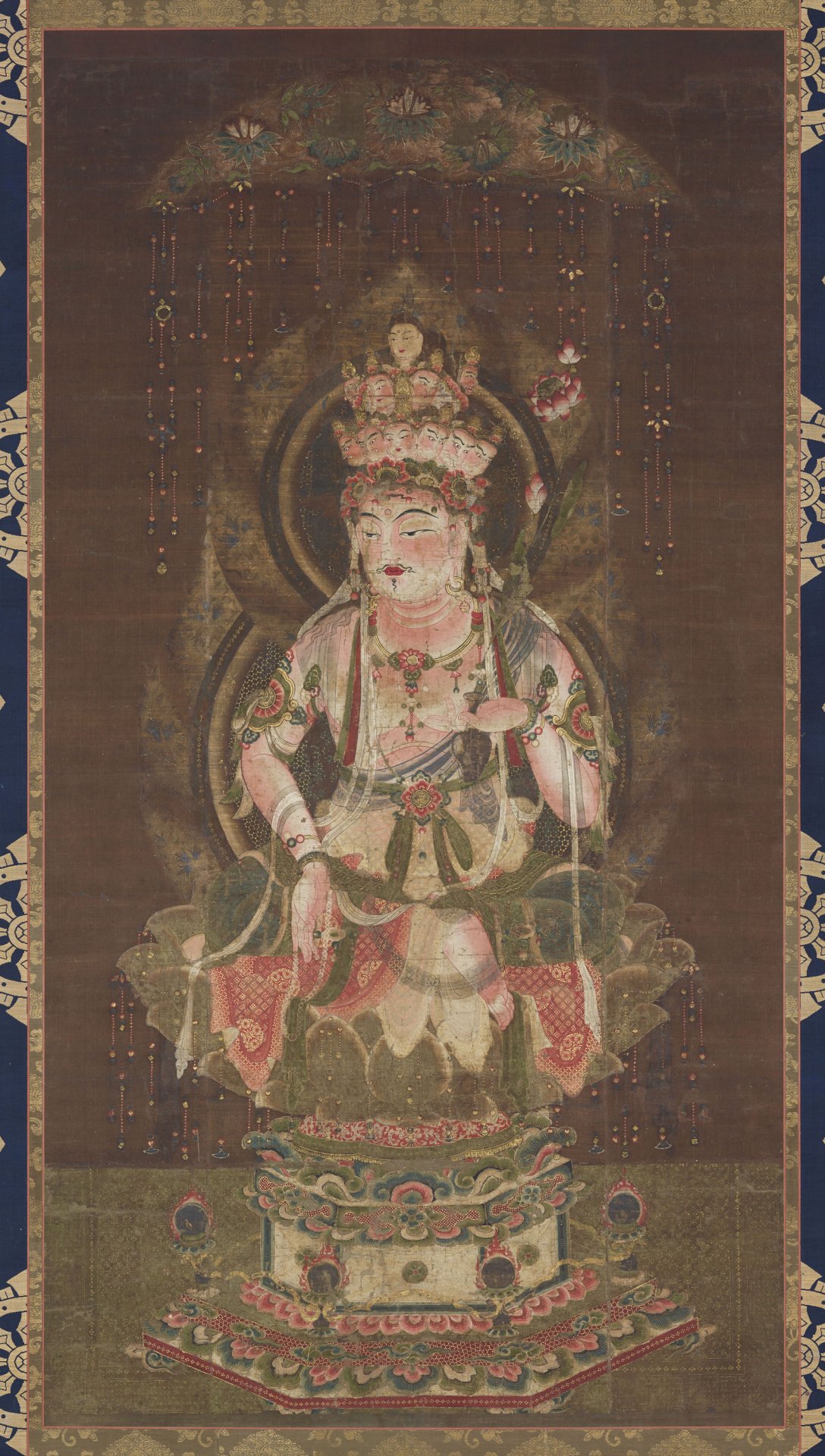
Silk-Painted Image of the Eleven-Headed Kannon: A Heian-Era National Treasure at Nara National Museum
Hidden away in the climate-controlled vaults of Nara National Museum lies one of Japan's most exquisite Buddhist paintings — the National Treasure "Silk-Painted Image of the Eleven-Headed Kannon" (Kenpon Chakushoku Jūichimen Kannon-zō). Created in the 12th century during the late Heian period, this single hanging scroll represents the absolute pinnacle of Japanese Buddhist painting, combining sumptuous color, intricate cut-gold-leaf decoration (kirikane), and a serene yet powerful image of the bodhisattva of compassion in eleven-headed form.
For visitors who appreciate the finest in Asian religious art, encountering this work — even on its rare public viewings — offers an unparalleled glimpse into the spiritual and aesthetic refinement of Japan's golden age of Buddhist culture.
Historical Background
The Eleven-Headed Kannon (Sanskrit: Ekādaśamukha-Avalokiteśvara) is one of the earliest forms of the bodhisattva of compassion to develop in Buddhist iconography, and worship of this deity has continued unbroken in Japan since the Nara period (710–794). The painting's iconography follows the description found in the "Heart Dharani Sutra of the Eleven-Headed Kannon," translated into Chinese by the great Tang-dynasty monk Xuanzang (602–664), who is famous in the West as the inspiration for the Chinese classic novel "Journey to the West."
The work was preserved for centuries at Hokkiji Temple, located near the more famous Hōryūji Temple in Ikaruga, just outside Nara. Hōryūji itself owns surviving fragments of Heian-period Buddhist paintings that share the distinctive heavy shading style of this image, and scholars have suggested that the artist may have drawn inspiration from the celebrated mural paintings that once adorned the Kondō (Main Hall) of Hōryūji. The painting eventually entered the collection of Nara National Museum, where it has been carefully preserved as a touchstone of Heian Buddhist art.
The 12th century, when this painting was created, was the final flowering of the Heian aristocratic culture before the rise of the warrior class. Buddhist art of this era reached extraordinary heights of refinement and beauty, blending Chinese influences from the Tang and the contemporary Song dynasty (960–1279) with distinctively Japanese sensibilities.
Why It Was Designated a National Treasure
This painting was elevated to National Treasure status on June 22, 1992, recognizing its position as one of the finest examples of Heian Buddhist painting in existence. Several scholarly factors contributed to this designation.
First, the painting holds the distinction of being among the oldest surviving silk-painted images of the Eleven-Headed Kannon in Japan. While the worship of this deity in painted form was widespread, almost no comparable works from the early to mid-Heian period have survived, making this scroll an irreplaceable record of how this iconography was understood and venerated.
Second, the work occupies a unique position in art history through its unconventional composition. Rather than depicting the deity in the strictly frontal pose typical of esoteric Buddhist icons, the artist turned Kannon slightly to the viewer's left — a daring choice that suggested a more naturalistic spatial awareness and links the painting to ancient iconographic traditions stretching back to the Nara period.
Third, the painting represents a rare confluence of multiple cultural currents — preserving older Japanese painting traditions while incorporating fashionable new motifs imported from Song-dynasty China, all rendered with technical mastery in the use of pigments, cut gold leaf, and silver. As the Cultural Affairs Agency's database notes, the work "occupies a singular position" within the corpus of Japanese Buddhist painting.
Artistic Highlights and Things to Look For
Standing before this scroll, viewers can appreciate craftsmanship of breathtaking sophistication. The painting measures 169.0 centimeters tall by 90.0 centimeters wide — a substantial scale that allows the artist's microscopic detail to register at human dimensions.
The Eleven Heads
Above Kannon's main face rise ten additional heads, each with a specific symbolic role. Three bodhisattva faces show serene compassion, three wrathful faces guard against evil, three faces with upward-protruding fangs symbolize the protective force of the dharma, one laughing face expresses the joy of enlightenment, and at the very summit sits a Buddha face representing the ultimate goal of awakening. Together, these eleven faces represent the eleven stages on the path to enlightenment.
The Pose and Attributes
Kannon holds a small water vessel containing a red lotus flower in the left hand, while the right hand rests in front of the knee in the wish-granting mudra (yogan-in), with prayer beads draped around the wrist. The deity sits in a relaxed posture with the right leg extended somewhat outward, rather than in the formal lotus position — an unusually intimate and approachable depiction.
Cut Gold Leaf and Color
The most extraordinary feature of the painting is its decoration with kirikane — paper-thin gold leaf cut into hair-fine strips and meticulously applied to create patterns. The robes display layered ground patterns and bold main motifs, including chrysanthemum medallions believed to be a fashionable design newly imported from Song China. The skin is rendered in a soft pink with bold red outlining and dramatic shading, giving the figure a sense of three-dimensional presence.
The Canopy and Mandorla
The decorative canopy hanging above Kannon's head and the openwork-style halo behind the figure are decorated with motifs of bamboo grass and gentian flowers (sasa-rindō), executed in cut gold leaf and silver gradations. The water vessel itself is rendered in silver pigment with translucent details — possibly intended to represent the rare imported glassware then beginning to appear in Japan from Song China.
Visiting the Painting
The Silk-Painted Eleven-Headed Kannon is part of the permanent collection of Nara National Museum, which has been celebrated as the "hall of Buddhist art" since its founding in 1895. Because this is a fragile painted work on silk, however, it is not on continuous public display. The painting is shown only on special occasions — typically as part of major exhibitions or themed displays of the museum's masterworks. Visitors hoping to see the actual scroll should consult the museum's exhibition calendar in advance.
Even when the original is not on view, the museum's Buddhist Art Library and Research Center hold reference materials, and high-quality digital reproductions can be examined through the e-Museum online platform operated by the National Institutes for Cultural Heritage.
Visitor Information
The museum is comprised of several buildings: the Nara Buddhist Sculpture Hall (the historic brick building, itself an Important Cultural Property of architecture), the East and West New Wings used for special exhibitions, and the Bronze Vessel Gallery. Standard admission to the permanent collection (Masterpieces Exhibition) is 700 yen for adults and 350 yen for university students, with free admission for high school students and younger as well as visitors aged 70 and over. Special exhibition fees vary.
Opening hours are generally 9:30 to 17:00, with extended evening hours on certain days. The museum is closed on Mondays (or the following weekday if Monday is a holiday) and from December 28 to January 1.
Getting There
The museum is located inside Nara Park, approximately a 15-minute walk east from Kintetsu Nara Station. Visitors can also take the city loop bus from JR Nara Station or Kintetsu Nara Station, alighting at the "Himuro Jinja / Kokuritsu Hakubutsukan" stop directly in front of the museum.
Surrounding Attractions
Nara National Museum sits at the heart of one of Japan's most concentrated zones of cultural heritage, making it the perfect anchor for a full day of exploration. Within easy walking distance are sites essential to understanding the origins of Japanese Buddhism and imperial culture.
Tōdai-ji Temple
A short walk north of the museum, Tōdai-ji houses the colossal bronze Great Buddha (Daibutsu), one of Japan's most iconic religious images. Its Great Buddha Hall is among the largest wooden structures in the world.
Kōfuku-ji Temple
Just west of the museum stands Kōfuku-ji, with its iconic five-story pagoda (currently undergoing major restoration) and its National Treasure Hall, which displays masterpieces including the celebrated Ashura statue.
Kasuga Taisha Shrine
To the east lies Kasuga Taisha, the ancient tutelary shrine of the Fujiwara clan, famous for its long avenue of stone lanterns winding through the primeval forest of Mount Kasuga.
Hōryū-ji and Hokki-ji
For visitors with deeper interest in the painting's history, Hōryū-ji Temple and the smaller Hokki-ji — the temple where this Kannon scroll was preserved during the Edo period — are located in nearby Ikaruga, accessible by bus or train. Both are UNESCO World Heritage Sites.
Nara Park's Famous Deer
The hundreds of free-roaming sika deer in Nara Park are revered as messengers of the gods and have become symbols of the city. Vendors sell special "deer crackers" (shika senbei) for visitors who wish to feed them.
Q&A
- Can I see the actual painting whenever I visit the museum?
- Unfortunately no. As a fragile painted work on silk, the National Treasure is rotated into display only on selected occasions, typically during special exhibitions or themed displays. Please check the museum's exhibition schedule in advance to plan your visit.
- Why does Kannon have eleven heads?
- The eleven heads symbolize Kannon's ability to perceive the suffering of all sentient beings in every direction and to offer salvation through eleven different aspects, corresponding to the eleven stages on the path to enlightenment.
- What is "kirikane" and why is it special?
- Kirikane is a uniquely refined Japanese decorative technique in which gold leaf is cut into incredibly thin strips and applied to a painted surface to create intricate patterns. It demands extraordinary skill and patience, and the technique reached its peak during the Heian and Kamakura periods.
- How does this painting compare to others of the same subject?
- It is among the oldest surviving silk paintings of the Eleven-Headed Kannon and is unusual for showing the deity in a slightly turned, naturalistic pose rather than the strictly frontal stance typical of esoteric icons. This combination of antique iconography and refined Heian elegance makes it singular among surviving works.
- Where was this painting before it entered the museum?
- The painting was preserved for centuries at Hokki-ji Temple near Hōryū-ji in Ikaruga, before eventually entering the collection of Nara National Museum, where it is now safeguarded for future generations.
Basic Information
| Designated Name | Kenpon Chakushoku Jūichimen Kannon-zō (Silk-Painted Image of the Eleven-Headed Kannon) |
|---|---|
| Designation | National Treasure (designated June 22, 1992) |
| Category | Painting |
| Period | Heian period, 12th century |
| Format | One hanging scroll; ink and colors on silk |
| Dimensions | Height 169.0 cm × Width 90.0 cm |
| Owner | National Institutes for Cultural Heritage |
| Location | Nara National Museum, 50 Noborioji-cho, Nara City, Nara Prefecture |
| Provenance | Formerly preserved at Hokki-ji Temple near Hōryū-ji |
| Access | Approx. 15-min walk east from Kintetsu Nara Station; or city loop bus to "Himuro Jinja / Kokuritsu Hakubutsukan" |
| Admission (Masterpieces Exhibition) | Adults 700 yen; University students 350 yen; High school and younger free |
| Hours | 9:30 – 17:00 (last entry 16:30); extended hours on selected days |
| Closed | Mondays (or following weekday if Monday is a holiday); December 28 – January 1 |
References
- e-Museum: Jūichimen Kannon (National Treasure, Nara National Museum)
- https://emuseum.nich.go.jp/detail?langId=en&webView=&content_base_id=101400&content_part_id=0&content_pict_id=0
- Cultural Heritage Online: 絹本著色十一面観音像
- https://bunka.nii.ac.jp/heritages/detail/203479
- Nara National Museum: Collection Database
- https://www.narahaku.go.jp/collection/1176-0.html
- Tokyo National Research Institute for Cultural Properties: Publication on the Eleven-Headed Kannon Image
- https://www.tobunken.go.jp/joho/japanese/publication/book/jyuichimen.html
- Nara National Museum Official Website
- https://www.narahaku.go.jp/
Last verified: 2026.04.24