Introduction: A Golden Mirror from the Ancient World

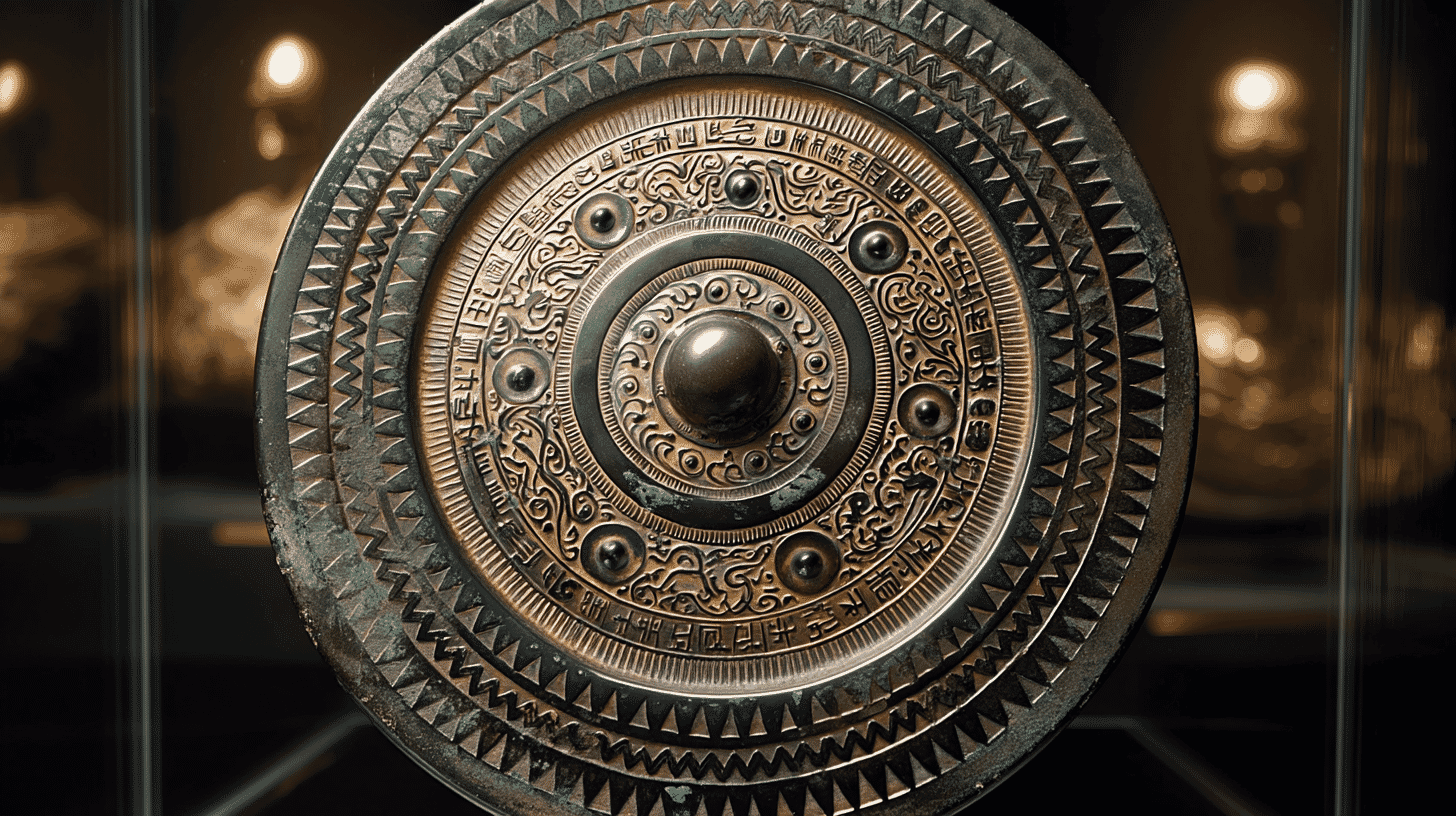
In the quiet galleries of Tokyo's Gotoh Museum lies a radiant treasure that has survived over 1,500 years—the Ryukin Jutaikyo (鎏金獣帯鏡), or Gilt Bronze Beast Band Mirror. This extraordinary artifact, designated as an Important Cultural Property of Japan, represents a fascinating intersection of Chinese craftsmanship and Japanese burial traditions during the Kofun period.

Unlike ordinary museum pieces, this mirror tells a story of ancient beliefs, cosmic harmony, and the powerful symbolism that connected China and Japan in ways that still resonate today. With its gleaming golden surface adorned with mythical creatures, the mirror invites us to explore a world where objects were believed to possess spiritual power and where art served as a bridge between the earthly and celestial realms.

What is the Gilt Bronze Beast Band Mirror?

The Ryukin Jutaikyo is a circular bronze mirror measuring 20.3 centimeters in diameter and weighing 1,284.3 grams. What makes this artifact truly special is its gilded surface—a lustrous golden coating achieved through an ancient technique called fire gilding, where mercury-gold amalgam was applied to the bronze surface and then heated to evaporate the mercury, leaving behind a brilliant gold finish.

The mirror belongs to a category known as "Beast Band Mirrors" (獣帯鏡), characterized by decorative bands featuring mythological creatures circling the central knob. This particular example showcases the Four Divine Beasts of Chinese mythology: the Azure Dragon (Seiryu), White Tiger (Byakko), Vermillion Bird (Suzaku), and Black Tortoise (Genbu). These celestial guardians were believed to protect the four cardinal directions and maintain cosmic balance.

The mirror dates to the 5th century during China's Six Dynasties period, specifically the Liu Song dynasty. However, its design is based on an older prototype—a mold from the mid-1st century Later Han dynasty. This practice of creating copies from earlier molds, known as "fumikashi" (踏み返し), was common in ancient China and allowed prestigious designs to be reproduced across generations.

The Four Divine Beasts: Guardians of the Cosmos

The Four Divine Beasts depicted on the mirror are among the most significant symbols in East Asian culture. Each creature guards one of the four cardinal directions and is associated with a season, color, and element according to the principles of Chinese cosmology and the Five Elements theory.

The Azure Dragon (青龍, Seiryu) guards the east, representing spring, the color blue-green, and the element of wood. It symbolizes prosperity, good fortune, and the power of transformation. The White Tiger (白虎, Byakko) protects the west, associated with autumn, the color white, and metal. Known as the king of beasts in ancient China, it represents courage and military prowess.

The Vermillion Bird (朱雀, Suzaku) watches over the south, embodying summer, the color red, and fire. Often confused with the phoenix, this celestial bird brings peace and dispels evil. The Black Tortoise (玄武, Genbu) defends the north, connected to winter, black, and water. Depicted as a tortoise entwined with a serpent, it symbolizes longevity, wisdom, and protection.

The inscription on the mirror reinforces these protective qualities, stating that the tiger on the right and dragon on the left ward off misfortune, while the Vermillion Bird and Black Tortoise harmonize yin and yang to ensure the proper rotation of celestial bodies and seasons.

Discovery and Historical Significance

The mirror was unearthed in 1869 (the second year of the Meiji era) from the Minami-deguchi Kofun, also known as Shirozuka Kofun, located in what is now Ono Town, Ibi District, Gifu Prefecture. This archaeological site is part of the No Kofun Cluster (野古墳群), a nationally designated historic site containing several keyhole-shaped burial mounds that reveal the political power structure of the region during the 5th and 6th centuries.

The Minami-deguchi Kofun itself is an impressive keyhole-shaped tomb (前方後円墳) measuring approximately 75 meters in total length, with a rear circular mound about 39 meters in diameter and 6.2 meters high. The mirror was discovered within the stone chamber of the rear circular section, along with horse trappings, swords, and other burial goods indicating the high status of the deceased.

The presence of a Chinese-made gilt bronze mirror in a Japanese tomb demonstrates the extensive trade networks and cultural exchanges between the Japanese islands and the Asian continent during the Kofun period. Such mirrors were highly prized objects, likely given as gifts from Chinese courts to Japanese rulers or obtained through diplomatic missions.

Why Was It Designated an Important Cultural Property?

The mirror was designated as an Important Cultural Property of Japan on March 31, 1953, in recognition of its exceptional historical, artistic, and archaeological value. Several factors contributed to this prestigious designation.

First, the mirror represents an outstanding example of ancient Chinese metallurgical and artistic achievement. The quality of the gilt work and the fineness of the decorative details demonstrate the sophisticated technical capabilities of 5th-century craftsmen. The gold surface has survived remarkably well, retaining much of its original brilliance after more than fifteen centuries.

Second, the mirror provides invaluable evidence of cultural exchange between China and Japan during the Kofun period. As an imported luxury item found in an elite burial context, it illuminates the political relationships and trade networks that connected early Japanese polities with the Chinese continent.

Third, the iconography of the Four Divine Beasts and the accompanying inscription offer insights into the religious and cosmological beliefs shared across East Asia. The mirror served not merely as a practical object but as a powerful spiritual talisman believed to protect its owner and ensure harmony with cosmic forces.

Visiting the Mirror at Gotoh Museum

The Ryukin Jutaikyo is currently preserved in the collection of the Gotoh Museum in Setagaya Ward, Tokyo. Founded in 1960 to house the art collection of Keita Goto, the founder of the Tokyu Corporation, the museum is renowned for its exceptional holdings of Japanese and East Asian art, including five National Treasures.

The museum building, designed by renowned architect Isoya Yoshida, harmonizes traditional Japanese aesthetics with modern functionality. Behind the main building extends a beautiful strolling garden that utilizes the natural terrain of the Musashino Plateau's Kokubunji cliff line. The garden features registered cultural properties including the tea houses Fujiintei and Kokyoro, as well as stone Buddhist sculptures scattered throughout the grounds.

Please note that the Gotoh Museum does not have a permanent display, and exhibitions rotate throughout the year with six to seven special exhibitions annually. The gilt bronze mirror may not always be on display, so visitors interested in seeing this specific artifact should check the museum's current exhibition schedule before planning their visit.

Exploring the Area: The No Kofun Cluster in Gifu

For those wishing to visit the original excavation site, the No Kofun Cluster in Ono Town, Gifu Prefecture, offers a remarkable opportunity to walk among ancient burial mounds. The cluster includes several notable tombs: the Motare Kofun, Fudo-zuka Kofun, Minami-deguchi Kofun (where the mirror was found), and Inui-yashiki Kofun, among others.

The surrounding area of Ono Town also offers attractions including the Rose Park with 2,000 rose bushes of 150 varieties, the Kurono Station Rail Park preserving the historic Meitetsu Kuronosen railway station, and the Palette Pia Ono roadside station featuring local products and restaurants. The Ono Onsen provides a relaxing hot spring experience for visitors exploring the region.

Q&A

QWhat does "Ryukin" mean in the mirror's name?
ARyukin (鎏金) refers to the ancient gilding technique also known as fire gilding or mercury gilding. In this process, gold is dissolved in mercury to create an amalgam, which is applied to the bronze surface. When heated, the mercury evaporates, leaving a permanent gold coating. This technique produced a more durable and brilliant finish than other gilding methods available at the time.
QWhy were mirrors placed in ancient Japanese tombs?
AIn ancient Japanese and Chinese cultures, mirrors were believed to possess mystical powers. Their reflective surfaces were thought to repel evil spirits and represent the sun's light. They were also symbols of authority and divine connection—one of Japan's Three Imperial Regalia is the sacred mirror Yata no Kagami. Placing mirrors in tombs was intended to protect the deceased and guide them in the afterlife.
QIs the Gotoh Museum difficult to access?
AThe Gotoh Museum is conveniently located just a 5-minute walk from Kaminoge Station on the Tokyu Oimachi Line. It can also be reached by a 15-minute walk from Futako-Tamagawa Station on the Tokyu Den-en-toshi Line. The museum is open from 10:00 AM to 5:00 PM (last entry at 4:30 PM) and is closed on Mondays. Admission is approximately ¥1,100 for adults.
QWhat is the difference between this mirror and the famous Triangular-rimmed Deity and Beast Mirrors?
AThe Triangular-rimmed Deity and Beast Mirrors (三角縁神獣鏡) are a distinct type characterized by their triangular cross-section rim and depictions of Chinese deities and sacred beasts. They are associated with 3rd-4th century Japan and the debate over their origin (Chinese-made vs. Japanese-made) relates to the legendary mirrors given to Queen Himiko. The Ryukin Jutaikyo, in contrast, is a Beast Band Mirror from the 5th century with a gilt surface, representing a different style and period.
QCan I see similar artifacts elsewhere in Japan?
AYes, ancient bronze mirrors are displayed at many museums across Japan. The Tokyo National Museum, Kyoto National Museum, and Nara National Museum all have significant collections. The Tenri Sankokan Museum specializes in archaeological artifacts including mirrors. For those interested in the Four Divine Beasts motif, the famous Kitora and Takamatsuzuka tomb murals in Nara also feature these celestial creatures.

Basic Information

Name Ryukin Jutaikyo (鎏金獣帯鏡) / Gilt Bronze Beast Band Mirror
Cultural Property Designation Important Cultural Property of Japan (designated March 31, 1953)
Period Six Dynasties period (Liu Song), 5th century CE (based on Later Han dynasty prototype, mid-1st century CE)
Origin China
Material Bronze with gilt (fire gilding)
Dimensions Diameter: 20.3 cm / Weight: 1,284.3 g
Excavation Site Minami-deguchi Kofun (Shirozuka), Ono Town, Ibi District, Gifu Prefecture
Year Discovered 1869 (Meiji 2)
Current Location Gotoh Museum, Setagaya Ward, Tokyo
Museum Address 3-9-25 Kaminoge, Setagaya-ku, Tokyo 158-0093
Museum Hours 10:00–17:00 (last entry 16:30)
Museum Closed Mondays (or following day if Monday is a holiday), exhibition changeover periods, summer maintenance, year-end/New Year
Museum Access 5-minute walk from Kaminoge Station (Tokyu Oimachi Line)

References

[鍍金]細線式獣帯鏡(同型鏡) | 公益財団法人 五島美術館
https://www.gotoh-museum.or.jp/2020/10/18/05-161-072/
鎏金獣帯鏡 - 文化遺産データベース
https://bunka.nii.ac.jp/db/heritages/detail/135037
国指定文化財等データベース
https://kunishitei.bunka.go.jp/heritage/detail/201/9710
史跡野古墳群 | 大野町
https://www.town-ono.jp/0000000491.html
五島美術館 - Wikipedia
https://ja.wikipedia.org/wiki/五島美術館
四神 - Wikipedia
https://ja.wikipedia.org/wiki/四神
銅鏡 - Wikipedia
https://ja.wikipedia.org/wiki/銅鏡

Nearby heritages