
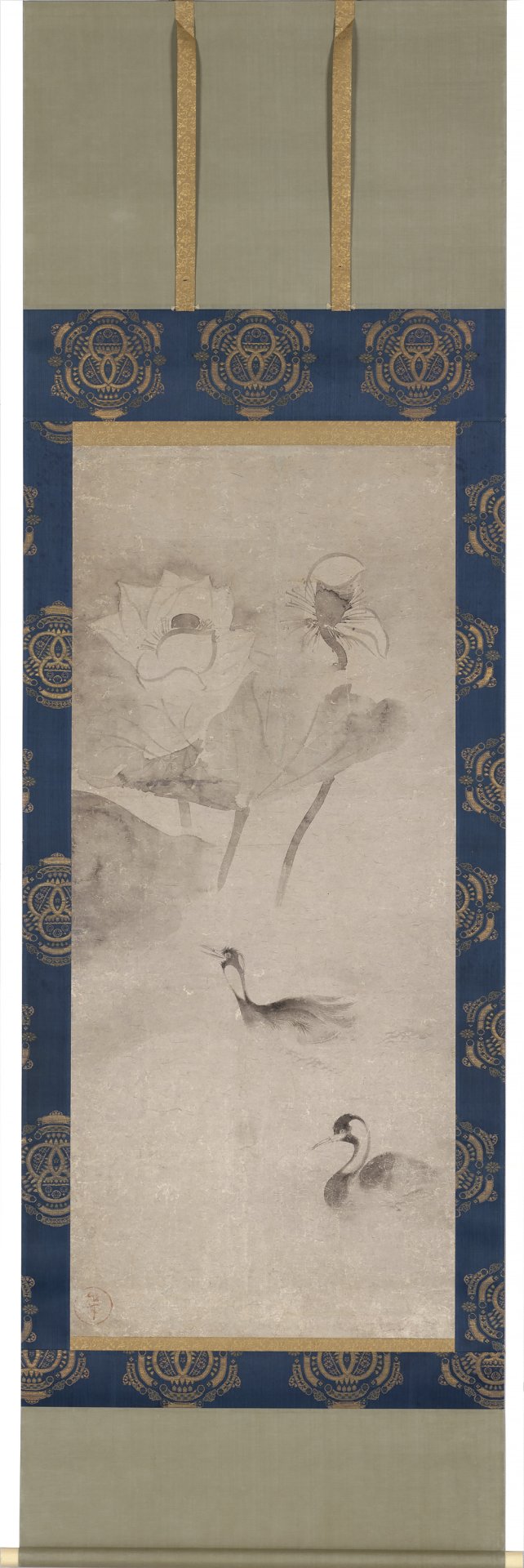
Lotus Pond and Waterfowl in Ink on Paper, by Tawaraya Sōtatsu — A National Treasure of Japanese Ink Painting
Hanging quietly in the hushed galleries of the Kyoto National Museum is a narrow scroll that, at first glance, seems almost too spare to be a masterpiece. Two stems of lotus rise from unseen water. Two small waterbirds glide and rest in ink-washed ripples. No color. No background. No signature — only a small round seal, reading "Inen," tucked into the lower corner. And yet this work, known in Japanese as Renchi Suikin-zu, is regarded as one of the supreme achievements of Japanese ink painting, and since 1964 it has held the nation's highest cultural designation: National Treasure.
The painter was Tawaraya Sōtatsu, an artist whose life is shrouded in mystery but whose creative hand helped shape the course of Japanese art. Best known for his thunderous gold-leaf masterpiece Wind God and Thunder God, Sōtatsu was equally a master of the opposite pole of expression — the stillness and subtlety of monochrome ink. This scroll is where those two worlds meet in their purest form.
Historical Background
Tawaraya Sōtatsu flourished in Kyoto at the turn of the seventeenth century, in the transitional years between the flamboyant Momoyama period and the newly established Edo era. He appears to have run a decorative painting studio called Tawaraya in Kyoto, producing not only masterworks for aristocratic and religious patrons but also designs for fans, textiles, and illustrated books. He was a contemporary and collaborator of the calligrapher Hon'ami Kōetsu, and together they pioneered the elegant, nature-infused aesthetic that would later be called Rinpa.
Although Sōtatsu is most famous today for his dazzling screen paintings rich in gold, silver, and mineral pigments, he was also deeply engaged with the Chinese tradition of ink painting. In the late thirteenth and fourteenth centuries, merchant and monastic networks had carried many Song and Yuan dynasty paintings across the sea to Japan, including decorative compositions of lotus ponds and waterfowl. These Chinese works were treasured by temples and powerful families, and Japanese painters studied them closely. When Sōtatsu turned to this subject, he was entering into a dialogue that spanned centuries and cultures.
Scholars believe this scroll was painted in the early decades of the seventeenth century, likely in the 1610s or 1620s. Because it shows only limited use of the pooled-ink technique known as tarashikomi — a signature innovation associated with Sōtatsu's mature work — it is considered a relatively early but fully accomplished example of his ink painting.
Why It Was Designated a National Treasure
On 26 May 1964, the Japanese government designated Lotus Pond and Waterfowl a National Treasure, recognising it as a work of supreme artistic and historical value. The designation rests on several converging reasons.
First, the painting represents the summit of Sōtatsu's achievements in ink. Among the surviving ink paintings by his hand and workshop, this scroll is universally recognised as the finest — a verdict confirmed by the nineteenth-century painter Sakai Hōitsu, who led the Edo-period revival of Sōtatsu and wrote on the storage box for this very work that it was the "supreme masterpiece" among Sōtatsu's creations.
Second, the scroll marks a decisive moment in the Japanization of ink painting. While continental Chinese compositions of lotus and waterfowl tended toward detailed description and colored ornament, Sōtatsu stripped the subject back to essentials and reimagined it through a sensibility that was unmistakably Japanese: spacious, lyrical, attuned to silence and seasonal change. In doing so, he produced a work that does not merely imitate the Chinese tradition but transforms it.
Third, although the scroll bears only a round red seal reading "Inen" and no signature, the authority of the brushwork, the delicacy of the ink tones, and the sureness of observation leave no doubt among specialists that the painting is by Sōtatsu himself, made at the height of his powers.
Highlights of the Painting
Two Lotuses, Two Moments in Time
The composition shows two stems of lotus rising from a shallow pond. One still carries a white bloom in full flower; the other has already shed its petals and stands as a bare seed pod. In a single glance, the viewer takes in the whole arc of a summer: full bloom and its passing, plenitude and its graceful decline. The curving leaves above and below, one opening upward and one bending down, amplify this quiet meditation on the passage of time.
Two Waterfowl in Dialogue
Gliding among the stems are two little grebes, small diving waterbirds found on Japanese ponds. One paddles forward, trailing gentle ripples as it searches for its next meal. The other rests motionless on the water, tucked in repose. Motion and stillness, pursuit and pause — the two birds mirror the two lotuses, deepening the painting's theme of complementary opposites.
The Magic of Ink Alone
What astonishes visitors is how much emotional atmosphere Sōtatsu conjures from ink alone. The white of the lotus is not painted at all — it is the bare paper, framed by the faint grey of the surrounding wash. The leaves shift from velvety black to pale silver through the gentlest gradations. The water is suggested with a few curving lines. Nothing is laboured, yet everything feels alive.
The "Inen" Seal
In the lower left corner is a small round seal reading "Inen." This mark later became the signature stamp of Sōtatsu's workshop and was impressed on many later paintings by his followers. Among all surviving paintings that bear an "Inen" seal, this scroll is regarded as supreme — the touchstone against which the rest are measured.
Visitor Information
The painting is owned and cared for by the Kyoto National Museum, which sits in the historic Higashiyama district of Kyoto. Because ink paintings on paper are highly sensitive to light, the scroll is not on permanent display; it is exhibited only periodically, usually during specially themed exhibitions. Visitors hoping to see it in person are encouraged to check the museum's official schedule and special exhibition announcements before planning a trip.
The Kyoto National Museum itself is a destination worth visiting at any time. Its galleries are divided between the striking Heisei Chishinkan, designed by Taniguchi Yoshio, and the red-brick Meiji Koto-kan, a turn-of-the-twentieth-century masterpiece of Western-style architecture by Katayama Tōkuma. Beyond the building, the tranquil garden is a pleasant space to rest and contemplate.
General hours are from 9:30 to 17:00, with last admission thirty minutes before closing. The museum is closed on Mondays (the following day if Monday falls on a holiday) and during the New Year period. A general admission fee of 700 yen applies for the permanent "Collection Galleries"; special exhibitions are charged separately. Visitors aged under eighteen or seventy and above are admitted free of charge with proof of age.
The museum is a short walk from Keihan Shichijō Station and a roughly ten-minute bus ride from JR Kyoto Station. For international visitors, the museum provides English labels, an English audio guide, and a multilingual website.
Surrounding Attractions
The Kyoto National Museum stands in one of the richest concentrations of cultural heritage in Japan. Directly across the street rises the long wooden hall of Sanjūsangen-dō, a thirteenth-century temple that houses one thousand and one gilded statues of the bodhisattva Kannon — an unforgettable sight. A short walk north leads to Chishaku-in, a temple famed for its exquisite sliding-door paintings from the Momoyama period, and for a beautiful strolling garden.
Continuing north through the Higashiyama slopes, visitors reach Kiyomizu-dera, perched on its great wooden stage above the city, and the atmospheric stone lanes of Ninen-zaka and Sannen-zaka. To the west, across the Kamo River, the district around Gion offers traditional teahouses, lantern-lit streets, and the possibility of glimpsing a geiko or maiko on her way to an engagement. For those with more time, Fushimi Inari Taisha and its famous vermilion torii gates are only a few train stops away, as is the Tōfuku-ji temple complex, celebrated for its autumn maples.
Q&A
- Is "Lotus Pond and Waterfowl" always on display at the Kyoto National Museum?
- No. Because the scroll is a delicate ink painting on paper, it is shown only occasionally, typically as part of themed special exhibitions. Public viewings have historically occurred every few years. We recommend checking the museum's official exhibition calendar before your visit.
- Who was Tawaraya Sōtatsu?
- Tawaraya Sōtatsu was a painter active in Kyoto in the late sixteenth and early seventeenth centuries. Though his biographical details are largely unknown, he is celebrated as one of the founders of the Rinpa tradition and as the creator of iconic works such as the "Wind God and Thunder God Screens" at Kennin-ji.
- What is "tarashikomi," and is it used in this painting?
- Tarashikomi is a technique in which a second layer of ink or pigment is dropped onto a still-wet first layer, creating soft, pooled gradations. Sōtatsu is famed for developing it. In this scroll, however, the technique is used only sparingly, which is one reason scholars place the work relatively early within his career.
- What does the "Inen" seal mean?
- "Inen" is the reading of the characters on the round red seal in the lower corner. It became something like a workshop hallmark associated with Sōtatsu and his atelier, and was used on many paintings after his time. Among works bearing this seal, Lotus Pond and Waterfowl is regarded as the finest.
- Why are the lotus flowers and seed pods shown together?
- The pairing allows the painting to express two moments of life at once — a bloom at the height of its beauty and a stem whose petals have already fallen — and to echo, in plant form, the contrast between the active and resting birds on the water. The composition becomes a quiet meditation on time, vitality, and repose.
Basic Information
| Official designated name | Shihon bokuga Renchi Suikin-zu (Tawaraya Sōtatsu hitsu) — Lotus Pond and Waterfowl in Ink on Paper, by Tawaraya Sōtatsu |
|---|---|
| Common title | Renchi Suikin-zu (Lotus Pond and Waterfowl) |
| Category | Painting (National Treasure) |
| Artist | Tawaraya Sōtatsu |
| Period | Edo period, early 17th century |
| Technique and support | Ink on paper (one hanging scroll) |
| Dimensions | 116.0 cm (height) × 50.0 cm (width) |
| Seal | Round red "Inen" seal in lower left corner; no signature |
| National Treasure designation | 26 May 1964 |
| Owner | Independent Administrative Institution, National Institutes for Cultural Heritage |
| Current location | Kyoto National Museum, 527 Chayamachi, Higashiyama-ku, Kyoto 605-0931 |
| Access | Approximately 7 minutes on foot from Keihan Shichijō Station; approximately 10 minutes by bus from JR Kyoto Station |
References
- Kyoto National Museum — Masterpiece Collection: Renchi Suikin-zu (Lotus Pond and Waterfowl)
- https://www.kyohaku.go.jp/jp/collection/meihin/kinsei/item03/
- Cultural Heritage Online — Renchi Suikin-zu (Tawaraya Sōtatsu)
- https://bunka.nii.ac.jp/heritages/detail/192373
- e-Museum (National Institutes for Cultural Heritage) — Renchi Suikin-zu
- https://emuseum.nich.go.jp/detail?langId=ja&webView=&content_base_id=100959
- Google Arts & Culture — Waterfowls in Lotus Pond, Tawaraya Sōtatsu
- https://artsandculture.google.com/asset/waterfowls-in-lotus-pond-tawarawa-sōtatsu/AAFaZETh_vA0gw
- Kyoto National Museum — Visitor Information
- https://www.kyohaku.go.jp/jp/visit/info/
Last verified: 2026.04.23