Ink Painting of Hanshan and Shide: A Masterpiece of Early Japanese Suiboku-ga at Tokyo National Museum

Discover the enigmatic Ink Painting of Hanshan and Shide attributed to Kaō, a 14th-century masterwork representing the dawn of Japanese ink painting. Learn about the legendary Zen eccentrics, their spiritual symbolism, and how to experience this registered art treasure at Tokyo National Museum.

Ink Painting of Hanshan and Shide: Encountering Zen's Most Beloved Eccentrics Through 700-Year-Old Brushstrokes

In the hushed galleries of Tokyo National Museum, a pair of hanging scrolls awaits visitors with a story that transcends time, borders, and even the boundaries between the sacred and the absurd. The "Ink Painting of Hanshan and Shide" (紙本墨画寒山拾得図), attributed to the mysterious 14th-century artist Kaō, offers a rare window into the earliest days of Japanese ink painting—and into the hearts of two legendary figures who have captivated Zen practitioners for over a millennium.

Who Were Hanshan and Shide? The Legendary Zen Eccentrics

Before exploring the artwork itself, understanding its subjects is essential. Hanshan (寒山, literally "Cold Mountain") and Shide (拾得, meaning "Foundling" or "Picked Up") were semi-legendary figures said to have lived during China's Tang Dynasty (618-907 CE) at Guoqing Temple on Mount Tiantai in Zhejiang Province.

Hanshan was a reclusive poet who lived in a cave on the mountain, writing verses on rocks, trees, and cliff faces. His poetry blends Buddhist philosophy, Taoist imagery, and sharp social criticism with a disarmingly simple style that has influenced poets for over a thousand years—including the American Beat poet Gary Snyder, who translated his works in the 1950s.

Shide worked as a kitchen helper at the nearby temple, where he would save food scraps in a bamboo tube for his friend Hanshan. The two were inseparable, known for their wild laughter, shabby clothes, and complete disregard for social conventions.

In Buddhist tradition, these seemingly eccentric outcasts are venerated as incarnations of two great bodhisattvas: Hanshan as Mañjuśrī (the Bodhisattva of Wisdom) and Shide as Samantabhadra (the Bodhisattva of Practice). This paradox—enlightened beings manifesting as social misfits—lies at the heart of Zen Buddhism's teachings about transcending appearances.

The Artist: Unraveling the Mystery of Kaō

The painter behind this masterpiece, known as Kaō (可翁), remains an enigmatic figure in Japanese art history. Active during the early to mid-14th century—the Muromachi period—Kaō is considered one of the pioneering figures of Japanese suiboku-ga (水墨画, ink wash painting).

Two main theories surround his identity. Some scholars believe he was the Zen monk Kaō Sōnen (可翁宗然), who served at prestigious temples including Kenninji, Nanzenji, and Kenchōji. Others suggest he was a professional painter from the Takuma school of Buddhist painting, noting that the small seal reading "Nika" (仁賀) beneath the "Kaō" seal uses a character common to Takuma family names.

Regardless of his true identity, Kaō's surviving works—including the National Treasure "Hanshan" (寒山図) and the "Kensui Oshō" (蜆子和尚図) at Tokyo National Museum—demonstrate his mastery of the Chinese ink painting tradition, particularly the styles of Southern Song masters like Muqi and Liang Kai.

Artistic Features and Cultural Significance

This registered art object consists of two hanging scrolls, each measuring approximately 88.7 cm × 34.0 cm. The pair depicts the two legendary figures separately but as complementary images meant to be displayed together.

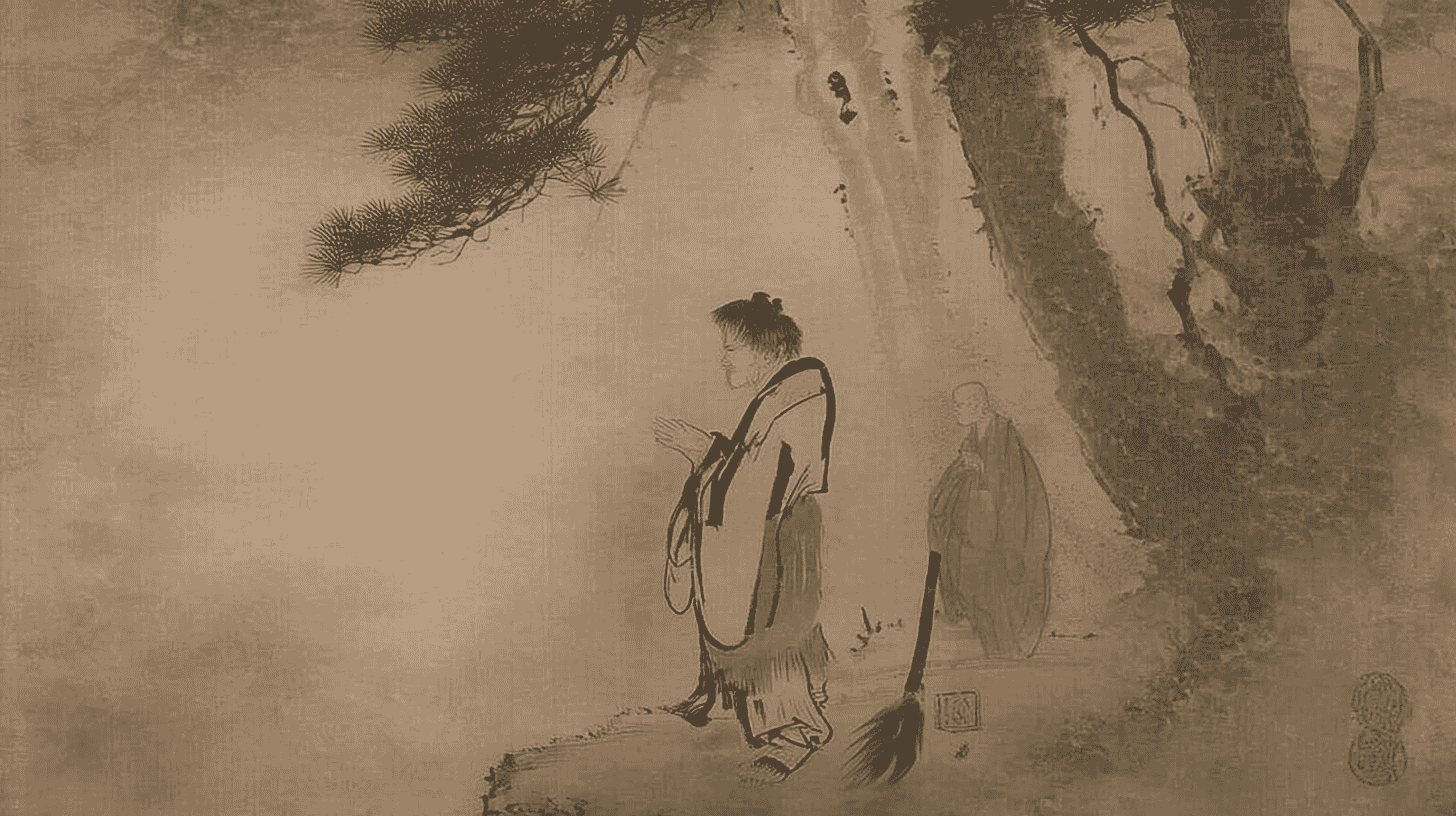
In the Hanshan scroll, the poet stands beneath a cliff, his gaze directed downward at an unrolled scroll in his hands—perhaps containing his own verses or Buddhist wisdom. In the Shide scroll, the kitchen monk stands sideways beneath a tree, his hands with characteristically long fingernails pressed together at his chest, with a broom propped against a rock at lower right—his humble tool of temple service.

The brushwork exemplifies the aesthetic principles that Kaō helped establish in Japan. Both figures wear tattered robes (敝衣蓬髪, heiihōhatsu) rendered with bold, abbreviated strokes in dark ink for the upper garments. The grass skirts, trees, and cliffs employ lighter ink washes with rougher, more spontaneous brushwork. Their faces are drawn with fine lines and accented with subtle shading around the edges (外暈, sotoguma), giving them an almost otherworldly quality.

What makes this work particularly valuable is its place in Japanese art history. It represents the earliest phase of suiboku-ga development in Japan, when artists were first adapting Chinese ink painting techniques to Japanese sensibilities. The composition's simplicity, the psychological intensity of the figures, and the masterful control of ink tonality all demonstrate why Kaō's works became models for generations of subsequent artists.

Why This Artwork Matters: Designation and Historical Value

Designated as a Registered Art Object (登録美術品) by the Japanese government, this painting holds significant importance for several reasons.

First, it provides crucial evidence for understanding the mysterious painter Kaō. Both scrolls bear the vermillion square seals reading "Kaō" and "Nika," connecting them to the larger body of works attributed to this artist. Multiple versions of Kaō's Hanshan-Shide paintings exist, and this work's Shide composition closely resembles the Hanshan figures in both the National Treasure version and the version held at the Freer Gallery of Art in Washington, D.C., suggesting it may preserve an important compositional variant.

Second, the work exemplifies the technical and spiritual achievement of Japan's earliest serious engagement with Chinese literati painting. It demonstrates how Japanese artists absorbed and transformed continental traditions to create something distinctively their own.

Third, as devotional objects in Zen monasteries, such paintings served not merely as decoration but as meditation aids and teaching tools, helping practitioners contemplate the meaning of enlightened freedom beyond worldly concerns.

Viewing Tips: How to Appreciate Ink Painting

For visitors unfamiliar with East Asian ink painting, here are some suggestions for deepening your appreciation of this masterwork.

Take your time. Unlike Western paintings that often reveal their content immediately, ink paintings reward patient observation. Notice how the ink varies from deep black to subtle gray, creating a sense of depth and atmosphere with remarkable economy.

Observe the brushwork. Look for places where the brush moved quickly versus slowly, where it pressed down versus barely touched the paper. Each stroke captures a moment of the artist's concentration and intention.

Consider the empty space. In East Asian aesthetics, what is not painted is as important as what is. The blank areas around the figures aren't emptiness—they're mist, atmosphere, and the infinite space of enlightenment.

Reflect on the paradox. These figures in rags, laughing at the world, are portrayed as embodiments of the highest wisdom. What does this say about the relationship between outward appearance and inner truth?

Visiting Tokyo National Museum

Tokyo National Museum (Tōhaku), located in Ueno Park, is Japan's oldest and largest museum, housing over 120,000 objects including 89 National Treasures. The museum's main building (Honkan) showcases Japanese art chronologically, providing excellent context for understanding works like the Hanshan and Shide painting.

Please note that as with many works on paper, this painting is not on permanent display to preserve it for future generations. The museum rotates its collection regularly, so checking the current exhibition schedule before your visit is recommended.

Nearby Attractions for Art Lovers

Ueno Park offers Japan's greatest concentration of museums and cultural institutions. After visiting Tokyo National Museum, consider exploring the National Museum of Western Art (a UNESCO World Heritage site designed by Le Corbusier), the Tokyo Metropolitan Art Museum, or the National Museum of Nature and Science.

For a deeper Zen experience, the historic temple Kanei-ji, once one of Edo's most powerful Buddhist institutions, is located within the park grounds. The nearby Nezu Shrine, with its spectacular azalea garden, offers a peaceful retreat just a short walk away.

Ueno is also famous as one of Tokyo's best areas for cherry blossom viewing in spring, making it an ideal destination for combining art appreciation with Japan's most beloved seasonal tradition.

📍 Plan Your Visit to Tokyo
Find tours, activities & transport passes near Ink Painting on Paper, Shudoku-Zu
[ Tokyo Skytree Asakusa & teamLab Experiences ]

Q&A

QIs this painting a National Treasure?
AThis particular work is designated as a Registered Art Object (登録美術品), which is a different category from National Treasure. However, Kaō's "Hanshan" (寒山図) at the same museum is designated as a National Treasure. Both works are considered masterpieces of early Japanese ink painting and represent the highest achievements of the artist's oeuvre.
QCan I take photographs of the painting?
APhotography policies vary by exhibition and individual work. Flash photography is generally prohibited to protect artworks. For the General Exhibition (Permanent Collection), non-flash photography is often permitted, but special exhibitions may have different rules. Please check signage at the gallery or ask museum staff for current guidelines.
QWhen can I see this painting?
AWorks on paper and silk are rotated regularly to prevent light damage. The museum typically displays such works for limited periods throughout the year. Check Tokyo National Museum's official website or the Bunka.nii.ac.jp database for current exhibition schedules. You can also inquire directly with the museum about upcoming display periods for specific works.
QAre there English explanations available at the museum?
AYes, Tokyo National Museum provides English translations for many exhibit labels and offers audio guides in multiple languages including English. The museum's official app also provides detailed information in English. Staff members at the information desk can assist with inquiries in English.
QWhere else can I see paintings of Hanshan and Shide?
ATokyo National Museum houses several other Hanshan-Shide paintings, including the famous National Treasure "Zenki-zu" (Scenes of Zen Enlightenment) by the Yuan Dynasty Chinese painter Yintuoluo (因陀羅). The Freer Gallery of Art in Washington, D.C., and the Tokiwayama Bunko in Japan also hold notable Kaō works. In Kyoto, Shōkokuji Temple and the Kyoto National Museum occasionally display related works from their collections.

Basic Information

Official Name 紙本墨画寒山拾得図 (Shihon Bokuga Kanzan Jittoku-zu / Ink Painting of Hanshan and Shide on Paper)
Artist Attributed to Kaō (伝 可翁)
Period Muromachi Period, 14th century
Medium Ink on paper, pair of hanging scrolls
Dimensions Each scroll: approximately 88.7 cm × 34.0 cm
Designation Registered Art Object (登録美術品)
Collection Tokyo National Museum
Museum Address 13-9 Ueno Park, Taito-ku, Tokyo 110-8712, Japan
Museum Hours 9:30 AM - 5:00 PM (Last entry 4:30 PM); Closed Mondays (or following day if Monday is a holiday)
Admission General: ¥1,000 / University students: ¥500 / Under 18 and over 70: Free
Access 10-minute walk from JR Ueno Station (Park Exit) or Uguisudani Station (South Exit); 15-minute walk from Tokyo Metro Ueno Station or Nezu Station

References

紙本墨画寒山拾得図 - 文化遺産オンライン
https://bunka.nii.ac.jp/heritages/detail/300389
可翁 - Wikipedia (Japanese)
https://ja.wikipedia.org/wiki/%E5%8F%AF%E7%BF%81
Hanshan and Shide - Wikipedia
https://en.wikipedia.org/wiki/Hanshan_and_Shide
Hanshan (poet) - Wikipedia
https://en.wikipedia.org/wiki/Hanshan_(poet)
Tokyo National Museum Official Website
https://www.tnm.jp/
国指定文化財等データベース(文化庁)
https://kunishitei.bunka.go.jp/
Kanzan (Hanshan) and Jittoku (Shide) - Asian Art Museum Education
https://education.asianart.org/resources/kanzan-hanshan-and-jittoku-shide-approx-1500-1625/

Last verified: 2026.01.29

Nearby heritages