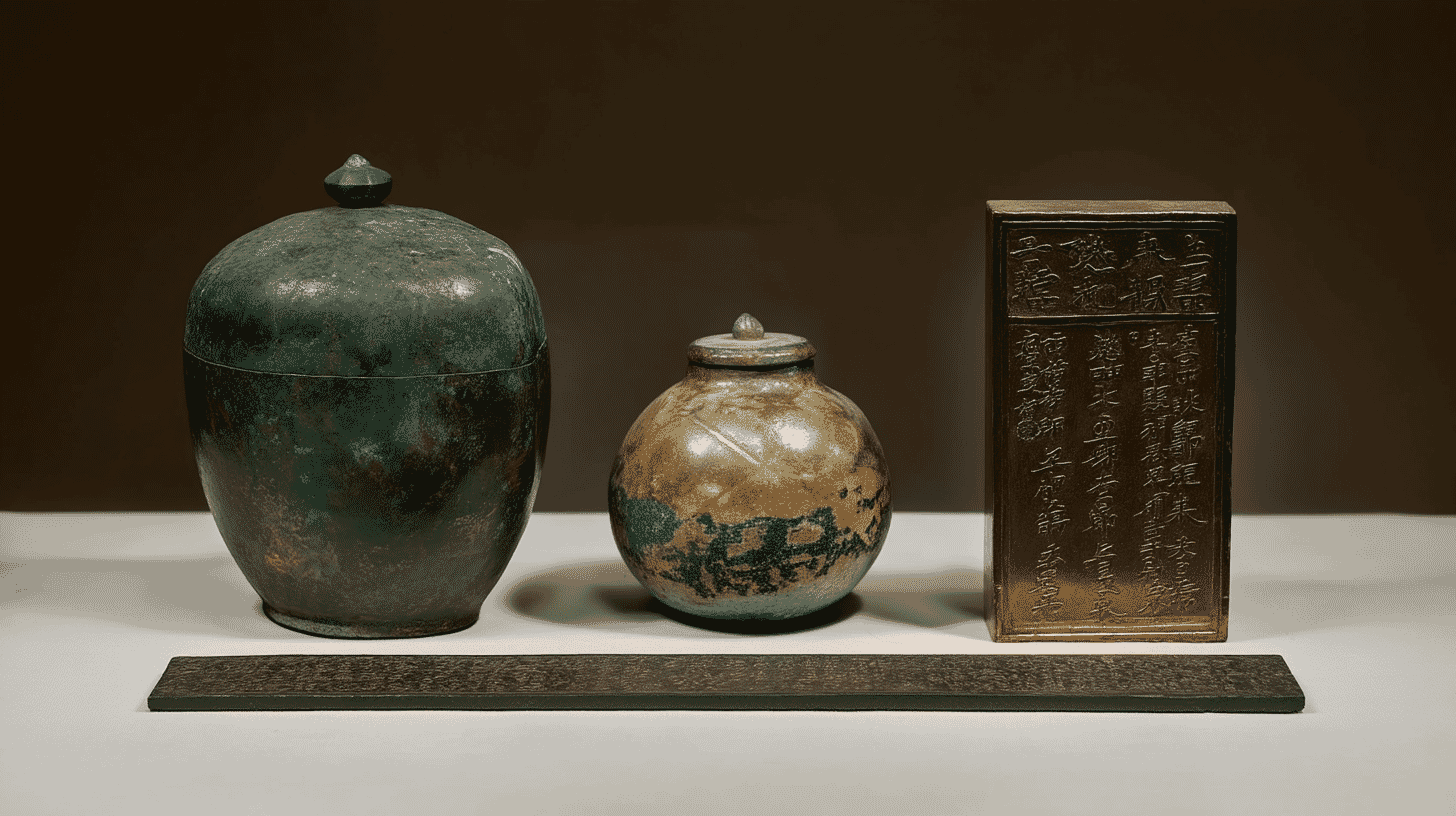
Objects from the Grave of Fumi no Nemaro: A National Treasure Revealing Japan's Earliest Cremation Practices and the Legacy of a Jinshin War Hero

Discover the National Treasure artifacts from the tomb of Fumi no Nemaro, a 7th-century warrior hero of the Jinshin War. This collection at Tokyo National Museum features Japan's oldest dated epitaph, a rare green glass cinerary urn, and gilt-bronze vessels—offering a glimpse into ancient Buddhist burial traditions and immigrant clan culture.

Introduction: Uncovering a Hero's Final Resting Place

In 1831, during the late Edo period, a farmer tilling his field in Yataki Village (present-day Uda City, Nara Prefecture) made an extraordinary discovery that would illuminate one of the most pivotal moments in Japanese history. Buried beneath the soil lay the cremated remains of Fumi no Nemaro, a warrior whose valor during the Jinshin War of 672 helped shape the future of Japan. Today, the artifacts from his tomb—designated as a National Treasure—stand as remarkable testimony to ancient Japan's evolving burial customs, Buddhist influences, and the high status accorded to immigrant clan warriors who served the imperial court.

The Objects from the Grave of Fumi no Nemaro represent far more than archaeological curiosities. They offer a tangible connection to a man whose name appears in Japan's most venerable historical records, the Nihon Shoki and Shoku Nihongi, and whose tomb provides the earliest reliably dated example of an epitaph accompanying cremated remains in Japan.

Who Was Fumi no Nemaro? A Warrior of Immigrant Heritage

Fumi no Nemaro belonged to the Kawachi no Fumi clan, an immigrant family (toraijin) that traced its lineage to Wang In (Wani), a scholar who came to Japan from the Korean kingdom of Baekje during the reign of Emperor Ōjin in the late 4th or early 5th century. The Fumi clan established themselves in the Furuichi district of Kawachi Province (present-day Habikino City, Osaka Prefecture) and served the Yamato court primarily through their expertise in writing and scholarship.

Unlike many of his clan members who devoted themselves to literary pursuits, Fumi no Nemaro distinguished himself as a military commander. When the Jinshin War erupted in 672—a conflict that would determine the succession to the Japanese throne—Nemaro proved his loyalty and martial prowess as one of Prince Ōama's most trusted retainers.

The Jinshin War: Japan's Greatest Ancient Civil Conflict

The Jinshin War of 672 stands as the largest internal conflict in ancient Japanese history. Following the death of Emperor Tenji, a succession dispute arose between his son Prince Ōtomo and his brother Prince Ōama. Although Tenji had initially designated Ōama as his successor, he later favored his son, prompting Ōama to retire to Yoshino Palace and announce his intention to become a monk.

However, when Tenji died and Ōtomo claimed the throne, Prince Ōama raised an army and launched a military campaign to seize power. Fumi no Nemaro was among the approximately 20 servants who accompanied Ōama on his flight eastward to Mino Province, where the prince gathered his forces.

Nemaro was appointed as one of the generals leading the invasion of Ōmi Province, where Prince Ōtomo had established his palace. Through a series of victories at battles including Okinaga-no-Yokokawa River, Tokono-yama Mountain, and Yasunokawa-hama Shore, Nemaro's forces advanced relentlessly. The decisive battle at Seta on the 23rd day of the seventh month resulted in complete victory for Prince Ōama's forces, leading to Prince Ōtomo's suicide the following day.

Prince Ōama subsequently became Emperor Tenmu, one of Japan's most influential rulers who significantly strengthened imperial authority. For his distinguished service, Fumi no Nemaro was eventually promoted to the rank of Junior Fourth Rank Lower Grade (Jushii-ge) during his lifetime, and posthumously elevated to Upper Senior Fourth Rank (Shōshii-jō)—an exceptional honor recorded on his epitaph.

The Discovery: A Farmer's Remarkable Find

The circumstances of the tomb's discovery in 1831 (Tenpō 2) are remarkably well-documented through official records kept by the local magistrate's office. As a farmer worked the fields in Yataki Village in Uda County, Yamato Province, his tools struck something unusual buried in the earth.

What emerged was an assemblage of artifacts that had lain undisturbed for over 1,100 years. A copper box contained a bronze epitaph plaque inscribed with the identity and rank of the deceased. Nearby, a gilt-bronze urn was discovered, and within it lay a translucent green glass vessel containing the cremated remains of Fumi no Nemaro. Surrounding both the copper box and the gilt-bronze urn was a large quantity of charcoal—a method used in ancient times to protect burial goods from moisture and decay.

Following their discovery, the artifacts were placed in the local Ryūsen-ji Temple for safekeeping. In 1952, they were collectively designated as a National Treasure, recognizing their extraordinary historical and cultural significance. The collection is now preserved at the Tokyo National Museum, where visitors can view these treasures that bridge the gap between legend and archaeology.

The Artifacts: Components of the National Treasure

The Epitaph (Boshi)

The epitaph is a cast bronze plaque bearing an inscription that reads: "General of the Jinshin Year, Commander of the Guards Department of the Left, Upper Senior Fourth Rank, Fumi no Nemaro. Died on the twenty-first day of the ninth month of Keiun 4 [707] in the junior fire-sheep year."

This epitaph holds immense historical significance as the oldest reliably dated example of an epitaph accompanying cremated remains in Japan. The practice of placing epitaphs in tombs came to Japan from China and Korea along with Buddhism, and this artifact provides crucial evidence of how these continental customs were adopted by Japanese elites in the early 8th century.

The Green Glass Cinerary Urn (Midori Ruri Tsubo)

Perhaps the most visually striking component of the collection is the green glass (midori ruri) cinerary urn that held Nemaro's cremated remains. Glass was an extremely precious material in 8th-century Japan, and its use as a bone container was exceptionally rare. The urn features a flat bottom and a lid topped with a jewel-shaped (hōju-gata) knob, echoing Buddhist reliquary designs.

The use of such a valuable material for containing human remains reflects the high status Nemaro achieved through his military service. Glass vessels of this quality were typically imported from the Asian continent or produced by skilled craftsmen working for the imperial court.

The Gilt-Bronze Outer Container (Kondō Tsubo)

The gilt-bronze urn served as an outer container for the glass vessel. It features a body with a low pedestal base and a lid crowned with a jewel-shaped knob similar to the inner vessel. Inside this urn, traces of cloth were found—remnants of the fabric used to wrap the glass cinerary urn before placing it in its protective outer container.

This nested arrangement—glass vessel wrapped in cloth, placed within a metal container—mirrors the traditional method of enshrining Buddhist relics (sharira), the sacred remains of Shakyamuni Buddha. The adoption of this practice for human burial demonstrates the profound influence of Buddhism on Japanese funerary customs during the Asuka and Nara periods.

Why This Collection Became a National Treasure

The Objects from the Grave of Fumi no Nemaro were designated as a National Treasure for several compelling reasons that extend beyond their aesthetic beauty.

First, the epitaph provides the oldest securely dated example of a tomb inscription accompanying cremated remains in Japan. Only 16 ancient epitaphs have been discovered throughout Japan, making this an exceptionally rare category of artifact. The clear date inscription allows historians to precisely place these objects within Japan's historical timeline.

Second, the green glass cinerary urn represents an extraordinarily rare use of this precious material for burial purposes. Such vessels demonstrate the highest level of craftsmanship and the elite status of those who could afford them.

Third, the complete set of burial objects—epitaph, glass urn, gilt-bronze container, and the documented presence of charcoal—provides an unparalleled window into Buddhist-influenced burial practices during the transition from the Asuka to the Nara period.

Finally, the documented connection to a historical figure mentioned in Japan's official chronicles adds incalculable value. These artifacts transform Fumi no Nemaro from a name in ancient texts into a tangible presence whose life, service, and death can be studied and appreciated.

Cultural Significance: Buddhism and Cremation in Ancient Japan

The practice of cremation arrived in Japan alongside Buddhism in the mid-6th century. Before this, the predominant burial practice was interment in tumuli (kofun), massive earthen mounds that characterized the preceding Kofun period. The adoption of cremation represented a dramatic shift in Japanese attitudes toward death and the body, influenced by Buddhist teachings about impermanence and the release of the spirit.

The fact that Fumi no Nemaro, a member of an immigrant clan with roots in the Korean Peninsula, was cremated and buried according to these Buddhist practices is significant. Immigrant clans often served as conduits for advanced continental technologies and religious practices, and Nemaro's burial demonstrates that by the early 8th century, cremation had been embraced by influential figures closely connected to the imperial court.

The treatment of Nemaro's remains—placing them in a glass vessel, wrapping the vessel in cloth, and enclosing it in a bronze container—directly parallels the Buddhist practice of enshrining sharira (relics of the Buddha). This suggests that Nemaro, or those who arranged his burial, wished to accord him honor comparable to that given to sacred Buddhist relics.

Visiting the Collection at Tokyo National Museum

The Objects from the Grave of Fumi no Nemaro are preserved at the Tokyo National Museum, Japan's oldest and largest museum dedicated to art and archaeology. The museum is located in Ueno Park in Tokyo's Taitō ward, easily accessible from several major train stations.

The archaeological artifacts are typically displayed in the Heiseikan building, which houses the Japanese Archaeology Gallery on its first floor. This gallery presents artifacts from Japanese prehistory through the medieval period, offering context for understanding the significance of Nemaro's burial goods within the broader sweep of Japanese history.

Please note that as National Treasures, these objects may not always be on display. Museum collections rotate regularly, and some items may be in storage for conservation purposes or on loan to other institutions. It is advisable to check the Tokyo National Museum's website or contact the museum directly before your visit if you specifically wish to see these artifacts.

Nearby Attractions

A visit to the Tokyo National Museum can easily be combined with exploration of Ueno Park and its many cultural institutions. The park is home to several other major museums, including the National Museum of Western Art (a UNESCO World Heritage Site designed by Le Corbusier), the National Museum of Nature and Science, and the Ueno Royal Museum.

Ueno Park also contains the beautiful Shinobazu Pond with its lotus flowers (spectacular in summer), Ueno Zoo (Japan's oldest zoo), and several historic temples and shrines including Kaneiji Temple and Ueno Toshogu Shrine. The park itself offers lovely walking paths and seasonal cherry blossoms that draw visitors from around the world each spring.

For those interested in following Fumi no Nemaro's story to its source, the original tomb site is located in the Haibara district of Uda City, Nara Prefecture. While there are no visible remains of the tomb today, the surrounding area offers beautiful rural Japanese scenery and is part of the historic Yamato region where much of early Japanese history unfolded.

📍 Plan Your Visit to Tokyo
Find tours, activities & transport passes near Items Excavated from Bunnemaro Tomb
[ Tokyo Skytree Asakusa & teamLab Experiences ]

Q&A

QWhat makes the epitaph from Fumi no Nemaro's tomb so historically significant?
AThe epitaph is the oldest reliably dated example of a tomb inscription accompanying cremated remains in Japan. Only 16 ancient epitaphs have been discovered in all of Japan, making this an exceptionally rare artifact. The clear date of 707 CE allows precise historical placement, and its detailed inscription provides information about Nemaro's military rank and service during the Jinshin War.
QWhy was a glass vessel used for the cremated remains?
AGlass was an extremely precious and rare material in 8th-century Japan. Using a green glass (midori ruri) vessel for bone storage was exceptionally uncommon and signified the deceased's high status. The use of such valuable materials reflected Nemaro's importance as a war hero and his posthumous elevation to Upper Senior Fourth Rank by the imperial court.
QCan I visit the original tomb site in Nara Prefecture?
AThe original tomb was located in what is now the Haibara Yataki area of Uda City, Nara Prefecture. However, after the artifacts were discovered in 1831, the tomb was refilled and there are no visible remains today. The artifacts themselves are all preserved at the Tokyo National Museum.
QWho were the Kawachi no Fumi clan?
AThe Kawachi no Fumi clan was an immigrant (toraijin) family who claimed descent from Wang In (Wani), a scholar from the Korean kingdom of Baekje. They settled in Kawachi Province (present-day Osaka) and traditionally served the Yamato court through literary and administrative work. Fumi no Nemaro was notable for distinguishing himself in military service rather than scholarly pursuits.
QAre these artifacts always on display at Tokyo National Museum?
AAs National Treasures, these objects are subject to careful conservation practices and may not always be on permanent display. Museum collections rotate regularly, and items may be in storage or on loan. It is recommended to check the museum's website or contact them directly before visiting if you specifically wish to see these artifacts.

Basic Information

Designation National Treasure (designated 1952)
Official Name Objects from the Grave of Fumi no Nemaro (文祢麻呂墓出土品)
Date Nara Period, Keiun 4 (707 CE)
Discovery Site Yataki, Haibara, Uda City, Nara Prefecture (formerly Yataki Village, Uda County, Yamato Province)
Discovery Date 1831 (Tenpō 2)
Components Bronze epitaph plaque, green glass cinerary urn with lid, gilt-bronze outer container with lid
Epitaph Dimensions Length: 26.2 cm
Collection Tokyo National Museum (Inventory: J-39201 to J-39203)
Display Location Heiseikan, Japanese Archaeology Gallery (when on display)
Museum Address 13-9 Ueno Park, Taito-ku, Tokyo 110-8712, Japan
Museum Hours 9:30 AM - 5:00 PM (until 9:00 PM on Fridays and Saturdays); closed Mondays
Admission General: 1,000 yen; University students: 500 yen; Under 18 and over 70: Free
Access 10-minute walk from JR Ueno Station (Park Exit) or Uguisudani Station (South Exit)

References

e-Museum: Objects from the Grave of Fumi no Nemaro (National Institutes for Cultural Heritage)
https://emuseum.nich.go.jp/detail?langId=en&content_base_id=100202&content_part_id=0&content_pict_id=0
Cultural Heritage Online: Epitaph of Fumi no Nemaro (Agency for Cultural Affairs)
https://bunka.nii.ac.jp/heritages/detail/540371
Cultural Heritage Online: Green Glass Cinerary Urn (Agency for Cultural Affairs)
https://bunka.nii.ac.jp/heritages/detail/528300
Wikipedia: Fumi no Nemaro
https://en.wikipedia.org/wiki/Fumi_no_Nemaro
Tokyo National Museum: Cinerary Urn Collection Information
https://www.tnm.jp/modules/r_collection/index.php?controller=dtl&colid=B2068X
Tokyo National Museum: Visitor Information
https://www.tnm.jp/modules/r_free_page/index.php?id=113&lang=en

Last verified: 2026.01.28

Nearby heritages