
One Hanging Scroll, an Important Cultural Property since 2006
Kasuga Fudarakusan Mandala (Color on Silk) (絹本著色春日補陀落山曼荼羅図, Kenpon Chakushoku Kasuga Fudarakusen Mandara Zu) is a Kamakura-period painting at 6-5-1 Minami-Aoyama, Minato Ward, Tokyo, designated an Important Cultural Property on 9 June 2006. The quantity is one hanging scroll and the owner is the Nezu Museum, a public-interest foundation.
A listing in 2006 is among the most recent encountered here, after Manpukuji in 2024 and Yasaka Shrine in 2020.
The record is correspondingly full, in keeping with the pattern seen so far that later listings carry fuller records.
Two Records for One Scroll
Cultural Heritage Online carries two records for this work: one drawn from the Agency's national database, the other supplied by the Nezu Museum, which holds it.
The two treat the same scroll but write about different things.
The Agency's record sets out the religious background. In the early Kamakura period at Nara, devotion to Kannon was promoted around the monk Jokei, and this appears to have merged with worship of the four Kasuga deities, whose original Buddhist form is the eleven-headed Kannon.
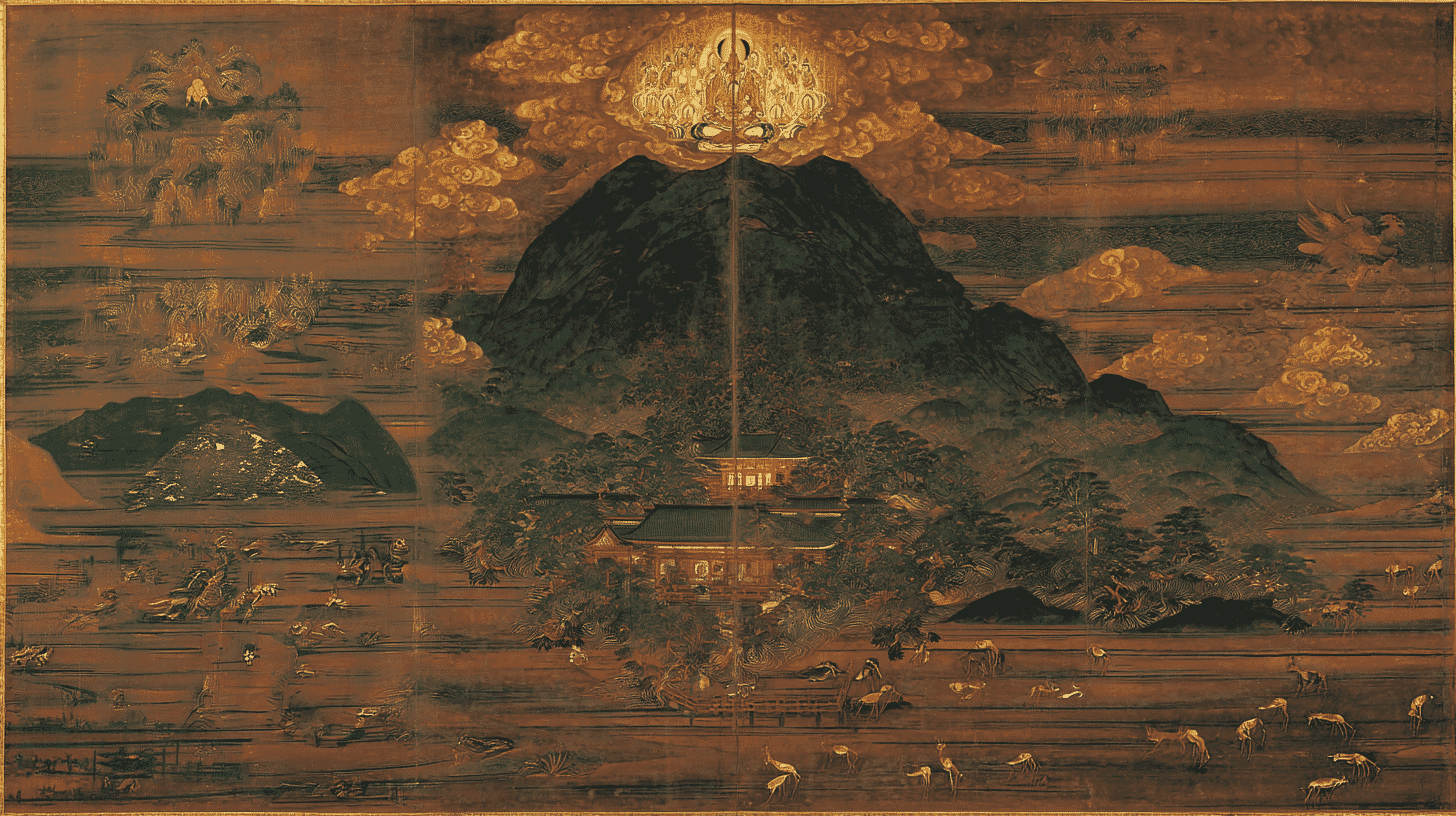
The museum's record sets out the detail of the picture. On the mountain of the pure land, surrounded on four sides by sea, halls and boats and figures appear at the foot, while arhats sit in meditation and lions roam on its slopes.
One carries what the work was made against; the other carries what the work shows. Both must be read for the whole.
Only the Museum's Record Gives Dimensions
The difference extends to measurements.
The Agency's record gives no dimensions. The museum's record gives color on silk, 98.8 centimetres by 55.0 centimetres.
Among the properties covered here, the Agency's records have often carried no dimensions. This is a clear instance of a holding institution's record filling that gap.
With the Choju Jinbutsu Giga, a detached fragment's record held the dimensions, and with the Saigyo scrolls the fragments' record gave measurements section by section. Both of those were records for different properties. Here two records stand for one and the same scroll.
The composition runs in two registers: below, the Kasuga shrine and Mount Mikasa taken as one, in the usual manner of Kasuga shrine mandalas; above, beyond a band of drifting mist, the pure land mountain. At its summit the eleven-headed Kannon sits with one leg pendant, rendered wholly in gold and casting a golden light.
Without Parallel, on the Museum's Authority
The words of assessment differ between the two records as well.
The Agency's record calls it precious as a product of such devotion, placing it within the history of belief.
The museum's record calls it precious as a work without parallel, placing it against other works.
Where earlier articles found claims of the oldest or the only in old texts, the Agency's records usually held nothing of the kind. Here the claim of no parallel does stand in the record, but it is the museum's, not the Agency's.
Which record an assessment comes from matters in a case like this. The museum's record also says that the astonishingly fine detail was presumably matched to aristocratic taste of the day. Presumably: an inference. The Agency's record likewise writes appears to have merged.
Seeing It
The scroll is at 6-5-1 Minami-Aoyama, Minato Ward, Tokyo, owned by the Nezu Museum. It is a museum holding, not an object kept on permanent display.
Paintings are vulnerable to light and are usually shown only for short periods. Being a single scroll, the whole of it can be seen when shown.
At 98.8 centimetres by 55.0 centimetres it is not a large hanging scroll. Seeing the fine detail calls for standing close.
Exhibition plans can change, so check the museum's information before travelling.
Q&A
- When was the scroll designated?
- On 9 June 2006, as an Important Cultural Property. The quantity is one hanging scroll, the address 6-5-1 Minami-Aoyama, Minato Ward, Tokyo, and the owner the Nezu Museum.
- Why are there two records?
- Cultural Heritage Online carries one record from the Agency's national database and another supplied by the Nezu Museum. The first sets out the religious background, the second the detail of the picture and its dimensions, so the two complement each other.
- What does it show?
- The Agency records the eleven-headed Kannon on the pure land mountain in the upper half and the Kasuga shrine precinct below. The museum's record adds halls, boats and figures at the mountain's foot and arhats and lions on its slopes.
- What size is it?
- The museum's record gives 98.8 centimetres by 55.0 centimetres. The Agency's record gives no dimensions.
- Is it a work without parallel?
- The museum's record says so. The Agency's record does not; it calls the work precious as a product of such devotion. Which record an assessment comes from needs to be kept clear.
Basic Information
| Name | Kasuga Fudarakusan Mandala, Color on Silk (絹本著色春日補陀落山曼荼羅図, Kenpon Chakushoku Kasuga Fudarakusen Mandara Zu) |
|---|---|
| Location | 6-5-1 Minami-Aoyama, Minato Ward, Tokyo |
| Designation | Important Cultural Property |
| Year Designated | 2006 (9 June), Important Cultural Property |
| Quantity | 1 hanging scroll |
| Dimensions | By the museum's record, color on silk, 98.8 centimetres by 55.0 centimetres; the Agency's record gives no dimensions. The eleven-headed Kannon on the pure land mountain occupies the upper half and the Kasuga shrine precinct the lower. Kamakura period |
| Owner | Nezu Museum |
| Public Access | A museum holding, not on permanent display. Paintings are vulnerable to light and shown only briefly |
References
- Cultural Heritage Online: Kasuga Fudarakusan Mandala, the Agency's record
- https://bunka.nii.ac.jp/heritages/detail/171331
- Cultural Heritage Online: Kasuga Fudarakusan Mandala, the museum's record
- https://bunka.nii.ac.jp/heritages/detail/146504
- Nezu Museum official site
- https://www.nezu-muse.or.jp/
- Agency for Cultural Affairs, National Cultural Properties Database
- https://kunishitei.bunka.go.jp/
Last verified: 2026.09.05