
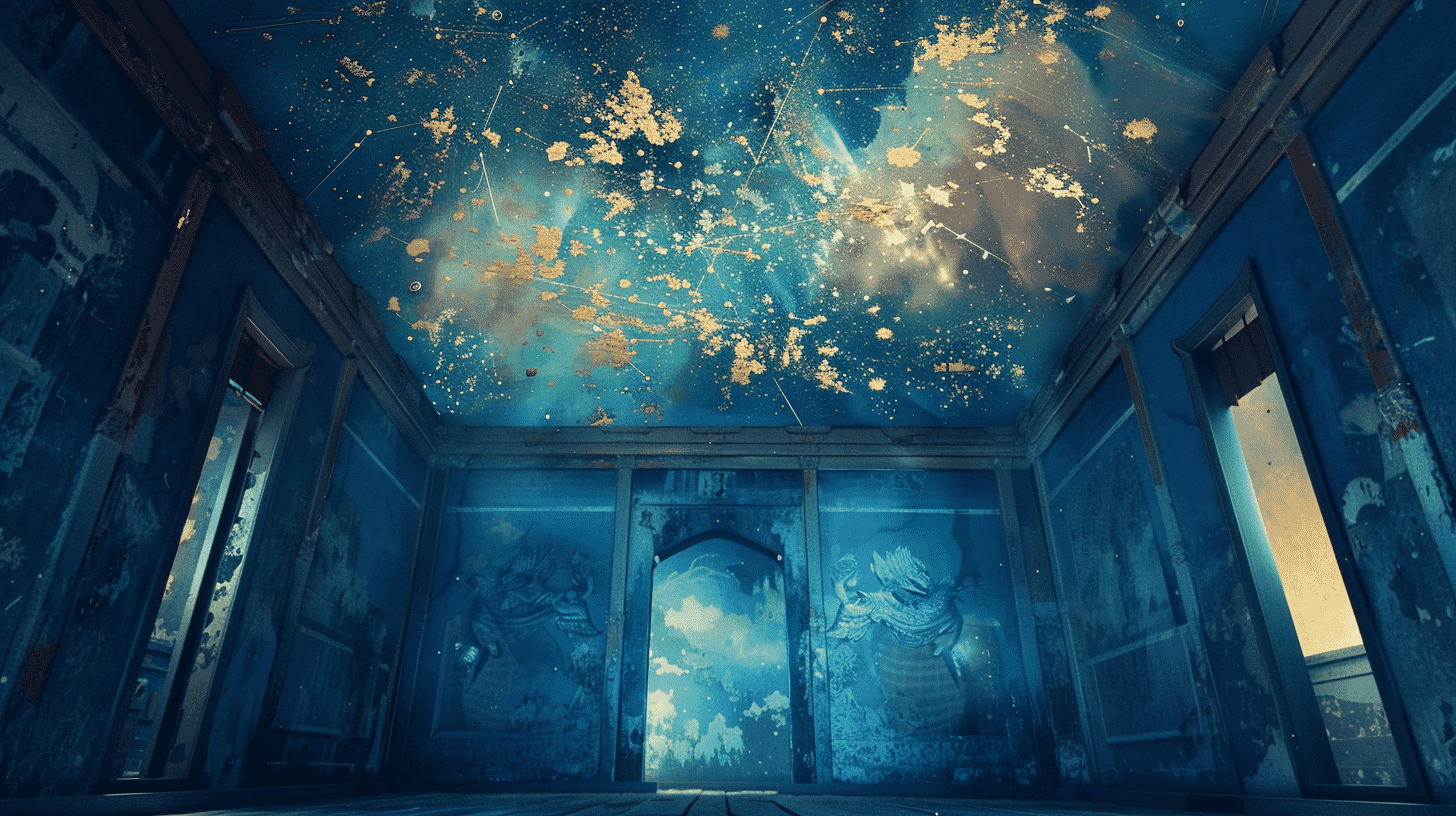
Five Asuka-Period Murals, National Treasure since 2019
The Kitora Tomb Murals (キトラ古墳壁画, Kitora Kofun Hekiga) are the wall paintings from the stone chamber of the Kitora tomb at Asuka Village, Takaichi District, Nara Prefecture, designated a National Treasure in 2019, on 23 July. They had become an Important Cultural Property on 31 October 2018. Five surfaces hold that status: the east, west, south and north walls and the ceiling. They belong to the state, under the Ministry of Education.
They were painted in the late seventh or early eighth century, in the Asuka period. The Nara National Research Institute for Cultural Properties notes that few Asuka-period paintings survive, and that among tomb murals with continental imagery only two have been found: those of Kitora and those of the Takamatsuzuka tomb.
Two grounds were given. The Kitora murals preserve in good condition the image of the vermilion bird, which is lost at Takamatsuzuka. And the star chart on the ceiling is valuable as the oldest example in East Asia. On these grounds the murals were held, with those of Takamatsuzuka, indispensable for the study of early Japanese painting.
On 26 July 2026 the Kitora tomb was inscribed as a component of the World Heritage site Ancient Capitals of Asuka and Fujiwara, Japan's twenty-seventh World Heritage property.
The Only Set of Four Guardians That Survives Complete
The four guardians are the divine beasts of the four quarters of heaven, and the paintings place each on the wall of its own direction: the azure dragon on the east, the vermilion bird on the south, the white tiger on the west and the black warrior on the north.
At Takamatsuzuka the vermilion bird on the south wall was lost to grave robbing. The Kitora murals are therefore the only set in Japan in which all four guardians survive, and the Agency for Cultural Affairs records this as the first such case in the country.
Below the guardians are the twelve zodiac figures, beast-headed and human-bodied, set three to a wall by direction, running clockwise from the rat at the centre of the north wall. Six can now be identified: rat, ox, tiger, horse, dog and boar. Half of the twelve are gone, and that is worth keeping in view alongside the completeness of the guardians.
The Star Chart: Equator and Ecliptic
The ceiling carries a star chart, with the sun in gold leaf to the east and the moon in silver leaf to the west.
The Nara institute records that the chart carries circles marking the equator and the ecliptic, and that as a full Chinese-style star map it can be called the oldest surviving example in the world. Three concentric circles, the inner limit, the equator and the outer limit, are drawn with the ecliptic, and constellations including the Big Dipper are set within them.
The stars number 277 in all. The chart follows the Chinese system while placing the northern stars according to observation, with correction for latitude. That it records observation rather than ornament is where its value lies.
The Agency's own wording is the oldest surviving example in East Asia; the phrase oldest in the world comes from the institute with the qualification as a full Chinese-style star map. The two are worth reading apart.
Murals Cut from the Chamber
The paintings are no longer inside the tomb.
Investigation began after the black warrior was found in the chamber on 7 November 1983, but once the tomb was opened, damp brought mould and the paintings began to alter. It was decided to detach and conserve them, and from August 2004 the Agency for Cultural Affairs removed them in order of damage.
The detached paintings are held at the Kitora Tomb Mural Experience Hall, the Shijin no Yakata, beside the mound, under strictly controlled temperature and humidity. The paintings are separated from the tomb and kept in a different building; that is the present state of their conservation.
The Kitora tomb itself is a round mound in two tiers, the upper 9.4 metres across and the terraced lower tier 13.8 metres, the two together estimated at somewhat over 4 metres high. It was designated a Historic Site and then a Special Historic Site in 2000.
Visiting
The Shijin no Yakata is free to enter and presents the guardians, the star chart and the zodiac through a full-size model of the chamber, reproductions and video. This is what an ordinary visit shows.
The paintings themselves are shown only during special openings run by the Agency for Cultural Affairs. Application procedures and charges change with each opening, so check the Agency's official pages for current information. Openings are held several times a year and the surfaces shown differ between them.
The Takamatsuzuka tomb lies in the same village. Kitora has the complete four guardians, the star chart and the zodiac; Takamatsuzuka has its groups of male and female figures and has lost its vermilion bird. What can be seen differs, so visiting both shows the range of painted tombs.
From Tsubosakayama Station on the Kintetsu Yoshino Line it is about 15 minutes on foot, within the Kitora district of the Asuka Historical National Government Park.
Q&A
- When were the Kitora Tomb Murals designated?
- They became an Important Cultural Property on 31 October 2018 and a National Treasure in 2019, on 23 July. Five surfaces hold that status: the east, west, south and north walls and the ceiling. They were painted in the late seventh or early eighth century, in the Asuka period.
- Why were they designated?
- Because the image of the vermilion bird, lost at Takamatsuzuka, survives here in good condition, and because the ceiling star chart is the oldest example in East Asia. Only two tomb murals with continental imagery have been found in Japan, and these were held indispensable for the study of early Japanese painting.
- How are the guardians and the zodiac painted?
- The azure dragon on the east, the vermilion bird on the south, the white tiger on the west and the black warrior on the north, each on the wall of its own direction. Kitora is the only set in Japan where all four survive. Below them run the twelve zodiac figures, three to a wall; six can now be identified.
- What is the star chart?
- Three concentric circles with the ecliptic, constellations including the Big Dipper set within, and 277 stars in all, with the sun in gold leaf to the east and the moon in silver to the west. The Agency for Cultural Affairs calls it the oldest surviving example in East Asia; the Nara institute calls it the oldest in the world as a full Chinese-style star map.
- Can the murals be seen?
- They were detached from 2004 because of mould and are held at the Shijin no Yakata. The originals are shown only during special openings run by the Agency for Cultural Affairs, with procedures and charges changing each time, so check the official pages. The hall itself is free and shows a full-size model and reproductions.
Basic Information
| Name | Kitora Tomb Murals (キトラ古墳壁画, Kitora Kofun Hekiga) |
|---|---|
| Location | Abeyama, Asuka Village, Takaichi District, Nara Prefecture (Kitora Tomb Mural Experience Hall, Shijin no Yakata) |
| Designation | National Treasure (painting); the Kitora tomb is a Special Historic Site; component of the World Heritage site Ancient Capitals of Asuka and Fujiwara |
| Year Designated | 2018 (31 October), Important Cultural Property; 2019 (23 July), National Treasure; 2026 (26 July), World Heritage inscription |
| Quantity | 5 surfaces (east, west, south and north walls and the ceiling) |
| Dimensions | Four guardians placed by direction, with beast-headed zodiac figures 3 to a wall below them. Ceiling star chart with 3 concentric circles and the ecliptic, 277 stars. Sun in gold leaf to the east, moon in silver to the west. Late 7th to early 8th century |
| Owner | The state, under the Ministry of Education |
| Public Access | Originals shown only during special openings run by the Agency for Cultural Affairs. The Shijin no Yakata is free and displays a full-size model and reproductions |
References
- Agency for Cultural Affairs: outline of the Kitora tomb
- https://www.bunka.go.jp/seisaku/bunkazai/takamatsu_kitora/kitora_gaiyo.html
- Nara National Research Institute for Cultural Properties: Shijin no Yakata
- https://www.nabunken.go.jp/shijin/about/
- Agency for Cultural Affairs: public showings of the Kitora Tomb Murals
- https://www.bunka.go.jp/seisaku/bunkazai/takamatsu_kitora/kitora_kokai/
- Asuka Historical National Government Park: the Kitora tomb
- https://www.asuka-park.jp/area/kitora/tumulus/
Last verified: 2026.09.03