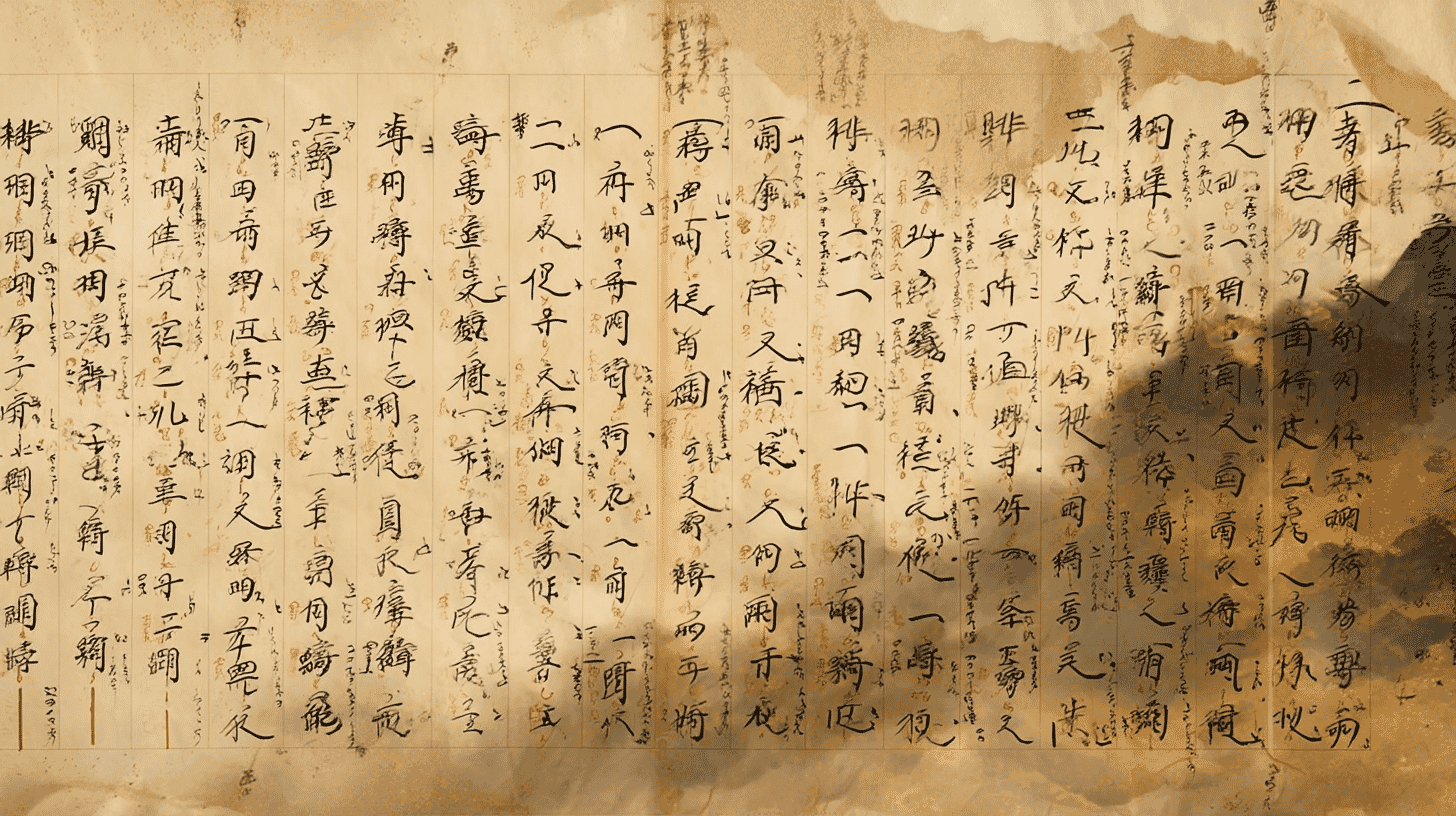
Nihon Shoki Jindaikan: The Sacred Manuscript That Tells Japan's Origin Story
Deep within the climate-controlled galleries of the Kyoto National Museum lies one of Japan's most precious cultural treasures—the Nihon Shoki Jindaikan (日本書紀神代巻), a handwritten manuscript from the Kamakura period (1185–1333) that preserves the mythological origins of Japan itself. This National Treasure is not merely an ancient document; it is the living repository of stories that shaped Japanese identity, Shinto religion, and the imperial lineage for over a millennium.
The Jindaikan, meaning "The Age of the Gods Volumes," comprises the first two chapters of the Nihon Shoki (Chronicles of Japan), Japan's oldest official history completed in 720 CE. Within these pages, visitors can encounter the divine couple Izanagi and Izanami creating the Japanese islands, the dramatic birth of the Sun Goddess Amaterasu, and the mythological foundation upon which Japan's cultural heritage rests.
What is the Nihon Shoki?
The Nihon Shoki, also known as the Nihongi or "Chronicles of Japan," is the second-oldest book of classical Japanese history and the first official history commissioned by the imperial court. Completed in 720 CE under the editorial supervision of Prince Toneri, this monumental work consists of 30 volumes spanning from the mythological creation of the world to the reign of Empress Jitō in 697 CE.
Unlike the Kojiki (compiled in 712 CE), which was written primarily for domestic consumption using a mixture of Chinese characters and phonetic Japanese, the Nihon Shoki was composed entirely in classical Chinese—the scholarly lingua franca of East Asia at the time. This deliberate choice reflected the court's ambition to present Japan's history on the international stage, creating a chronicle worthy of comparison with the great dynastic histories of China.
The first two volumes, known collectively as the Jindaikan or "Age of the Gods Volumes," hold special significance. These chapters transcend mere historical record-keeping, presenting instead the sacred mythology that explains how the Japanese islands came into being, how the gods (kami) established the natural and spiritual order, and how the imperial family traces its lineage directly to the Sun Goddess Amaterasu.
The Yoshida-bon: A National Treasure Manuscript
The particular manuscript designated as a National Treasure and housed at the Kyoto National Museum is known as the "Yoshida-bon" (吉田本) or "Kōan-bon" (弘安本). This exquisite copy was handwritten by Urabe Kanekata, a scholar from the Urabe family who served as hereditary diviners at shrines throughout Japan.
According to the colophon (closing notes) in the lower volume, Kanekata completed his "reverse-side annotations" in the spring of 1286 (Kōan 9). Paleographic analysis confirms that the main text was also written in Kanekata's distinctive hand, making this a complete autograph manuscript—a rarity of immense scholarly and cultural value.
The manuscript consists of two scrolls written in careful kaisho (regular script) calligraphy, with 14 characters per line. What makes this copy particularly valuable are the meticulous vermillion reading marks (kunten) applied throughout the text, as well as the detailed annotations written in the margins and on the reverse side of the paper. These annotations reflect the scholarly interpretations that Kanekata's father, Urabe Kanefumi, had developed while lecturing on the Nihon Shoki to former regent Ichijō Sanetsune and other nobles.
Kanekata later compiled these annotations into the Shaku Nihongi, the oldest surviving commentary on the Nihon Shoki, demonstrating how this particular manuscript served as the foundation for medieval scholarship on Japan's ancient texts.
Why Was It Designated a National Treasure?
The Nihon Shoki Jindaikan (Yoshida-bon) was designated as a National Treasure on March 29, 1952, under Japan's Cultural Properties Protection Law. Several factors contributed to this prestigious designation:
First, the manuscript's autograph nature makes it extraordinarily rare. Unlike many medieval copies made by anonymous scribes, this version bears the unmistakable personal handwriting of a known scholar, providing direct insight into 13th-century textual scholarship and calligraphic practice.
Second, the extensive annotations and reading marks offer invaluable information about how medieval scholars interpreted and pronounced the classical Chinese text. The vermillion kunten reveal the Japanese reading conventions of the Kamakura period, while the marginal notes preserve scholarly debates and variant interpretations that might otherwise have been lost.
Third, the Urabe (later Yoshida) family played a pivotal role in Japanese religious history. In the Muromachi period, Yoshida Kanetomo (1435–1511), a descendant of this scholarly lineage, established Yoshida Shinto, which became one of the most influential schools of Shinto thought. The manuscript thus represents an important link in the transmission of knowledge that shaped Japanese religious identity.
Finally, the physical condition of the manuscript, despite being over 700 years old, remains remarkably good, with the paper, ink, and vermillion annotations still clearly legible. This preservation allows scholars and visitors alike to experience a direct connection to the medieval world.
The Myths Within: Japan's Creation Story
The Nihon Shoki Jindaikan contains some of the most beloved and culturally significant myths in Japanese tradition. Understanding these stories enriches any encounter with the manuscript itself.
The Creation of Japan
The narrative begins with the emergence of order from primordial chaos. The divine couple Izanagi ("He-who-invites") and Izanami ("She-who-invites") stood upon the Floating Bridge of Heaven and, using a jeweled celestial spear called Ame-no-nuboko, stirred the formless ocean below. When they lifted the spear, brine dripped from its tip and coagulated to form the first island, Onogoro-shima. Descending to this island, the divine pair established a great palace and began creating the Japanese archipelago and the myriad kami who inhabit them.
The Birth of the Sun Goddess
Tragedy struck when Izanami died giving birth to the fire god Kagutsuchi. Grief-stricken, Izanagi pursued her to Yomi, the land of the dead, but broke his promise not to look upon her. Finding her body corrupted by decay, he fled in horror. After sealing the entrance to Yomi with a massive boulder, Izanagi purified himself in a sacred river. As he washed his left eye, the Sun Goddess Amaterasu Ōmikami was born; from his right eye emerged the Moon God Tsukuyomi; and from his nose came Susanoo, the Storm God. Izanagi then divided the world among his three noble children, with Amaterasu receiving dominion over the High Plain of Heaven.
The Imperial Lineage
Through Amaterasu, the Japanese imperial family claims divine ancestry. According to the myth, Amaterasu sent her grandson Ninigi-no-Mikoto to pacify and rule the terrestrial realm, giving him three sacred treasures: a mirror, a sword, and a jewel. Ninigi's great-grandson, Jimmu, is traditionally regarded as the first human emperor of Japan. This mythological framework, preserved in the Nihon Shoki, provided the ideological foundation for imperial authority throughout Japanese history.
Viewing the National Treasure
The Nihon Shoki Jindaikan (Yoshida-bon) is housed in the collection of the Kyoto National Museum. However, due to the extreme fragility of ancient manuscripts and the need to protect them from light exposure, the original is not on permanent display. Instead, it appears periodically in special exhibitions and rotating displays within the museum's Heisei Chishinkan (Gallery of New Knowledge).
In 2020, to commemorate the 1300th anniversary of the Nihon Shoki's completion, the Kyoto National Museum held a special exhibition featuring this National Treasure alongside other important Nihon Shoki manuscripts, including the Iwasaki-bon (another National Treasure in the museum's collection). Such commemorative exhibitions offer rare opportunities to view these precious documents in person.
For those unable to visit during special exhibitions, high-resolution digital images of the manuscript are available through the e-Museum website (e国宝), which allows detailed examination of the calligraphy, annotations, and reading marks. Additionally, a full-color facsimile edition published in 2014 makes the complete manuscript accessible to scholars worldwide.
Exploring the Area Around Kyoto National Museum
A visit to the Kyoto National Museum can be combined with exploration of the culturally rich Higashiyama-shichijō area. The museum's location places visitors within walking distance of several remarkable sites:
Sanjūsangendō (Rengeō-in)
Just across Shichijō Street from the museum stands Sanjūsangendō, famous for its breathtaking assembly of 1,001 statues of the thousand-armed Kannon. The 120-meter-long hall, rebuilt in 1266 (the same era as the Yoshida-bon manuscript), houses the spectacular central seated Kannon by master sculptor Tankei, flanked by 500 standing Kannon figures on each side. All are designated National Treasures.
Toyokuni Shrine
North of the museum, Toyokuni Shrine honors Toyotomi Hideyoshi, the 16th-century warlord who unified Japan. The shrine's magnificent karamon (Chinese-style gate), a National Treasure believed to have been relocated from Fushimi Castle, exemplifies the opulent Momoyama aesthetic with its elaborate carved decorations.
Chishaku-in Temple
East of Sanjūsangendō, Chishaku-in Temple treasures spectacular National Treasure sliding door paintings (fusuma-e) by Hasegawa Tōhaku and his son—vibrant depictions of cherry trees and maples that represent the pinnacle of Momoyama-period painting.
Yōgen-in Temple
This intimate temple adjacent to Sanjūsangendō features ceiling boards said to be from Fushimi Castle, stained with the blood of samurai who died defending it—the famous "blood ceiling." The temple also preserves exquisite paintings by Tawaraya Sōtatsu, founder of the Rinpa school.
Practical Information for Visitors
When planning your visit to view Japan's cultural heritage at the Kyoto National Museum, keep in mind that the display of delicate artifacts like the Nihon Shoki Jindaikan rotates regularly. Check the museum's website before your visit to confirm current exhibitions and verify whether specific items are on display.
The museum's permanent collection galleries (Meihin Gallery) showcase rotating selections from the approximately 14,600 items in the collection, spanning archaeology, ceramics, sculpture, painting, calligraphy, textiles, lacquerware, and metalwork. Even if the Nihon Shoki manuscript is not on display during your visit, you can encounter numerous other National Treasures and Important Cultural Properties that illuminate Japanese artistic and cultural achievement.
The museum grounds themselves offer additional attractions, including the Meiji Kotokan (Old Imperial Kyoto Museum), a magnificent red-brick building from 1897 designated as an Important Cultural Property, and outdoor sculptures including a bronze cast of Rodin's "The Thinker."
Q&A
- Can I always see the original Nihon Shoki Jindaikan manuscript when I visit the Kyoto National Museum?
- No, the original manuscript is not on permanent display. Due to conservation requirements, ancient manuscripts are shown only during special exhibitions or rotating displays. The museum typically exhibits this National Treasure every few years. Please check the museum's exhibition schedule before your visit. High-quality digital images are available online through the e-Museum website.
- What makes this particular manuscript different from other copies of the Nihon Shoki?
- The Yoshida-bon (Kōan-bon) is exceptionally valuable because it is an autograph manuscript—written entirely in the hand of the scholar Urabe Kanekata in 1286. It includes extensive annotations and vermillion reading marks that reveal how medieval scholars interpreted and pronounced the text. These scholarly notes later formed the basis for the Shaku Nihongi, the oldest surviving commentary on the Nihon Shoki.
- Is the Nihon Shoki related to Shinto religion?
- Yes, profoundly so. The Jindaikan (Age of the Gods volumes) contains the foundational myths of Shinto, including the creation of Japan by the divine couple Izanagi and Izanami, and the birth of Amaterasu, the Sun Goddess who is enshrined at Ise Grand Shrine. These narratives also establish the divine ancestry of the Japanese imperial family. The Nihon Shoki, along with the Kojiki, serves as one of the primary textual sources for Shinto mythology and ritual.
- How can I explore Japanese mythology if I cannot read the original manuscript?
- Several English translations of the Nihon Shoki are available, including the classic translation by W.G. Aston (1896). Modern editions with scholarly annotations provide accessible entries into Japan's creation myths. Additionally, the stories from the Jindaikan are retold in various forms throughout Japanese culture—in shrine festivals, kabuki theater, anime, and manga. Museums like Kyoto National Museum often provide English explanations of exhibited items.
- What other National Treasures related to the Nihon Shoki can I see?
- The Kyoto National Museum also holds the Iwasaki-bon, another National Treasure manuscript containing volumes 22 and 24 of the Nihon Shoki. Additionally, the Nara National Museum holds the Tanaka-bon (volume 10), and Tenri University Library preserves the Kengen-bon (another copy of the Jindaikan from 1303). Each manuscript offers unique insights into textual transmission and medieval scholarship.
Basic Information
| Official Name | Nihon Shoki Jindaikan (Yoshida-bon) / 日本書紀神代巻〈上下/(吉田本)〉 |
|---|---|
| Designation | National Treasure (designated March 29, 1952) |
| Category | Calligraphy and Books (Shoseki Tenseki) |
| Period | Kamakura Period, 13th century (colophon dated 1286) |
| Scribe | Urabe Kanekata (卜部兼方) |
| Format | 2 handscrolls, ink on paper with vermillion annotations |
| Repository | Kyoto National Museum |
| Address | 527 Chayamachi, Higashiyama-ku, Kyoto 605-0931 |
| Museum Hours | 9:30 AM – 5:00 PM (last entry 4:30 PM); Special exhibitions may have extended hours |
| Closed | Mondays (or following day if Monday is a holiday), New Year period |
| Admission | Permanent collection: Adults ¥700, University students ¥350; High school students and younger free; Special exhibition fees vary |
| Access | City Bus to "Hakubutsukan Sanjūsangendō-mae" stop; 7-minute walk east from Keihan Shichijō Station; 20-minute walk from JR Kyoto Station |
| Official Website | https://www.kyohaku.go.jp/ |
References
- e-Museum: Nihon Shoki Jindaikan (Yoshida-bon)
- https://emuseum.nich.go.jp/detail?langId=ja&content_base_id=101084
- Agency for Cultural Affairs: Cultural Heritage Online - Nihon Shoki Jindaikan
- https://bunka.nii.ac.jp/heritages/detail/132917
- Kyoto National Museum: Official Website
- https://www.kyohaku.go.jp/
- Nihon Shoki - Wikipedia
- https://en.wikipedia.org/wiki/Nihon_Shoki
- Nihon Shoki - World History Encyclopedia
- https://www.worldhistory.org/Nihon_Shoki/
- Kyoto National Museum: 1300th Anniversary Special Exhibition - Nihon Shoki
- https://www.kyohaku.go.jp/old/jp/project/nihonshoki_2021.html
- Library of Congress: Chronicle of Japan, Volumes 1 and 2
- https://www.loc.gov/item/2021666419
- Yagi Shoten: Nihon Shoki Manuscripts Overview
- https://company.books-yagi.co.jp/archives/4212
- WANDER National Treasures: Nihon Shoki Jindaikan (Yoshida-bon)
- https://wanderkokuho.com/201-00620/
- Izanagi and Izanami - Britannica
- https://www.britannica.com/topic/Izanagi
Nearby heritages
- Clothing and Accessories (owned by Tokugawa Ieyasu)
- Tokugawa Museum 1-1215-1 Mikawa, Mito City, Ibaraki Prefecture
- Masayoshi Shuyi〈Self-Volume 5th to 9th/(Kanazawa Paperback)〉
- 1-1215-1 Mikawa, Mito City, Ibaraki Prefecture
- Lectures on the Seven Books of Shishi, Volume 40 (Questions
- 1-1215-1 Mikawa, Mito City, Ibaraki Prefecture
- Great Light Kokushi Calligraphy <Hogo/Mengxia, 2nd Year of
- 1-1215-1 Mikawa, Mito City, Ibaraki Prefecture
- Docilina Kirishitan (Christian Edition / 1600 AD)
- 1-1215-1 Mikawa, Mito City, Ibaraki Prefecture
- Tokiwa Park
- Tokiwacho and Mikawacho in Mito City
- Illustrated Biography of Prince Shotoku, Colored on Paper
- 2-1-12 Midoricho, Mito City
- Materials Related to the Hitotsubashi Tokugawa Family
- 2-1-15 Midoricho, Mito City, Ibaraki Prefecture
- Excavated Items from the Sammaizuka Tomb in Ibaraki
- 2-1-15 Midoricho, Mito City, Ibaraki Prefecture / 1-1 Kanda Surugadai, Chiyoda Ward, Tokyo
- Wada Family Residence Ennenro
- 4610-29 Jiyugaoka, Mito City, Ibaraki Prefecture