
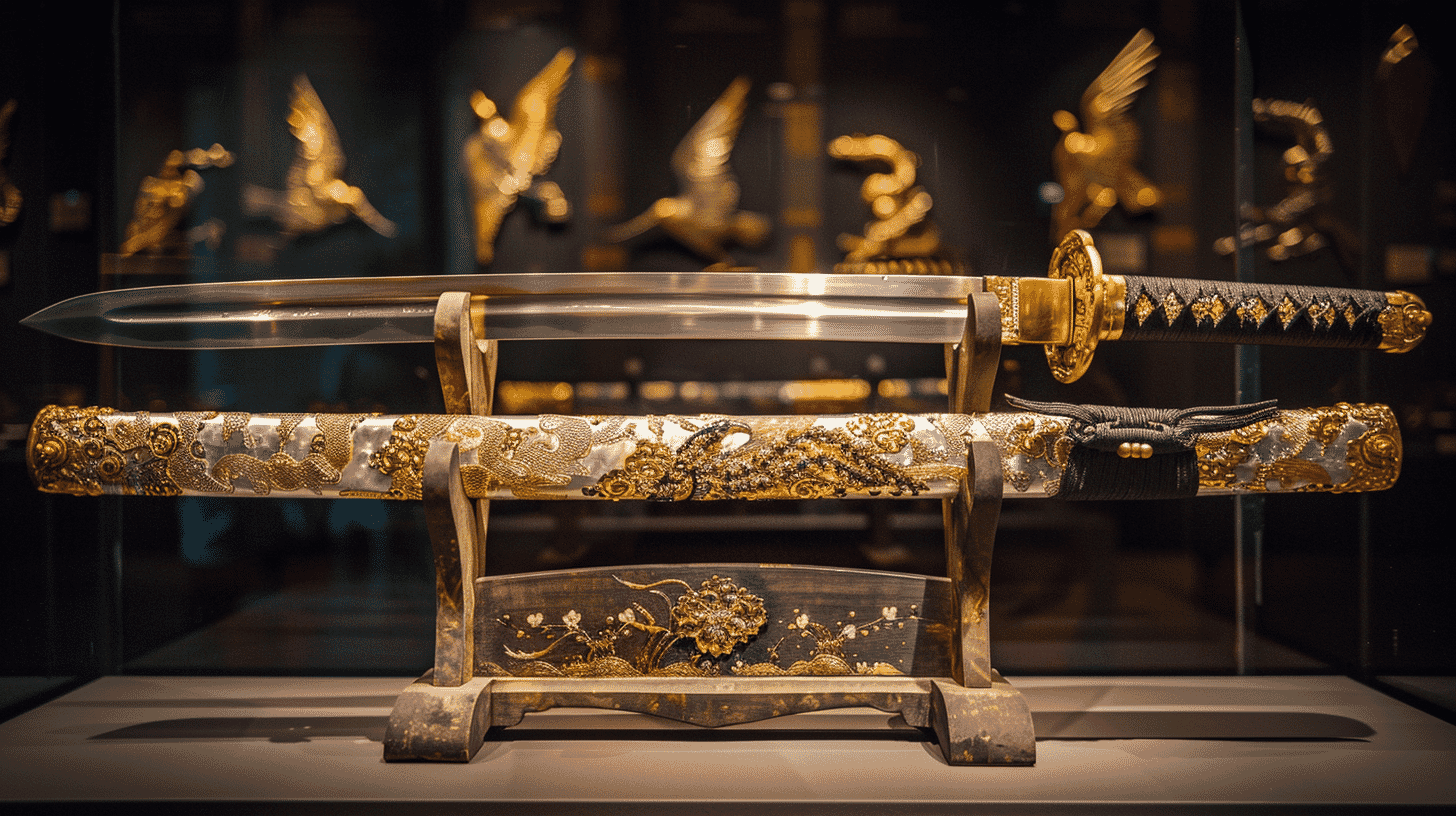
One Ceremonial Sword, National Treasure since 1962
Pear-Skin Mother-of-Pearl Inlay Gold-Lacquered Sword (梨地螺鈿金荘餝劔, Nashiji Raden Kinso Kazaritachi) is a Heian-period craft object at the Tokyo National Museum, 13-9 Ueno Park, Taito Ward, Tokyo, made an Important Cultural Property on 29 March 1952 and designated a National Treasure on 21 June 1962. The quantity is one sword and the owner the National Institutes for Cultural Heritage.
29 March 1952 is the day on which the tachi inscribed Masatsune was designated a National Treasure. 21 June 1962 is the day of the Nezame Monogatari scrolls.
The Agency's commentary reads: a work of the Heian period. This is the twentieth one-sentence commentary among the properties covered here.
The Title Uses Variant Characters
The name of this piece is written with unfamiliar characters.
Two of them are older variants: one of the character meaning to ornament, the other of the character for sword. Same sound and same sense, written in another form.
A related entry is titled with the same words but the ordinary form of the character for ornament. The two variants stand side by side.
Accounts elsewhere use the modern forms of both characters. So the same title exists in three spellings.
How titles are written has come up repeatedly here. The sword inscriptions marked illegibility with a phrase or with squares; the sutra's note ended with a word meaning and so forth. Those concern what is not written. This concerns having several characters for one word.
This article follows the Agency's record.
A Property Differing Only in Its First Three Characters
Two titles here are nearly identical.
This piece is a mother-of-pearl and gold-mounted sword on a pear-skin ground. A related entry is a mother-of-pearl and gold-mounted sword on a poured-gold ground.
Five characters in the middle are shared, and the last is the same. Only the first three differ.
Both name lacquer techniques, distinguished by how the gold powder is laid. The head of the title states the technique, and that alone separates the two.
At Himeji Castle, a turret of one name stood as both National Treasure and Important Cultural Property. With the tachi inscribed Masatsune, several swords shared a signature. Here the distinction rests on the name of a technique.
What Is Not in the Record
The record is short, and what it omits is worth setting down.
The dimensions field is empty, as are the fields for maker, for form and condition, and for date.
Heian period, one sword, owned by the National Institutes for Cultural Heritage: that is all the record establishes.
For the Mikazuki Munechika, the temper line, the shape of the tang, the number of peg holes and the placing of the signature were all set down. Within one category, the amount recorded varies widely.
Accounts elsewhere assign the piece to the twelfth century. The Agency gives only the Heian period, without a century, and this article does not add one.
Seeing It
The sword is at the Tokyo National Museum, owned by the National Institutes for Cultural Heritage. It is a museum holding, not kept on permanent display.
The title itself tells something. A pear-skin ground is lacquer strewn with gold powder to resemble the skin of a pear; mother-of-pearl inlay sets pieces of shell into the surface; gold mounting means fittings of gold.
Three techniques are named in a row. Where each was used, and how, the record does not say.
The last character names a sword, but the title also carries the word for ornament. This was a sword for display rather than for use.
Exhibition plans can change, so check the museum's information before travelling.
Q&A
- When was the sword designated?
- It became an Important Cultural Property on 29 March 1952 and a National Treasure on 21 June 1962. The quantity is one sword, the location the Tokyo National Museum, and the owner the National Institutes for Cultural Heritage.
- Why is the title written with unusual characters?
- Two are older variants, of the characters for ornament and for sword. A related entry uses the ordinary form of the first, and accounts elsewhere use modern forms of both, so three spellings exist. This article follows the Agency.
- Is there a similar title?
- Yes, differing only in its first three characters, which name a different lacquer ground. Both techniques strew gold powder, laid in different ways, and that alone separates the two properties.
- Are its size and maker known?
- No. The fields for dimensions, maker, form and condition, and date are all empty, and the commentary reads only: a work of the Heian period.
- What kind of sword is it?
- The title names three techniques: a pear-skin lacquer ground, mother-of-pearl inlay and gold mounting. The word for ornament in the title suggests a sword for display rather than use, though where each technique was applied is not recorded.
Basic Information
| Name | Pear-Skin Mother-of-Pearl Inlay Gold-Lacquered Sword (梨地螺鈿金荘餝劔, Nashiji Raden Kinso Kazaritachi); a sword on a poured-gold ground is a separate property |
|---|---|
| Location | Tokyo National Museum, 13-9 Ueno Park, Taito Ward, Tokyo |
| Designation | National Treasure (craft) |
| Year Designated | 1952 (29 March), Important Cultural Property; 1962 (21 June), National Treasure |
| Quantity | 1 sword |
| Dimensions | The Agency's fields for dimensions, maker, form and condition, and date are all empty, and the commentary reads only: a work of the Heian period. The period is Heian |
| Owner | National Institutes for Cultural Heritage |
| Public Access | A museum holding, not on permanent display |
References
- Cultural Heritage Online: the pear-skin ground ceremonial sword
- https://bunka.nii.ac.jp/heritages/detail/159455
- Tokyo National Museum official site
- https://www.tnm.jp/
- Agency for Cultural Affairs, National Cultural Properties Database
- https://kunishitei.bunka.go.jp/
- Agency for Cultural Affairs: introduction to fine arts and crafts
- https://www.bunka.go.jp/seisaku/bunkazai/shokai/bijutsu_kogei/
Last verified: 2026.09.05