
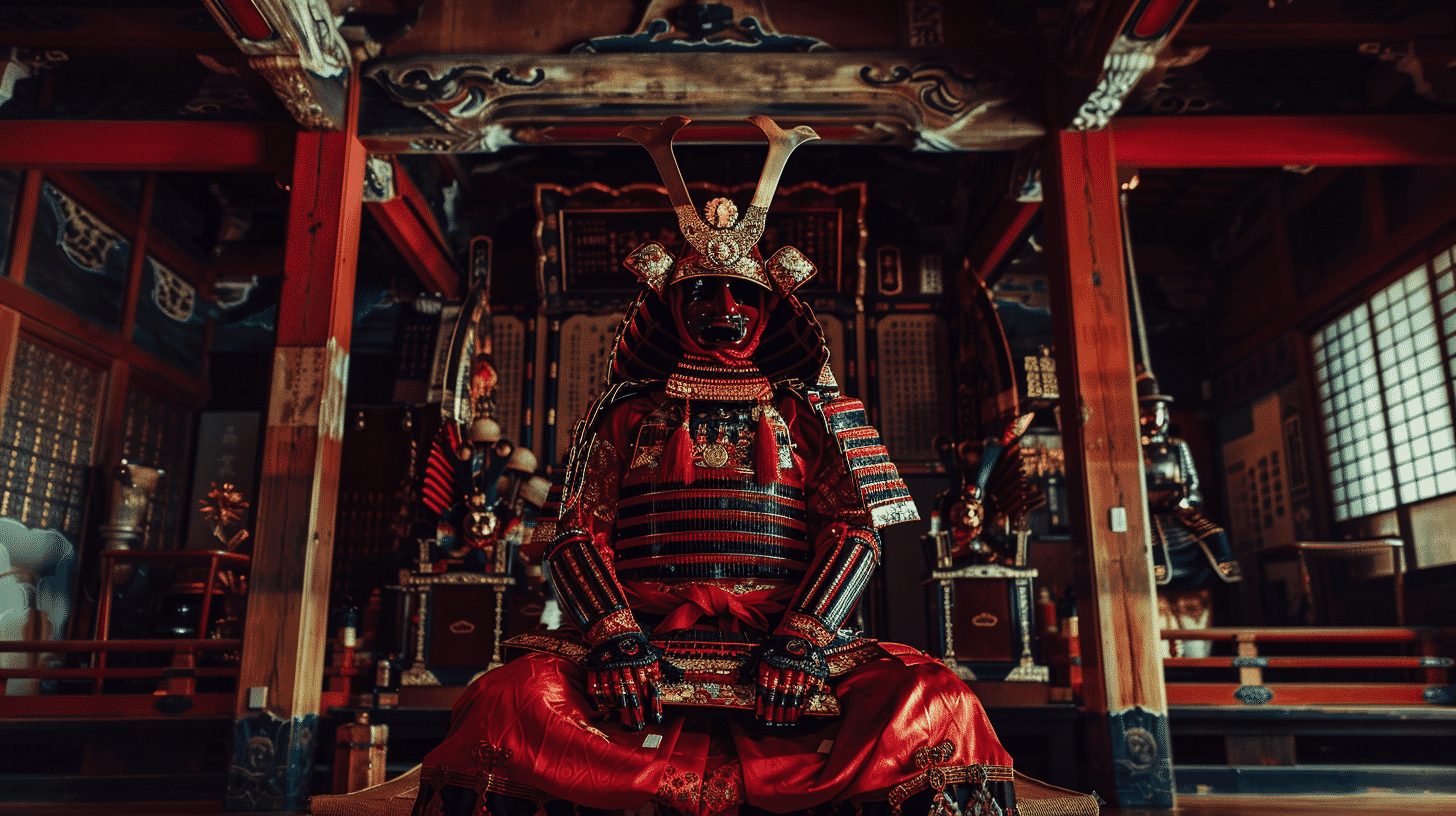
A Heian-Period Great Armour, National Treasure since 1952
The Red-Laced Armour with Helmet and Large Sleeves (赤絲威鎧〈兜、大袖付〉, Akaito Odoshi Yoroi) is a Heian-period great armour held by Musashi Mitake Shrine at Mitakesan, Ome City, Tokyo, designated a National Treasure in 1952, on 22 November. It had become an Important Cultural Property on 1 August 1899. The quantity is one suit, the category applied arts, and the designation number 00075.
The Agency for Cultural Affairs is brief. Long famous as the finest work in the Kanto region, this armour was repaired during the Meiji era and the color of its lacing has been lost, though every part of it survives. The form as a whole is bold and grand, sufficient to convey the bearing of a warrior of the Genpei age.
The phrase about the lacing having lost its color is worth keeping in view. The name means laced in red silk, but after the Meiji repairs the original color does not remain. Descriptions calling it a crimson armour do not match what the Agency records of its present state.
Another National Treasure Shares the Name
This is not the only National Treasure called Akaito Odoshi Yoroi. Oyamazumi Shrine in Imabari, Ehime Prefecture, holds a Red-Laced Armour with Large Sleeves, likewise a National Treasure.
The two names are close and are easily confused. They are distinguished as follows.
This one belongs to Musashi Mitake Shrine in Tokyo and includes a helmet. It became an Important Cultural Property on 1 August 1899 and a National Treasure on 22 November 1952. The Oyamazumi suit has large sleeves but no helmet, and its two designations fall on the same date, 29 March 1952.
Whether the bracketed part of the name reads with helmet and large sleeves or with large sleeves is the decisive difference. When consulting sources, check that bracket and the location.
Measurements and Construction
The cuirass stands 85.0 centimetres high, the helmet bowl 12.1 centimetres, and the large sleeves are 42.4 centimetres long.
The Agency's description of materials and form runs as follows. The flat scales are lacquered black, leather scales with iron scales set among them here and there, and the lacing is red silk. The edge cords and the cross-stitching are in mottled silk, and the diamond stitching in red tanned leather.
Scales are the small plates from which armour is built, laced together to form the cuirass and the sleeves. Mixing iron scales among leather ones balances lightness against protection. The lacing is the cord that joins them, and the use of red cord gives the armour its name.
The cuirass is built with two plates at the front rise, a back plate with a reversed plate and a third plate behind, four plates at the body, and skirts of four sections in five tiers including the side guard. The large sleeves have six tiers, with the cord rings set on the reverse.
The helmet bowl is iron lacquered black, made of seventeen plates, with thirteen ridges of standing rivets. The neck guard has five tiers and the turnbacks four, in a cedar-standing form. Seventeen iron plates joined into one bowl is what the record sets down.
The Dyed Leather
The metal-mounted areas and the leather-covered areas are wrapped in dyed leather patterned with lions in roundels among lattices of cloud scrolls.
Dyed leather is leather printed with a pattern, wrapped over the key points of an armour to reinforce and to ornament at once. Cloud scrolls run in a lattice with lions set in roundels within it. The trim boards are wrapped in iris-patterned leather.
The small edging is red leather and the binding cords purple and pale blue-white. The rims of the metal mounts are gilded, and rivets are set, among them gilt chrysanthemum-seated cap rivets. Leather, cord and metal are used to build up color and texture separately, as the detail of the record shows.
When the Agency calls the whole bold and grand, it means the impression these elements make together.
Provenance and Seeing It
Under provenance the Agency records a shrine tradition that Hatakeyama Shigetada presented the armour. The database writes the surname with a character meaning field rather than the one used for Hatakeyama, which appears to be a slip; this article notes the discrepancy rather than adopting the form as it stands.
This is shrine tradition, and no primary source giving a year of presentation was found within the scope of this article. The Agency records the period only as Heian and leaves the year field blank.
The armour is kept and shown in the treasure hall of Musashi Mitake Shrine. Opening days and charges change from time to time, and it is not necessarily on view all year, so check with the shrine before travelling if the object itself is the purpose of the visit.
Musashi Mitake Shrine stands on the summit of Mount Mitake. From Mitake Station on the JR Ome Line take a bus to the cable car, then the Mitake Tozan Railway to Mitakesan Station, and walk about 25 minutes.
- 📍 Plan Your Visit to Tokyo
- Find tours, activities & transport passes near Red-Laced Armour with Helmet and Large Sleeves
- [ Tokyo Skytree Asakusa & teamLab Experiences ]
Q&A
- When was this armour designated a National Treasure?
- On 22 November 1952, having become an Important Cultural Property on 1 August 1899. It is listed as one suit in the applied arts category under designation number 00075. The period given is Heian, and it belongs to Mitake Shrine.
- Is there another National Treasure with the same name?
- Yes. Oyamazumi Shrine in Imabari, Ehime, holds a Red-Laced Armour with Large Sleeves, also a National Treasure. This one includes a helmet and was designated in 1899 and 1952 on separate dates; the Oyamazumi suit has no helmet and both its designations fall on 29 March 1952. Check the bracketed part of the name and the location.
- Is the armour still red?
- The Agency for Cultural Affairs records that it was repaired during the Meiji era and that the color of the lacing has been lost. The name means laced in red silk, but the original color does not remain. Every part of the armour, however, is recorded as surviving.
- How is the armour built?
- The cuirass is 85.0 centimetres high, the helmet bowl 12.1 and the sleeves 42.4 long. Flat scales are lacquered black, leather with iron scales set among them, laced in red silk. The cuirass has four body plates and skirts of four sections in five tiers; the helmet bowl is iron of seventeen plates with thirteen ridges of standing rivets.
- Where can the armour be seen?
- In the treasure hall of Musashi Mitake Shrine. Opening days and charges change and it is not necessarily on view all year, so check with the shrine before travelling. The shrine stands on the summit of Mount Mitake, about 25 minutes on foot from Mitakesan Station.
Basic Information
| Name | Red-Laced Armour with Helmet and Large Sleeves (赤絲威鎧〈兜、大袖付〉, Akaito Odoshi Yoroi) |
|---|---|
| Location | 176 Mitakesan, Ome City, Tokyo (Musashi Mitake Shrine) |
| Designation | National Treasure (applied arts), designation no. 00075 |
| Year Designated | 1899 (1 August), Important Cultural Property; 1952 (22 November), National Treasure |
| Quantity | 1 suit |
| Dimensions | Cuirass 85.0 cm high, helmet bowl 12.1 cm, large sleeves 42.4 cm long. Flat scales lacquered black, leather with iron scales among them, laced in red silk. Cuirass with 2 plates at the front rise, 4 body plates, skirts of 4 sections in 5 tiers. Helmet bowl of 17 iron plates with 13 ridges of standing rivets. Sleeves of 6 tiers. Heian period |
| Owner | Mitake Shrine |
| Public Access | Kept and shown in the treasure hall of Musashi Mitake Shrine. Opening days and charges change and it is not necessarily on view all year |
References
- Agency for Cultural Affairs, National Cultural Properties Database: Red-Laced Armour with Helmet and Large Sleeves
- https://kunishitei.bunka.go.jp/heritage/detail/201/363
- Cultural Heritage Online: Red-Laced Armour with Large Sleeves (Oyamazumi Shrine, a separate item)
- https://bunka.nii.ac.jp/heritages/detail/188886
- Musashi Mitake Shrine: treasures, the red-laced great armour
- https://musashimitakejinja.jp/homotsu_multilingual/ja/akaito_ja.html
- Musashi Mitake Shrine official site
- https://musashimitakejinja.jp/
Last verified: 2026.09.05