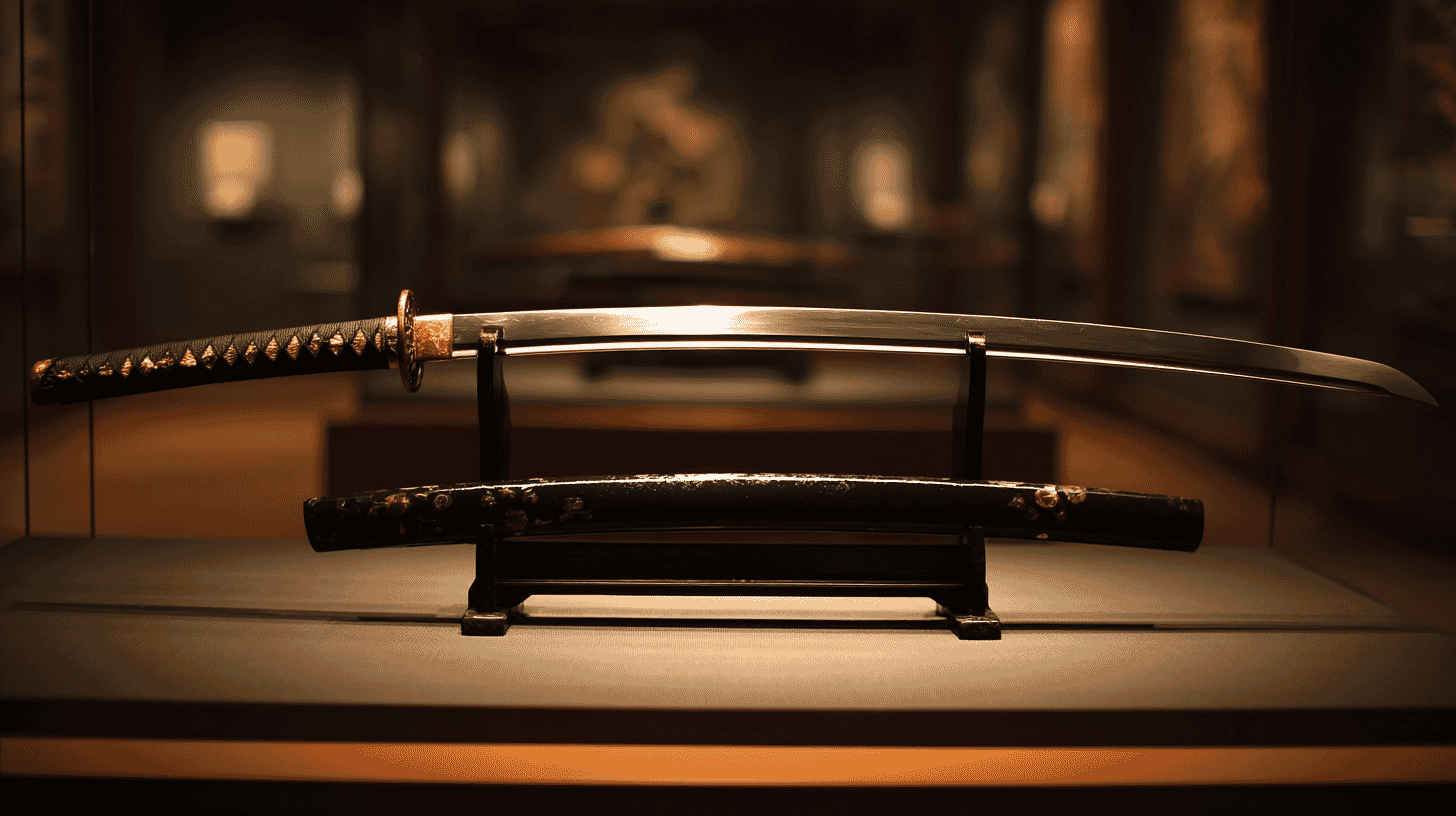
Rai Kunimitsu Sword: A Masterpiece of Kamakura Era Swordsmithing at Tokyo National Museum

Discover the Important Cultural Property 'Katana with Gold Inlay Inscription Rai Kunimitsu' at Tokyo National Museum. Explore this Kamakura period masterpiece by the legendary Rai school swordsmith, appraised by the prestigious Hon'ami family.

Rai Kunimitsu: Encountering a Masterpiece of Medieval Japanese Swordsmithing

Among the countless treasures housed at the Tokyo National Museum lies a blade that embodies seven centuries of Japanese sword-making tradition—the Katana with Gold Inlay Inscription "Rai Kunimitsu Suriage / Hon'a (Kaō)." This Important Cultural Property represents not just a weapon of extraordinary quality, but a living testament to the golden age of Japanese swordsmithing and the enduring legacy of the Hon'ami family's expertise in sword appraisal.

For international visitors seeking to understand the profound artistry and craftsmanship that elevated the Japanese sword beyond mere weaponry into the realm of fine art, this blade offers an exceptional opportunity. Created during the Kamakura period (14th century) by one of Japan's most celebrated sword-making lineages, it stands as a window into an era when sword-making reached unprecedented heights of technical and aesthetic achievement.

The Rai School: Masters of Yamashiro Swordsmithing

The Rai school (来派) represents one of the most prestigious lineages in Japanese sword-making history. Operating from Yamashiro Province (present-day southern Kyoto Prefecture), the school flourished from the mid-Kamakura period through the Nanboku-chō period, producing some of the finest blades ever forged in Japan.

According to historical records, particularly the Kanchi-in text of the "Meizukushi" (銘尽), the Rai school's ancestors were said to have come from Korea, giving the school its distinctive name—"Rai" (来) meaning "to come." While the veracity of this origin story remains debated among scholars, what is certain is that the Rai school established itself as the preeminent representative of the Yamashiro tradition, one of the "Five Traditions" (Gokaden) of Japanese swordsmithing.

Rai Kunimitsu himself is generally believed to have been the son of Rai Kunitoshi, though some scholars propose alternative theories regarding his parentage. What distinguishes Kunimitsu among his peers is the remarkable breadth of his work—he produced masterpieces across an unusually wide range of styles, demonstrating mastery of both the traditional straight-tempered blades (suguha) favored by his father and the more dynamic temper patterns influenced by the Sōshū school. His active period spans from approximately 1313 to 1351, and an remarkable 44 of his works have been designated as National Treasures, Important Cultural Properties, or Important Art Objects.

Understanding the Gold Inlay Inscription

The sword's full designation—"Katana with Gold Inlay Inscription: Rai Kunimitsu Suriage / Hon'a (Kaō)"—tells a rich story through its very name. Let us decode this fascinating title.

The term "suriage" (磨上) refers to the practice of shortening a blade by cutting into the tang (nakago). During the Muromachi period, as warfare evolved from mounted combat to ground-based fighting, the long tachi of earlier eras became less practical. Rather than forge entirely new weapons, existing excellent blades were often shortened to create more manageable katana. This process typically removed the portion of the tang bearing the original smith's signature.

The gold inlay inscription (kinzōgan-mei) on this blade was added during the early Edo period by Hon'ami Kōshitsu, a master sword polisher and appraiser from the prestigious Hon'ami family. This family had served as official sword appraisers and polishers since the Muromachi period, and their judgment on the authenticity and quality of blades was considered definitive. The "kaō" (花押) refers to a stylized signature mark, confirming that the Hon'ami family authenticated this blade as a genuine work of Rai Kunimitsu.

Why This Blade Matters: Artistic and Historical Significance

This katana exemplifies the first of Rai Kunimitsu's two major styles—the tradition-following approach characterized by straight temper lines (suguha). The blade exhibits several features that demonstrate why Kunimitsu was considered among the greatest of the Rai school masters.

The ji-gane (ground metal) displays an exceptionally refined itame-hada (wood grain pattern) that is tightly forged and precise. From the shinogi (ridge line), a subtle nie-utsuri (reflection pattern) rises—a characteristic feature of Rai school blades that adds depth and dimension to the surface. The hamon (temper pattern) presents a brilliant, clear straight temper with an exceptionally bright nioi-guchi (temper line), punctuated by frequent ko-ashi (small feet-like patterns) that extend into the ji.

With a blade length (nagasa) of 75.1 centimeters and a curvature (sori) of 1.8 centimeters, the sword maintains elegant proportions that speak to its Kamakura-period origins. The designation as an Important Cultural Property (重要文化財), bestowed on February 8, 1958, acknowledges both its exceptional craftsmanship and its significance as a representative example of medieval Japanese metalworking artistry.

The Hon'ami Legacy: Custodians of Sword Culture

Understanding this blade requires appreciation of the Hon'ami family's extraordinary role in Japanese sword history. For over 600 years, the Hon'ami served as the supreme authorities on sword authentication, polishing, and appraisal. The phrase "origami-tsuki" (折紙付き), meaning "certified" or "guaranteed authentic," derives from the authentication certificates the Hon'ami family issued.

Hon'ami Kōshitsu, who polished and appraised this particular blade, belonged to this distinguished lineage. When a blade was shortened and its original signature lost, the Hon'ami family's authentication through gold inlay inscription provided a new form of provenance, declaring to future generations the identity of the original smith. This practice reveals the profound respect accorded to outstanding swordsmiths even centuries after their deaths.

The Hon'ami family also produced Hon'ami Kōetsu (1558-1637), a Renaissance-like figure who became one of Japan's most celebrated calligraphers, ceramicists, and lacquer artists. Though primarily known for these artistic pursuits, Kōetsu's aesthetic sensibility was shaped by his family's centuries of intimate engagement with the beauty of Japanese swords.

Viewing Experience at Tokyo National Museum

The Tokyo National Museum (Tōkyō Kokuritsu Hakubutsukan), located in Ueno Park, houses this Important Cultural Property as part of its extensive sword collection. The museum's sword gallery, located in Room 13-2 of the Honkan (Main Building), offers visitors the opportunity to appreciate Japanese swords under carefully designed lighting that reveals the subtle beauty of the blades' surfaces.

When viewing this Rai Kunimitsu blade, take time to observe how the light plays across the surface, revealing the nie-utsuri and the clarity of the hamon. Note the gold inlay inscription on the tang—a testament to centuries of careful preservation and authentication. The blade rotates through display periods, so visitors should check the museum's current exhibition list before planning their visit.

The museum also offers English-language audio guides and information panels that help international visitors understand the technical and aesthetic elements of Japanese sword appreciation. Staff members can often assist with specific questions about exhibited pieces.

Surrounding Attractions in Ueno

A visit to see the Rai Kunimitsu blade can be combined with exploration of Ueno's rich cultural district. Ueno Park itself encompasses several world-class museums, including the National Museum of Western Art (a UNESCO World Heritage Site designed by Le Corbusier), the National Museum of Nature and Science, and the Tokyo Metropolitan Art Museum.

The historic Ueno Tōshō-gū Shrine, dating from 1627, offers a glimpse into Edo-period religious architecture, while Shinobazu Pond provides a peaceful natural setting. The nearby Ameyoko market street presents a colorful contrast with its bustling atmosphere and diverse food offerings—perfect for experiencing everyday Tokyo life after a morning of cultural appreciation.

For visitors with deeper interest in Japanese swords, the Sword Museum (Tōken Hakubutsukan) in Sumida Ward offers specialized exhibitions focusing exclusively on Japanese blades. The museum operates under the auspices of the Society for Preservation of Japanese Art Swords and provides excellent English-language resources.

📍 Plan Your Visit to Tokyo
Find tours, activities & transport passes near Sword (Gold Inlay Inscription Rai Kunimitsu Surijo / Hon'a
[ Tokyo Skytree Asakusa & teamLab Experiences ]

Q&A

QWhat does "suriage" mean in the sword's name?
ASuriage (磨上) refers to the practice of shortening a blade by cutting into the tang. This was commonly done during the Muromachi period when warfare styles changed from mounted to foot combat, requiring shorter, more practical weapons. When a blade was shortened, the original maker's signature was often lost, which is why authentication through gold inlay inscription became important.
QWho was Rai Kunimitsu and why is he significant?
ARai Kunimitsu was a master swordsmith who worked in Kyoto from the late Kamakura period through the Nanboku-chō period (approximately 1313-1351). He is considered one of the greatest representatives of the Yamashiro tradition and is known for the remarkable breadth of his work. An astonishing 44 of his works have been designated as National Treasures, Important Cultural Properties, or Important Art Objects.
QWhat is the role of the Hon'ami family in Japanese sword culture?
AThe Hon'ami family served as Japan's supreme sword appraisers, polishers, and authenticators for over 600 years. When blades lost their original signatures through shortening or damage, the Hon'ami family would authenticate them through gold inlay inscriptions. The Japanese expression "origami-tsuki" (meaning "guaranteed authentic") comes from their authentication certificates.
QIs the sword always on display at the Tokyo National Museum?
AJapanese swords are rotated through display periods to ensure their preservation. Visitors should check the Tokyo National Museum's current exhibition list on their website before visiting to confirm this blade is currently on display. The sword gallery is located in Room 13-2 of the Honkan (Main Building).
QWhat should I look for when viewing this blade?
APay attention to the exceptionally refined wood grain pattern (itame-hada) in the ground metal, the subtle reflection pattern (nie-utsuri) rising from the ridge line, and the bright, clear straight temper line (suguha) with its distinctive small feet-like patterns (ko-ashi). Also note the gold inlay inscription on the tang that bears the Hon'ami authentication.

Basic Information

Official Name Katana with Gold Inlay Inscription: Rai Kunimitsu Suriage / Hon'a (Kaō)
刀〈金象嵌銘来国光スリ上/本阿(花押)〉
Creator Rai Kunimitsu (来国光)
Period Kamakura Period (14th century)
Dimensions Blade length: 75.1 cm, Curvature: 1.8 cm
Designation Important Cultural Property (designated February 8, 1958)
Owner Independent Administrative Institution National Institutes for Cultural Heritage
Location Tokyo National Museum, 13-9 Ueno Park, Taito-ku, Tokyo 110-8712
Access 9-minute walk from JR Ueno Station (Park Exit); 10-minute walk from JR Uguisudani Station (South Exit); 15-minute walk from Tokyo Metro Ueno or Nezu Stations
Hours 9:30-17:00 (until 19:00 on Fridays and Saturdays); Last entry 30 minutes before closing
Closed Mondays (or following day if Monday is a holiday), Year-end and New Year holidays
Admission Adults ¥1,000, University students ¥500, Free for those under 18 and 70+ (with ID)
Website https://www.tnm.jp/

References

Cultural Heritage Online - Katana with Gold Inlay Inscription Rai Kunimitsu
https://bunka.nii.ac.jp/heritages/detail/209889
e-Museum (National Institutes for Cultural Heritage) - Katana Rai Kunimitsu
https://emuseum.nich.go.jp/detail?langId=ja&content_base_id=100460
Touken World - Rai Kunimitsu (Swordsmith)
https://www.touken-world.jp/sword-artisan-directory/rai-kunimitsu/
Wikipedia - Rai School
https://ja.wikipedia.org/wiki/来派
Meitō Gensō Jiten - Rai Kunimitsu
https://meitou.info/index.php/来国光
Tokyo National Museum Official Website
https://www.tnm.jp/

Last verified: 2026.01.28

Nearby heritages