
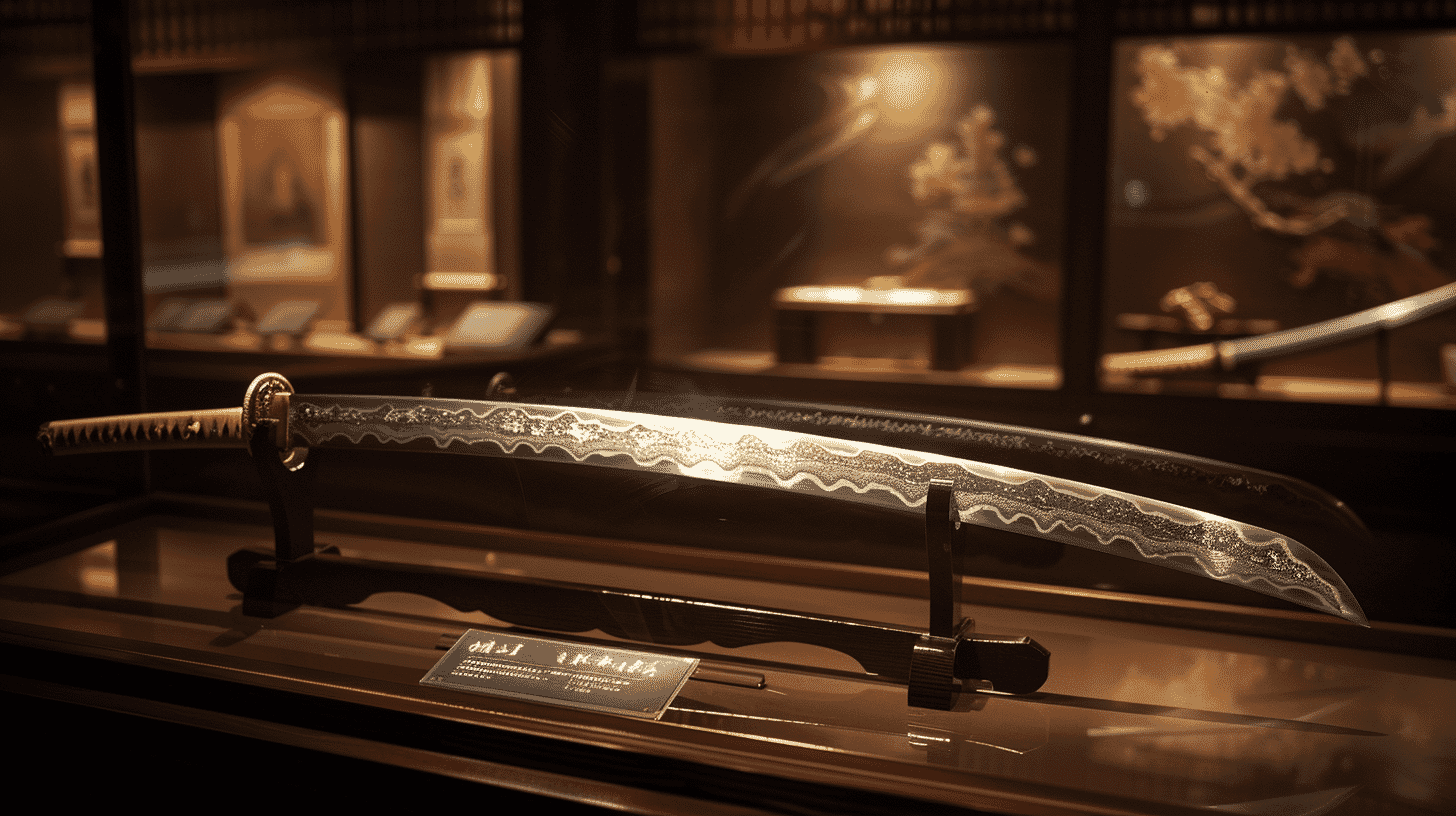
One Sword, National Treasure since 1951
Tachi Sword (signed Sanjo, known as Mikazuki Munechika) (太刀, Tachi) is a Heian-period craft object at the Tokyo National Museum, 13-9 Ueno Park, Taito Ward, Tokyo, made an Important Cultural Property on 23 January 1933 and designated a National Treasure on 9 June 1951. The quantity is one sword and the owner the National Institutes for Cultural Heritage.
The blade is 80.0 centimetres long, with a curvature of 2.7 centimetres, 2.9 centimetres wide at the base, 1.4 at the point, and a point length of 2.1 centimetres. As with the Masamune katana, the measurements are metric.
23 January 1933 is the date on which the buildings of Aoi Aso Shrine also became Important Cultural Properties. 9 June 1951 is the day on which both Yohen Tenmoku bowls were designated.
The Name Comes from a Pattern in the Steel
The origin of the by-name is recorded.
Counted since the Muromachi period among the five great swords of the realm, it bears the by-name crescent moon from the shape of its temper line.
The temper line is the pattern that appears along the edge from quenching. Its shape resembles a crescent, and the name followed.
The Agency describes it: half-moon markings of a certain kind recur frequently along the curve of the edge. The half-moon shape appears again and again.
Origins of names have varied here. The tachi signed Hisakuni transcribes an inscription; the Soranjo takes the opening words of its text; the Wakan Roeishu names its paper; the Okichimozuku habitat carries a place name; the Inaba Tenmoku an owner's family name; the Nakatsukasa Masamune an owner's court title. This one takes a pattern on the surface of the object.
The Signature Reads Sanjo, Which Is Not a Person
Inside the angle brackets of the title stands the signature Sanjo. It is not a personal name.
The Agency writes that blades signed Sanjo have from ancient times been held to be by the same hand as Munechika, and that securely signed works surviving from that hand are extremely few.
Blades bearing that signature have long been ascribed to a man named Munechika. The signature itself does not name a person; tradition ties it to one.
This makes a fourth way of fixing a maker. The tachi signed Hisakuni was settled by a signature the smith cut. The tachi inscribed Masatsune had a signature but several smiths of that name. The Masamune katana had its maker's name inlaid by an appraiser. Here a signature that is not a personal name is joined to a person by tradition.
The placing is precise: the tang is untouched, shaped like a pheasant's thigh, the file marks unclear, with two peg holes, and the signature stands at the centre of a peg hole on the reverse as worn. The Masatsune tachi had its signature below the original peg hole.
The Appended Scabbard Has Lost Its Hilt
An appendage belongs with this sword.
The appended mounting, though its hilt is lost, is a Momoyama-period scabbard, its ground worked in gold flake with a paulownia crest in gold lacquer, and fittings of punched copper alloy set with crescent moons, clouds and paulownia.
The hilt is gone. The piece is designated in that incomplete state.
The blade is of the Heian period, the scabbard of the Momoyama. Several centuries lie between them, and they stand as body and appendage within one property.
With the Masamune katana, the mounting appeared in the dimensions field as an accompanying piece, giving a total length of 93.5 centimetres. Here the scabbard is an appendage and no dimensions are given. The same kind of fitting is handled differently.
The fittings carry crescent moons. The by-name taken from a pattern in the steel is used again in the ornament of the housing.
Seeing It
The sword is at the Tokyo National Museum, owned by the National Institutes for Cultural Heritage. It is a museum holding, not kept on permanent display.
The assessment is recorded: the sword is of outstandingly beautiful form, and in the modelling of its body it carries the oldest air of the curved blade.
The category differs between records. The Agency gives craft; the Tokyo National Museum gives other. The period too is Heian in the Agency's record and the twelfth century of the Heian period in the museum's.
The Vajrabhadrani Sutra and the Meihoki likewise showed two databases differing over category.
Exhibition plans can change, so check the museum's information before travelling.
Q&A
- When was the sword designated?
- It became an Important Cultural Property on 23 January 1933 and a National Treasure on 9 June 1951. The quantity is one sword, the location the Tokyo National Museum, and the owner the National Institutes for Cultural Heritage.
- Where does the by-name crescent moon come from?
- From the shape of the temper line, the pattern along the edge left by quenching. The Agency records half-moon markings recurring frequently along the curve of the edge, and the name followed from that shape.
- Is Sanjo the maker's name?
- No. The Agency records that blades signed Sanjo have from ancient times been held to be by the same hand as Munechika. The signature does not name a person; tradition ties it to one.
- What is designated as an appendage?
- A Momoyama-period scabbard from a mounting. The Agency notes that its hilt is lost, describing gold-flake ground with a paulownia crest in gold lacquer and fittings set with crescent moons, clouds and paulownia. It is designated in that incomplete state.
- What is the category?
- The Agency gives craft, while the Tokyo National Museum gives other. The period is Heian in the Agency's record and the twelfth century of the Heian period in the museum's. This article follows the Agency.
Basic Information
| Name | Tachi Sword, signed Sanjo, known as Mikazuki Munechika (太刀, Tachi) |
|---|---|
| Location | Tokyo National Museum, 13-9 Ueno Park, Taito Ward, Tokyo |
| Designation | National Treasure (craft); a Momoyama-period scabbard is designated as an appendage, and the holding museum records the category as other |
| Year Designated | 1933 (23 January), Important Cultural Property; 1951 (9 June), National Treasure |
| Quantity | 1 sword |
| Dimensions | Blade 80.0 centimetres, curvature 2.7 centimetres, 2.9 centimetres wide at the base, 1.4 centimetres at the point, point length 2.1 centimetres. Ridged construction with a peaked back and small point; the tang is untouched, shaped like a pheasant's thigh, with 2 peg holes. The maker is Munechika and the period Heian |
| Owner | National Institutes for Cultural Heritage |
| Public Access | A museum holding, not on permanent display |
References
- Cultural Heritage Online: tachi signed Sanjo, known as Mikazuki Munechika
- https://bunka.nii.ac.jp/heritages/detail/125494
- Cultural Heritage Online: the same sword in the museum's record
- https://bunka.nii.ac.jp/heritages/detail/453801
- Tokyo National Museum official site
- https://www.tnm.jp/
- Agency for Cultural Affairs, National Cultural Properties Database
- https://kunishitei.bunka.go.jp/
Last verified: 2026.09.05