
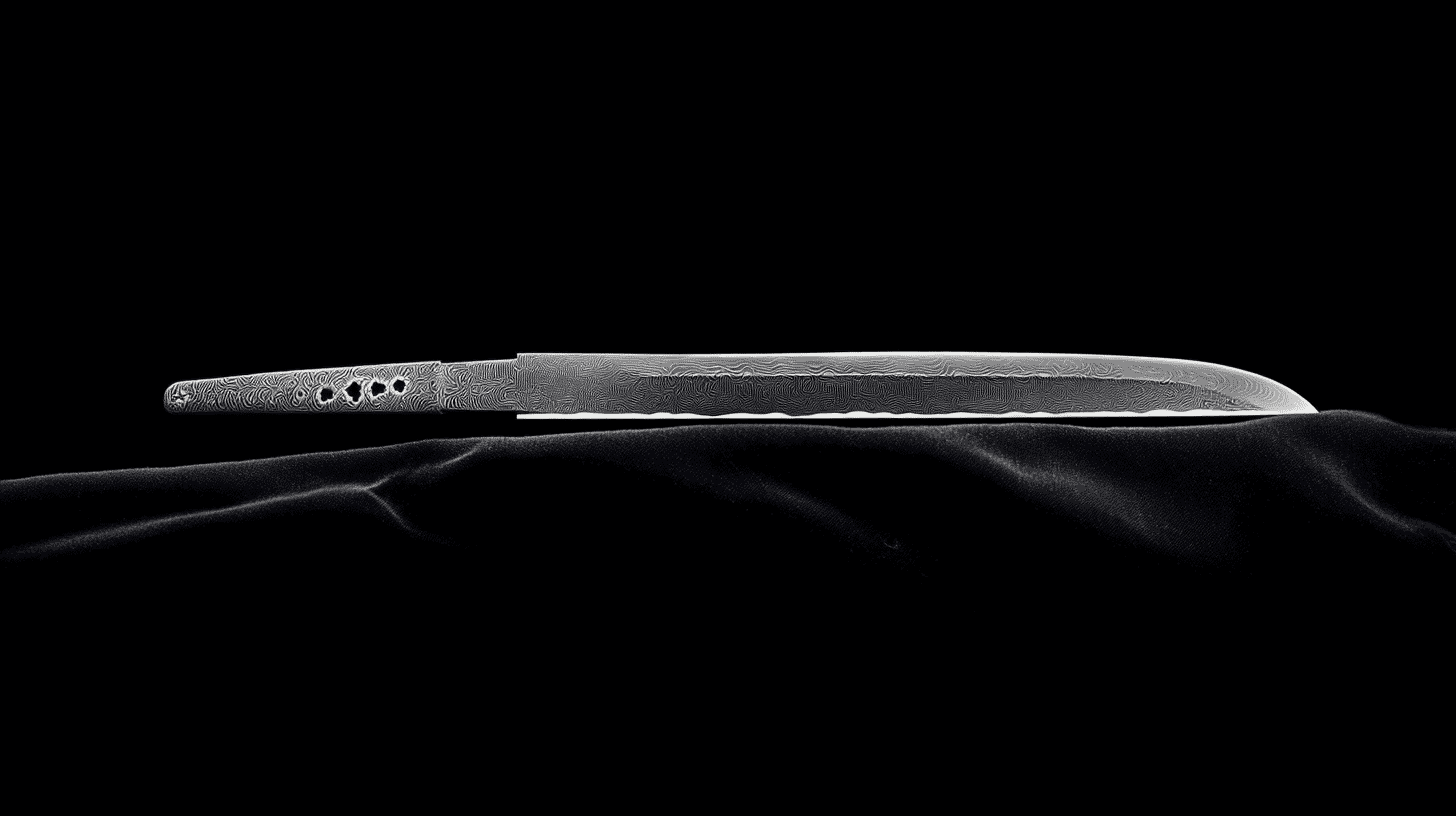
One Dagger, National Treasure since 1954
Tanto (inscribed Yoshimitsu, known as Goto Toshiro) (短刀, Tanto) is a Kamakura-period craft object at the Tokugawa Art Museum, 1017 Tokugawa-cho, Higashi Ward, Nagoya City, Aichi Prefecture, made an Important Cultural Property on 14 November 1953 and designated a National Treasure on 20 March 1954. The quantity is one blade and the owner the Tokugawa Reimeikai, a public-interest foundation.
Both dates match those of the engraved mirror exactly: the same day for the earlier listing and the same day for the designation.
The two Yohen Tenmoku bowls shared only their National Treasure date. This blade and the engraved mirror share both.
The Dimensions Differ Slightly between Records
The measurements do not agree from one record to the next.
The Agency gives a body length of 27.7 centimetres, a width at the base of 2.3 centimetres, and a tang length of 11.4 centimetres.
The Tokugawa Art Museum gives a body length of 27.6 centimetres and a tang length of 11.5 centimetres.
The blade is 0.1 centimetre shorter and the tang 0.1 centimetre longer. The wording differs too: the two records use different terms for the tang.
Discrepancies between records have appeared before. The Vajrabhadrani Sutra and the Meihoki differed over category, the Five Wisdom Buddhas over the name, the Fumi no Nemaro material over the period, the Mikazuki Munechika over both category and period. Here the figures themselves differ.
Neither is necessarily wrong. Where a piece is measured, and with what, can produce such a difference. This article takes the Agency's figures as primary and gives the museum's alongside.
Four Peg Holes
The description of the tang carries a count.
The tang is untouched, the end shaped in a chestnut curve, the file marks slanting, with four peg holes and a two-character signature below a peg hole.
A peg hole takes the pin that holds blade and hilt together. There are four of them.
The Mikazuki Munechika has two; the Masatsune tachi one original hole. Four is the largest count met here.
The tang is untouched, never cut back, and yet it carries four holes. Each new hilt evidently called for a new hole. How often the blade was mounted survives as a number of holes.
The placing of the signature is given as below a peg hole. Which of the four is not stated.
The Date of a Gift, and What Was Given with It
On provenance the museum's record is fuller.
In the ninth month of 1639 the second lord Mitsutomo received the blade from the third shogun Iemitsu, together with a sword known as the Samidare Go.
Giver, receiver, date, and the name of the other blade given at the same time are all set down.
The provenance of the Inaba Tenmoku was four holders joined by dashes. The Soranjo told seven stages in prose. This record takes a single occasion and gives it with its date and its companion gift.
The origin of the by-name is recorded too. The Agency writes that the name comes from its ownership by Goto Shozaburo, who headed the gold and silver mints. An owner's family name becoming the by-name follows the same pattern as the Inaba Tenmoku.
The museum names him more fully still.
Seeing It
The blade is at the Tokugawa Art Museum, owned by the Tokugawa Reimeikai. It is a museum holding, not kept on permanent display.
The assessment is recorded: a work by Toshiro Yoshimitsu, a leading smith of the Awataguchi school, comparatively large among his blades, showy in its irregular temper, with a fine flame at the point.
The comparison is with the maker's own works. Where the armed warrior haniwa was called the finest among warrior figures of eastern Japan, here the field is one smith's output.
The category differs as well. The Agency gives craft; the museum gives metalwork within craft, a finer division.
Exhibition plans can change, so check the museum's information before travelling.
Q&A
- When was the blade designated?
- It became an Important Cultural Property on 14 November 1953 and a National Treasure on 20 March 1954. Both dates match those of the engraved mirror exactly.
- What are its dimensions?
- The records differ slightly. The Agency gives 27.7 centimetres in body length, 2.3 across the base and 11.4 for the tang; the Tokugawa Art Museum gives 27.6 centimetres and 11.5 respectively.
- Why are there four peg holes?
- The Agency gives no reason. Since the tang is untouched yet carries four holes, each new hilt evidently called for a new one. The Mikazuki Munechika has two and the Masatsune tachi one.
- How did it come down?
- The museum records that in the ninth month of 1639 the second lord Mitsutomo received it from the third shogun Iemitsu, together with another sword. Giver, receiver, date and companion gift are all named.
- Where does the by-name Goto come from?
- The Agency records that the name comes from its ownership by Goto Shozaburo, who headed the gold and silver mints. An owner's family name gives the by-name, as with the Inaba Tenmoku.
Basic Information
| Name | Tanto, inscribed Yoshimitsu, known as Goto Toshiro (短刀, Tanto) |
|---|---|
| Location | Tokugawa Art Museum, 1017 Tokugawa-cho, Higashi Ward, Nagoya City, Aichi Prefecture |
| Designation | National Treasure (craft); the holding museum records it as metalwork within craft |
| Year Designated | 1953 (14 November), Important Cultural Property; 1954 (20 March), National Treasure |
| Quantity | 1 blade |
| Dimensions | The Agency gives a body length of 27.7 centimetres, 2.3 centimetres across the base and a tang of 11.4 centimetres; the museum gives 27.6 centimetres and a tang of 11.5 centimetres. Flat construction with a three-faceted back and a slight inward curve; the tang is untouched with 4 peg holes. The maker is Toshiro Yoshimitsu and the period Kamakura |
| Owner | Tokugawa Reimeikai, a public-interest foundation |
| Public Access | A museum holding, not on permanent display |
References
- Cultural Heritage Online: tanto inscribed Yoshimitsu, known as Goto Toshiro
- https://bunka.nii.ac.jp/heritages/detail/197480
- Cultural Heritage Online: the same blade in the museum's record
- https://bunka.nii.ac.jp/heritages/detail/41598
- Tokugawa Art Museum official site
- https://www.tokugawa-art-museum.jp/
- Agency for Cultural Affairs, National Cultural Properties Database
- https://kunishitei.bunka.go.jp/
Last verified: 2026.09.05