
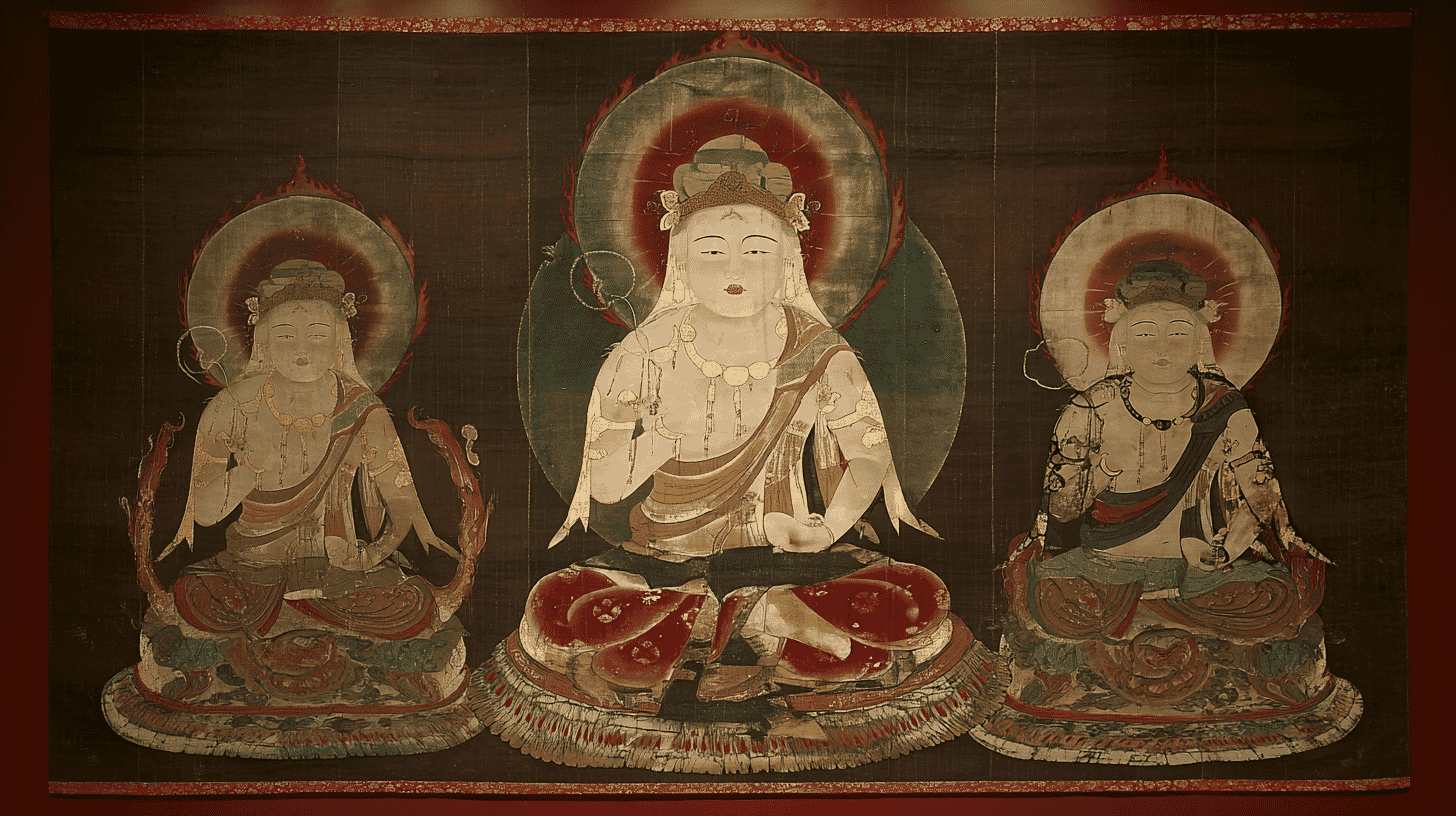
Twelve Hanging Scrolls, National Treasure since 1952
The Twelve Devas (Color on Silk) (絹本著色十二天像, Kenpon Chakushoku Juniten Zo) is a Heian-period Buddhist painting at the Kyoto National Museum, 527 Chaya-cho, Higashiyama Ward, Kyoto City, Kyoto Prefecture, designated a National Treasure on 29 March 1952. The quantity is twelve hanging scrolls, the category painting, and the owner the National Institutes for Cultural Heritage.
The Agency for Cultural Affairs leaves the field for designation as an Important Cultural Property blank, so the work went to National Treasure without that earlier step, the sixteenth such case among the properties covered here.
The commentary reads: a work of the Heian period. This is the twelfth one-sentence commentary among the properties covered here.
Same Title, Same Count, Same Owner
This is not the only property called the Twelve Devas.
The Nara National Museum, at 50 Noborioji-cho, Nara City, holds a property of the same name, also twelve hanging scrolls, also owned by the National Institutes for Cultural Heritage. Its period is Kamakura, and it became an Important Cultural Property on 29 August 1904.
Title, count and owner all agree. What differs is period, rank of listing and the museum that holds it: Heian, National Treasure, Kyoto here; Kamakura, Important Cultural Property, Nara there.
Works of the same name have come up before, but never with the owner matching too. The images of Fudo Myoo were listed by state, prefecture and city, and the Fugen Enmei images had different owners.
Since the owner cannot separate them, period and museum must.
The Old Article Named a Different Museum
The holding institution was recorded inconsistently as well.
Accounts elsewhere say the work is seen at the Tokyo National Museum, or on deposit there. The Agency's record gives the location as the Kyoto National Museum.
The prefecture field in the database holds both Tokyo and Kyoto. The Agency's own field for prefecture of location gives Kyoto alone.
A deposit can move, but the Agency's record says Kyoto National Museum, and this article follows the record.
With the Nezame handscroll, the database likewise held two prefectures, Osaka and Nara. Two values in a location field have now occurred twice in succession.
Twelve Complete Does Not Mean Twelve from the Start
An important observation about this subject appears in the record for another property.
A set in Gifu Prefecture, recorded as the Twelve Devas with three appended scrolls, carries a full commentary. Each sheet measures roughly 77 centimetres by 36.5 centimetres, and every figure stands with a flaming halo.
It continues: although twelve scrolls are complete as things stand, the manner varies, and they fall into four scrolls of the oldest character, five somewhat later, and three later still.
It adds that how the present grouping came about is unknown, and that loss and replacement may have been repeated, or separate sets of Twelve Devas may at some stage have been brought together as one.
Twelve scrolls complete does not by itself mean twelve from the beginning. The observation belongs to the Gifu property, but it matters for the subject at large. The record for this work is a single sentence and carries no such discussion.
Seeing It
The work is at the Kyoto National Museum and owned by the National Institutes for Cultural Heritage. It is a museum holding, not an object kept on permanent display.
Buddhist paintings are vulnerable to light and are usually shown only for short periods. All twelve are not necessarily shown at once.
As with the sixteen arhat scrolls, a work of many sheets may go on show only in part.
Exhibition plans can change, so check the museum's information before travelling.
Q&A
- When was the work designated?
- On 29 March 1952, as a National Treasure. The quantity is twelve hanging scrolls, the location the Kyoto National Museum, and the owner the National Institutes for Cultural Heritage. The field for Important Cultural Property is blank.
- Are there other properties of the same name?
- Yes. The Nara National Museum holds twelve scrolls of the same name with the same owner, dated Kamakura and listed as an Important Cultural Property on 29 August 1904. Period and museum are what separate them.
- Where is it kept?
- The Agency records the Kyoto National Museum. Accounts elsewhere name the Tokyo National Museum, and the database holds both Tokyo and Kyoto in its prefecture field, but this article follows the Agency's record.
- Were the twelve always one set?
- The record for this work says nothing on the point. The record for a set in Gifu notes that twelve complete scrolls may vary in manner and that how such a grouping came about can be unknown, with loss and replacement or the merging of separate sets both possible.
- Can it be seen?
- It is a museum holding and not on permanent display. Buddhist paintings are vulnerable to light and shown only briefly, and all twelve are not necessarily shown at once.
Basic Information
| Name | The Twelve Devas, Color on Silk (絹本著色十二天像, Kenpon Chakushoku Juniten Zo) |
|---|---|
| Location | Kyoto National Museum, 527 Chaya-cho, Higashiyama Ward, Kyoto City, Kyoto Prefecture |
| Designation | National Treasure (painting); designated without an earlier listing as an Important Cultural Property. Twelve scrolls of the same name at the Nara National Museum are a separate property |
| Year Designated | 1952 (29 March), National Treasure |
| Quantity | 12 hanging scrolls |
| Dimensions | The Agency's commentary reads only: a work of the Heian period, with neither dimensions nor contents recorded. The period is Heian |
| Owner | National Institutes for Cultural Heritage |
| Public Access | A museum holding, not on permanent display; all 12 are not necessarily shown at once |
References
- Cultural Heritage Online: the Twelve Devas at the Kyoto National Museum
- https://bunka.nii.ac.jp/heritages/detail/169205
- Cultural Heritage Online: the Twelve Devas at the Nara National Museum
- https://bunka.nii.ac.jp/heritages/detail/178812
- Cultural Heritage Online: the Twelve Devas with three appended scrolls, Gifu
- https://bunka.nii.ac.jp/heritages/detail/434173
- Agency for Cultural Affairs, National Cultural Properties Database
- https://kunishitei.bunka.go.jp/
Last verified: 2026.09.05