
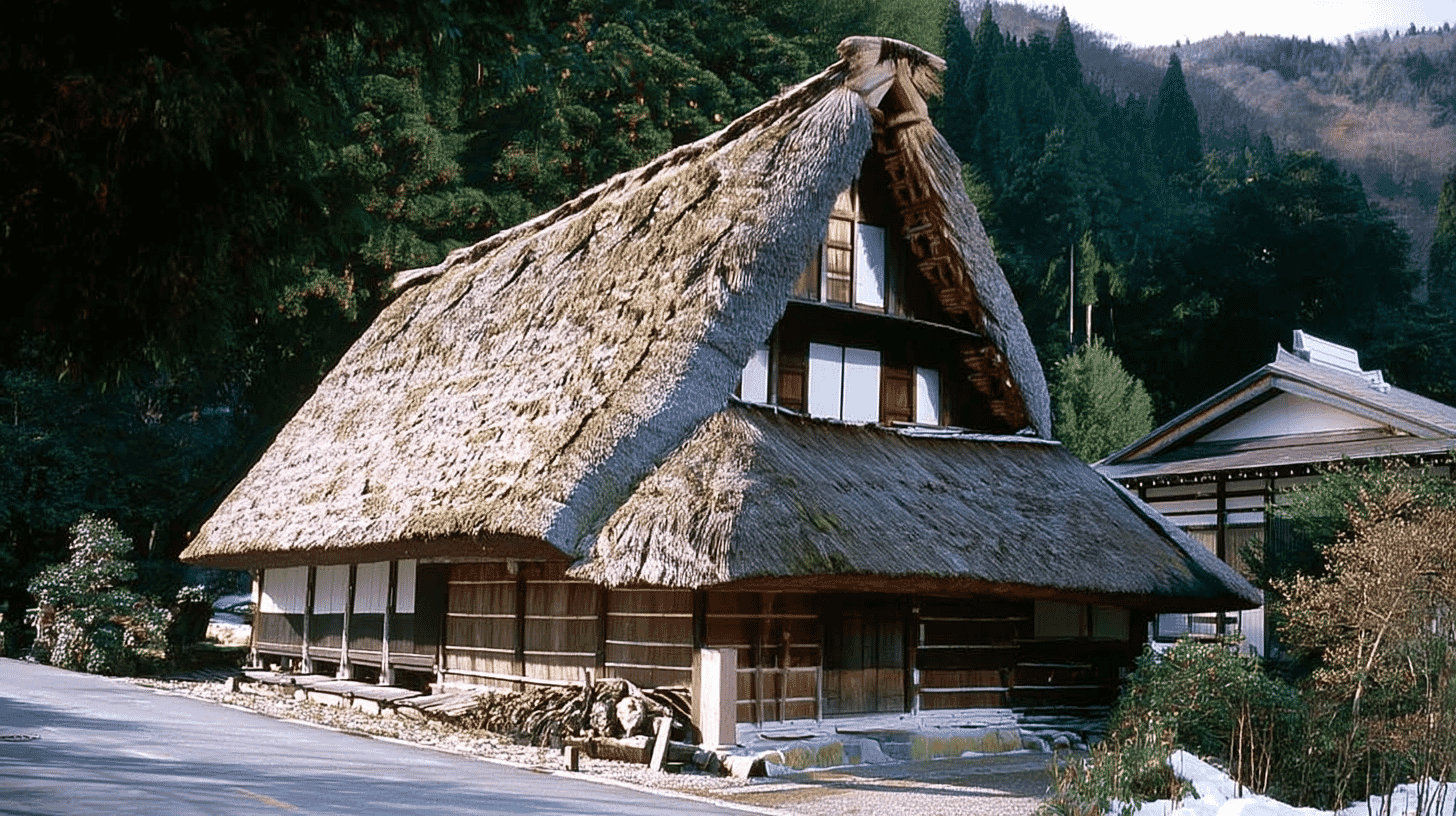
Hamba Family Residence: A Window into the Origins of Gasshō-Zukuri Architecture
Tucked away in the quiet Tamukai settlement of Toyama Prefecture, the Hamba Family Residence (羽馬家住宅) stands as a precious time capsule of Japan's architectural heritage. Designated as an Important Cultural Property of Japan, this modest yet historically significant farmhouse preserves the earliest known form of gasshō-zukuri construction—the iconic "praying hands" style of traditional mountain architecture that has captivated visitors to the nearby UNESCO World Heritage Gokayama region.
Unlike its larger and more elaborate neighbors, the Hamba residence offers visitors something truly unique: an authentic glimpse into how ordinary mountain families lived before the gasshō-zukuri style evolved into the grand multi-story structures we see today. This is not a museum recreation—it is the real thing, remarkably preserved through centuries of careful stewardship.
Why Hamba Family Residence Earned National Recognition
The Hamba Family Residence was designated as an Important Cultural Property on May 14, 1958, alongside two other significant gasshō-zukuri houses in the Gokayama area: the Murakami Family Residence and the Iwase Family Residence. However, what sets the Hamba residence apart is its exceptional representation of the most primitive stage of gasshō-zukuri development.
Architectural historians believe the building dates to the Kanbun era (1661-1672) of the mid-Edo period, making it potentially over 350 years old. According to local records, the house was relocated from Ōshima settlement, approximately 4 kilometers downstream, to its current location in 1769 after a devastating fire destroyed most of Tamukai village.
The cultural significance of this residence lies in several key factors. First, the structure demonstrates the earliest stage of gasshō-zukuri development, with notably finer timber proportions compared to later constructions. Second, minimal alterations have been made over the centuries, preserving the original construction methods and spatial arrangements. Third, the residence retains ancient construction techniques including adze and spokeshave finishing on structural members. Finally, it provides invaluable insight into the evolution of traditional mountain architecture in this region.
Architectural Features: Reading the Story in the Beams
The Hamba Family Residence reveals its age through numerous architectural details that distinguish it from later gasshō-zukuri buildings. The main structure measures 14.3 meters in length and 8.8 meters in depth, with eaves attached to both the east and west sides. The building rises three stories beneath its characteristic steep thatched roof.
The floor plan consists of just four rooms: the Oe (main living area with the central hearth), Dei (formal reception room), Nema (sleeping quarters), and Omae (a secondary space). This compact arrangement represents the basic template from which larger and more complex gasshō-zukuri houses would later evolve.
One particularly notable feature is the Nema, or master bedroom, which is almost entirely enclosed with only a raised threshold entrance called a chōdaigamae. This "canopy bed-style" entrance—a design element borrowed from aristocratic architecture—would have provided both privacy and protection from drafts in the harsh mountain winters.
The interior height of approximately 1.7 meters (5 shaku 6 sun in traditional measurements) reflects the smaller stature of people in earlier centuries and the need for heat efficiency. The timber members throughout show the distinctive texture of hand-finishing with traditional tools, a technique that was later replaced by mechanical planing in newer constructions.
The Gokayama Context: Understanding the Broader Heritage
The Hamba Family Residence sits within the cultural landscape of Gokayama, a mountainous region whose name means "Five Mountains." For centuries, the steep valleys and heavy snowfall of this area—often exceeding 3 meters annually—isolated these communities from the outside world, creating a distinctive way of life that persisted well into the modern era.
During the Edo period, the Gokayama region was administered by the powerful Kaga Domain (present-day Kanazawa area). The harsh terrain made rice cultivation nearly impossible, so villagers developed alternative industries under domain patronage. Saltpeter production for gunpowder, sericulture (silkworm raising), and traditional papermaking became the economic foundations of these mountain communities.
The gasshō-zukuri style evolved to accommodate these industries. The steep 60-degree roof angle shed heavy snow effectively while creating expansive attic spaces perfect for silkworm cultivation. The large structures we see today at World Heritage sites like Ainokura and Suganuma represent the fully developed form of this architectural tradition. The Hamba residence, by contrast, shows us the humble beginnings from which this distinctive building type emerged.
Visiting Hamba Family Residence: What to Expect
Unlike some cultural properties that have been converted into museums, the Hamba Family Residence retains its character as a private home. The exterior can be viewed freely, and during certain periods, visitors may glimpse the interior through open sliding doors. This authentic preservation means the experience is less about curated exhibits and more about appreciating the building as it has been lived in for over three centuries.
Adjacent to the residence stands Kōmyō-ji Temple, whose grounds contain a monument with an inscription attributed to Katsu Kaishū, the famous statesman who negotiated the peaceful transfer of Edo Castle at the end of the shogunate. The monument records the hardship of farmers from Kanazawa who were exiled to this region during the Edo period, adding another layer of historical depth to the site.
The Tamukai settlement itself offers a peaceful contrast to the more visited World Heritage villages. Here, the pace of tourism slows considerably, allowing visitors to appreciate the authentic mountain village atmosphere without crowds. The settlement is located across the Taira Bridge from the Kaminashi district, where the famous Murakami Family Residence stands.
Nearby Attractions: Creating Your Gokayama Itinerary
The Hamba Family Residence works best as part of a broader exploration of Gokayama's cultural heritage. Just across the river, the Murakami Family Residence (also designated as an Important Cultural Property) offers a fascinating comparison. While both date to the mid-Edo period, the Murakami house represents a more developed stage of gasshō-zukuri architecture with its four-story structure and elaborate interior features. The Murakami residence functions as a museum and offers guided explanations by the current owner, as well as performances of traditional kokiriko folk dances by reservation.
The UNESCO World Heritage villages of Ainokura and Suganuma are easily accessible from the Kaminashi area. Ainokura preserves 20 gasshō-zukuri houses dating from 100 to 350 years ago, while the smaller Suganuma features 9 houses in a particularly picturesque setting along the Shōgawa River. Both villages offer accommodations in traditional farmhouses, providing an immersive overnight experience.
For those interested in traditional crafts, the Gokayama Washi no Sato (Japanese Paper Village) offers hands-on papermaking experiences using techniques that have been practiced in this region for centuries. The paper produced here was historically so valued that it was used for official Kaga Domain documents.
Best Times to Visit
Each season brings its own character to the Gokayama region. Spring (April-May) sees the mountains come alive with fresh greenery, and the famous 300-year-old camellia tree at nearby Murakami residence blooms with distinctive striped flowers. Summer (June-August) offers lush landscapes and comfortable temperatures for exploring, while the September Kokiriko Festival brings vibrant folk performances to the region.
Autumn (September-November) paints the mountainsides in spectacular colors, creating picture-perfect scenes of thatched roofs against crimson and gold foliage. Winter (December-March) transforms the landscape into a snow-covered wonderland, with annual illumination events at the World Heritage villages creating magical nighttime scenes. However, winter visitors should note that some facilities may have limited hours, and road conditions can be challenging.
Practical Tips for Visitors
When visiting the Hamba Family Residence and surrounding area, comfortable walking shoes are essential, as the terrain includes unpaved paths and uneven surfaces. The residence is a private property, so please observe from a respectful distance and avoid entering the grounds without permission.
Photography of the exterior is generally permitted, but always be mindful of residents' privacy. The best exterior views can be obtained from the approach path and public road.
Consider combining your visit with stops at the Gokayama Tourist Information Center near the Murakami residence, where English materials and local recommendations are available. The center can also provide updated information on seasonal events and accessibility.
- 📍 Plan Your Visit to Toyama
- Find tours, activities & transport passes near Uma Family Residence (Taira Village, Higashitonami District,
- [ Kurobe Gorge Train & Tateyama Alpine Route ]
Q&A
- Can visitors go inside the Hamba Family Residence?
- The Hamba Family Residence remains a private home, so interior access is not regularly available. However, visitors can view the exterior freely, and during certain times when the sliding doors are open, glimpses of the interior may be possible. For a full gasshō-zukuri interior experience, the nearby Murakami Family Residence operates as a museum with regular visiting hours.
- What makes Hamba Family Residence different from other gasshō-zukuri houses?
- The Hamba Family Residence preserves the earliest known form of gasshō-zukuri architecture. Unlike the larger, multi-story structures at the World Heritage sites, this residence shows the simpler, more compact design from which the style evolved. Its finer timber proportions, enclosed bedroom design, and hand-finished structural members using traditional tools are characteristics rarely seen in later buildings.
- How do I get to Hamba Family Residence from the Gokayama World Heritage villages?
- From the World Heritage villages, take the World Heritage Bus toward Takaoka and alight at the "Kaminashi" stop. The residence is about a 6-minute walk from the bus stop, across the Taira Bridge in the Tamukai settlement. By car, it's approximately 8 minutes from Gokayama IC on Route 156 toward Tonami.
- Is there an admission fee for Hamba Family Residence?
- There is no admission fee for viewing the exterior of the Hamba Family Residence. As a private residence that can be appreciated from the public path, visitors can experience this Important Cultural Property at no cost.
- What other Important Cultural Properties are nearby?
- The Gokayama region has three Important Cultural Property gasshō-zukuri residences designated in 1958: Hamba Family Residence, Murakami Family Residence (in Kaminashi, across the river), and Iwase Family Residence (in Nishi-Akao, near the Gifu border). Each represents a different stage of gasshō-zukuri development, making visiting all three an excellent way to understand the architectural evolution of this unique building style.
Basic Information
| Name | Hamba Family Residence (羽馬家住宅) |
|---|---|
| Designation | Important Cultural Property of Japan (designated May 14, 1958) |
| Construction Period | Mid-Edo Period (estimated Kanbun era, 1661-1672) |
| Architectural Style | Gasshō-zukuri (gable-entry, three-story, thatched roof) |
| Dimensions | 14.3m length × 8.8m depth, with eaves on east and west sides |
| Address | 254 Tamukai, Nanto City, Toyama Prefecture 939-1913 |
| Admission | Free (exterior viewing only) |
| Access | By car: 8 min from Gokayama IC via Route 156 toward Tonami, cross Taira Bridge to Tamukai. By bus: World Heritage Bus to "Kaminashi" stop, 6 min walk. |
| Contact | 076-237-9655 (Hamba Family) |
References
- Hamba Family Residence - Cultural Heritage Online (Agency for Cultural Affairs)
- https://bunka.nii.ac.jp/heritages/detail/155285
- Important Cultural Property Hamba Family Residence - Gokayama Official Tourism Site
- https://gokayama-info.jp/archives/1711
- Hamba Family Residence - Toyama Cultural Heritage
- https://toyama-bunkaisan.jp/search/1526/
- Hamba Family Residence - Nanto City Cultural Properties
- https://culture-archives.city.nanto.toyama.jp/culture/bunkazai/bunkazai0004/
- Historic Villages of Shirakawa-go and Gokayama - UNESCO World Heritage Centre
- https://whc.unesco.org/en/list/734/
- Gasshō-zukuri Architecture - World Heritage Center Shirakawa-go and Gokayama
- https://whc-shirakawa-goandgokayama.jp/learn/structure/
- Gokayama Gasshō-zukuri Villages - Toyama Cultural Heritage
- https://toyama-bunkaisan.jp/pickup/world02.php
Last verified: 2026.01.29