
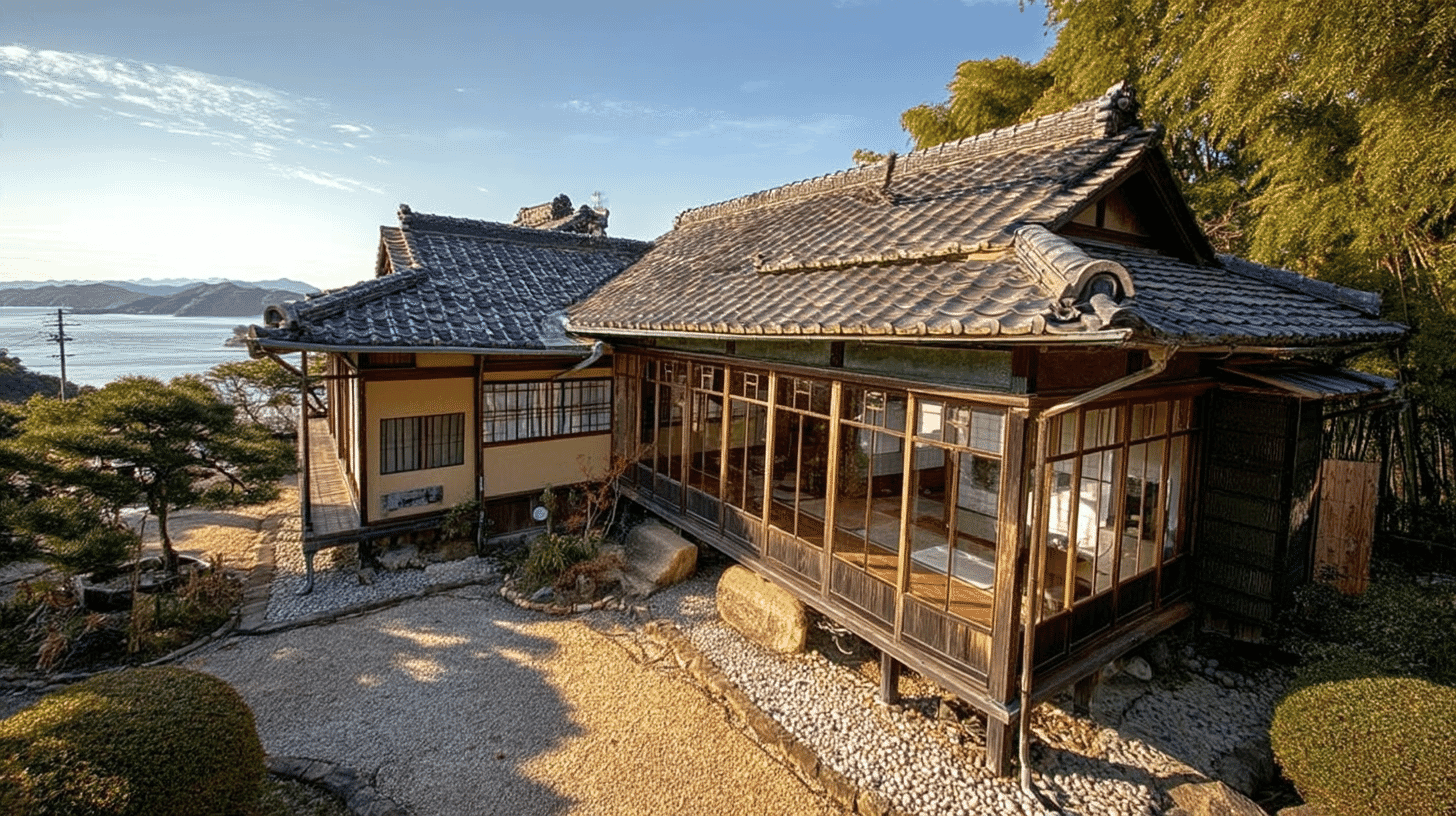
A Detached Building of 1916, Registered in 2022
Gamagori Classic Hotel Ryotei Takeshima (former Tokiwakan Ume Annexe) (蒲郡クラシックホテル料亭竹島(旧常磐館梅別館)) is a detached building of 1916 at 451-1 and adjoining lots, Takeshima-cho, Gamagori City, Aichi Prefecture, entered on the national register of tangible cultural properties on 17 February 2022. The quantity is one building: timber, single storey, tiled roof, with a footprint of 125 square metres. It belongs to Gamagori Classic Hotel Co.
The Agency for Cultural Affairs writes: a detached building on the hill south of the main building. Single storey, with a hip-and-gable roof of pantiles in a complex composition. The entrance on the north face projects slightly, and two guest rooms are set east of the entrance vestibule. The room projecting to the southeast carries snow-viewing screens and commands a view of Mikawa Bay. Exposed-post construction with much use of bamboo gives a modern Japanese character on a sukiya basis.
Of the four buildings registered together, this is the oldest. The main building dates from 1934 and the Rokkakudo from 1936, while the Oshukutei is given only as early Showa, 1926 to 1945. This one is dated 1916.
Snow-Viewing Screens and a Projecting Room
The most concrete part of the Agency's account is the room to the southeast: it carries snow-viewing screens and commands a view of Mikawa Bay.
A snow-viewing screen sets glass into the lower part of a paper screen, with a small sliding panel in front of it that can be raised. Raise the panel and the outside is visible from a seated position. The name comes from watching snow from indoors.
The room projects to the southeast for the sake of that view. Pushing part of the plan beyond the outline of the building allows openings on three sides.
Sitting to look out is what both the screens and the projection answer to. These are not windows made for standing at.
Exposed Posts and Bamboo
The Agency writes of exposed-post construction with much use of bamboo, giving a modern Japanese character on a sukiya basis.
Exposed-post construction leaves the columns visible rather than burying them in the wall. The columns stand forward of the wall face, so their spacing becomes the division of the elevation. It is the opposite approach to hiding the frame within the wall.
Heavy use of bamboo belongs to the sukiya manner. Members that keep their roundness and their nodes, rather than squared timber, give a lightness that holds back formality. The Oshukutei on the same grounds uses log timbers in the same spirit.
The roof is hip-and-gable in pantiles, which the Agency calls a complex composition. Hip-and-gable forms are combined to give relief, so the outline is not simple even in a single-storey building. The slightly projecting entrance on the north face is part of that.
Its Place Among the Four
Four buildings including this one were registered together on 17 February 2022: the main building (former Gamagori Hotel main building), the Rokkakudo (former Gamagori Hotel Shubido) and the Oshukutei (former Tokiwakan annexe tea house). Each carries its own registration.
The former names divide them into two lines. The main building and the Rokkakudo come from the former Gamagori Hotel; the Gamagori Classic Hotel Ryotei Takeshima and the Oshukutei from the former Tokiwakan. These two are buildings of the same earlier establishment.
Both stand as detached buildings on the hill south of the main building and share a sukiya basis. But the Ryotei Takeshima holds two guest rooms while the Oshukutei holds a tea room, so their uses differ, and their footprints are 125 and 90 square metres.
The main building is three storeys of reinforced concrete, different again in scale and structure. The four share a site but not their origins or their uses.
Using the Building
The Ryotei Takeshima was refitted in 2025 and is in use as lodging under the name THE COVE. Seeing the interior means becoming a guest.
Conditions of use and charges can change, so check before travelling. Registration brings no opening days and no admission charge.
Registration is a separate mechanism from designation: it works by notification and leaves the owner wide freedom to keep using the building. Changing its use while continuing in service follows from that framework.
From Gamagori Station on the JR Tokaido Main Line it is about five minutes by car or fifteen minutes on foot.
Q&A
- When was the Ryotei Takeshima built and registered?
- The Agency for Cultural Affairs dates it to 1916. It was entered on the national register of tangible cultural properties on 17 February 2022. It counts as one building: timber, single storey, tiled roof, footprint 125 square metres. It is the oldest of the four registered together.
- What is a snow-viewing screen?
- A paper screen with glass set into its lower part and a small sliding panel in front that can be raised, so that the outside is visible from a seated position. The Agency records that the room projecting southeast carries these screens and commands a view of Mikawa Bay.
- What is exposed-post construction?
- A method that leaves the columns visible rather than burying them in the wall, so that their spacing becomes the division of the elevation. It is the opposite of hiding the frame within the wall. Here it is combined with heavy use of bamboo for a modern Japanese character on a sukiya basis.
- How does it relate to the other buildings on the site?
- Four were registered together on 17 February 2022, each with its own entry. The former names divide them: the main building and the Rokkakudo from the former Gamagori Hotel, the Ryotei Takeshima and the Oshukutei from the former Tokiwakan. The last two are both detached buildings on the same hill, but one holds guest rooms and the other a tea room.
- Can the building be seen?
- It was refitted in 2025 and is in use as lodging under the name THE COVE, so seeing the interior means becoming a guest. Registration brings no opening days and no admission charge. Conditions of use and charges can change, so check before travelling.
Basic Information
| Name | Gamagori Classic Hotel Ryotei Takeshima (former Tokiwakan Ume Annexe) (蒲郡クラシックホテル料亭竹島(旧常磐館梅別館)) |
|---|---|
| Location | 451-1 and adjoining lots, Takeshima-cho, Gamagori City, Aichi Prefecture |
| Designation | Registered Tangible Cultural Property (structure) |
| Year Designated | 2022 (17 February), registered |
| Quantity | 1 building |
| Dimensions | Timber, single storey, tiled roof, footprint 125 square metres. Hip-and-gable roof in pantiles, complex in composition. Entrance on the north face projecting slightly, with 2 guest rooms east of the vestibule. The room projecting southeast carries snow-viewing screens. Exposed-post construction with much use of bamboo, on a sukiya basis. Built 1916 |
| Owner | Gamagori Classic Hotel Co. |
| Public Access | Refitted and in use as lodging. The interior is reached as a guest. No opening days or admission charge are set |
References
- Cultural Heritage Online: Gamagori Classic Hotel Ryotei Takeshima
- https://bunka.nii.ac.jp/heritages/detail/554415
- Cultural Heritage Online: Gamagori Classic Hotel Oshukutei
- https://bunka.nii.ac.jp/heritages/detail/584026
- Gamagori tourism association
- https://www.gamagori.jp/spot/750
- Agency for Cultural Affairs: the registration system for tangible cultural properties
- https://www.bunka.go.jp/seisaku/bunkazai/shokai/yukei_kenzobutsu/
Last verified: 2026.09.04