
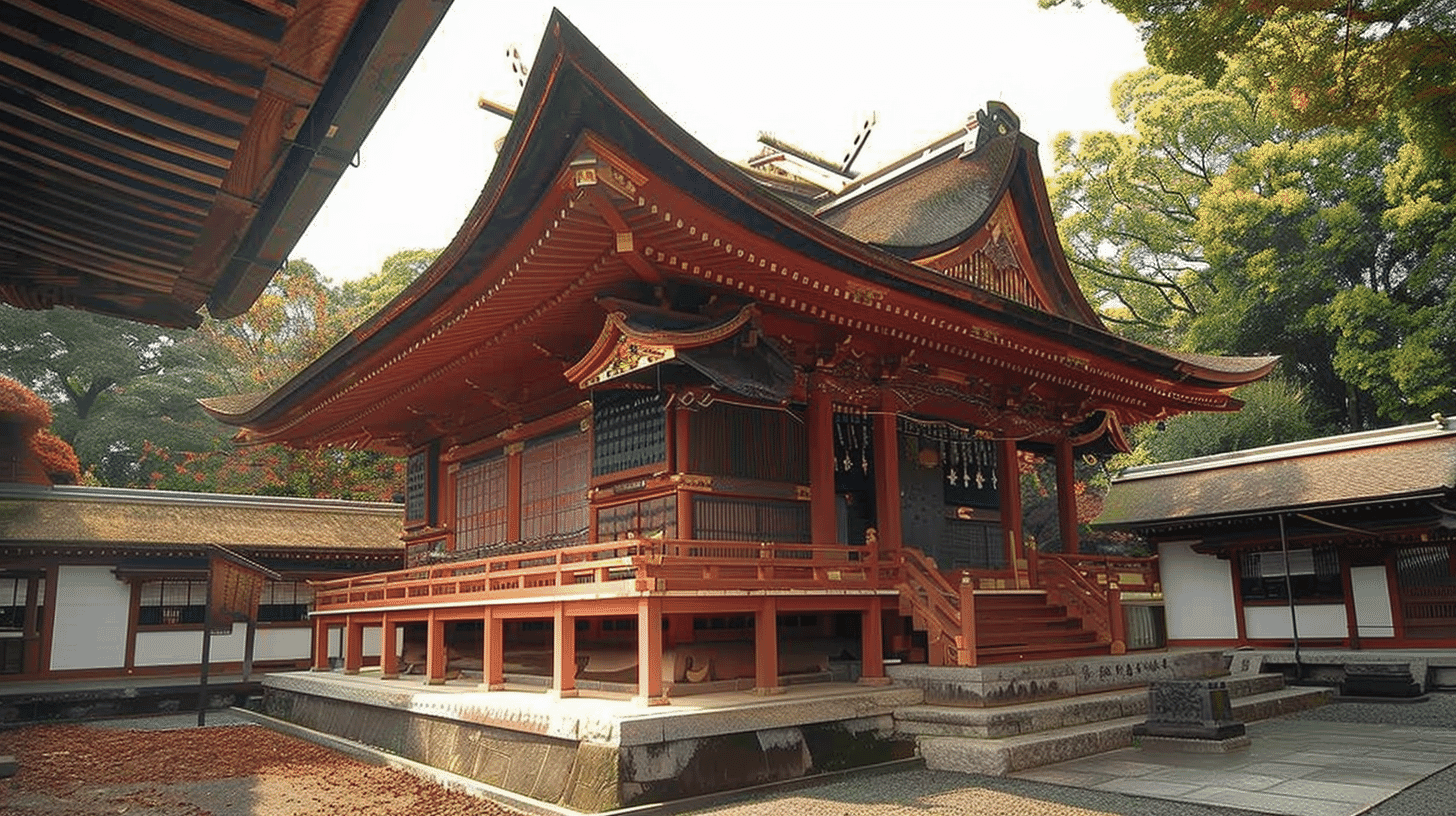
A Three-Bay Nagare Hall of 1605, Designated in 1920
Tsushima Shrine Main Hall (津島神社本殿, Tsushima Jinja Honden) is a Momoyama-period shrine building at Shinmei-cho, Tsushima City, Aichi Prefecture, designated an Important Cultural Property in 1920, on 15 April. The quantity is one building, three bays wide in the nagare form under a cypress bark roof. The Agency for Cultural Affairs dates it to the Momoyama period, 1605. It belongs to Tsushima Shrine.
The Agency's database records only the form and the date for this building and carries no commentary. The record holds a form and a year and no words of assessment.
The three-bay nagare form is a shrine building three bays across the front whose roof extends forward over the approach. Nagare is the form most widely used for shrine sanctuaries.
The Tower Gate Is a Separate Designation
Tsushima Shrine also has a tower gate, likewise an Important Cultural Property but under a designation separate from the hall.
The gate was designated on 14 May 1958, thirty-eight years after the hall. Its form is a three-bay gate with one opening, hip-and-gable roof, cypress bark. The Agency dates it to the Tensho era, about 1590.
The commentary for the gate opens: the main hall of Tsushima Shrine is already an Important Cultural Property. The gate was built in the Tensho era. It is a well-proportioned three-bay gate with one opening. That opening phrase, already designated, marks the gate as the later addition to the list.
The order of building runs the other way. The gate dates to about 1590 and the hall to 1605, so the gate is the older by some fifteen years.
The Class of Designation
Tsushima Shrine Main Hall holds Important Cultural Property status. It has not been raised beyond that.
The field for the higher designation in the Agency's database is blank. Earlier descriptions that could be read as claiming the higher status are mistaken, and the class of designation should be handled precisely.
An Important Cultural Property is designated by the state under the Law for the Protection of Cultural Properties. From among those, items of particular value receive a further designation. This building stands at the first of those stages.
Other cultural properties in the precinct are designated by the city or the prefecture, which is a different class again from designation by the state.
The Term Owari-Zukuri
The arrangement of buildings at Tsushima Shrine is sometimes called owari-zukuri, a form found in the Owari region: sanctuary, offering hall, corridor and worship hall set one behind another.
The Agency's record, however, gives the form of the hall only as three-bay nagare and does not use the word owari-zukuri. That term describes the arrangement of several buildings rather than the form of one.
What is designated is the one building, not the arrangement. The two should not be confused. This article treats owari-zukuri as a term for how the precinct reads.
The three-bay nagare form of the hall itself is found widely across Japan and is not particular to Owari.
Visiting
The precinct is open. The main hall stands within a fence and is worshipped from the hall in front of it, so how closely the exterior can be seen is limited.
The tower gate stands at the entrance to the precinct and can be seen close to. Three bays with one opening means three intervals across the front, the middle one serving as the passage.
The Owari Tsushima Tenno festival is held in July. It is an Important Intangible Folk Cultural Property and one of the events inscribed on the UNESCO list of intangible cultural heritage as Yama, Hoko, Yatai float festivals. This is a separate framework from the designation of the buildings.
From Tsushima Station on the Meitetsu Tsushima Line it is about fifteen minutes on foot.
Q&A
- When was Tsushima Shrine Main Hall built and designated?
- The Agency for Cultural Affairs dates it to the Momoyama period, 1605. It was designated an Important Cultural Property in 1920, on 15 April. It counts as one building, three bays wide in the nagare form under a cypress bark roof.
- What class of designation does it hold?
- Important Cultural Property. The field for the higher designation in the Agency's database is blank. Items of particular value among Important Cultural Properties receive a further designation, and this building has not been raised to that level.
- Is the tower gate covered by the same designation?
- No, it carries its own. The gate was designated on 14 May 1958, thirty-eight years after the hall, also as an Important Cultural Property. Its form is a three-bay gate with one opening under a hip-and-gable cypress bark roof, dated to about 1590, so the gate is the older of the two by some fifteen years.
- What is owari-zukuri?
- A term for an arrangement of sanctuary, offering hall, corridor and worship hall set one behind another, found in the Owari region. The Agency's record gives the form of the hall only as three-bay nagare and does not use the term, which describes an arrangement of several buildings rather than the form of one. What is designated is the single building.
- Can the main hall be seen close to?
- The precinct is open, but the hall stands within a fence and is worshipped from the hall in front, so close views of the exterior are limited. The tower gate at the entrance can be seen close to. It is about fifteen minutes on foot from Tsushima Station on the Meitetsu Tsushima Line.
Basic Information
| Name | Tsushima Shrine Main Hall (津島神社本殿, Tsushima Jinja Honden) |
|---|---|
| Location | 1 Shinmei-cho, Tsushima City, Aichi Prefecture |
| Designation | Important Cultural Property (structure); the tower gate carries its own Important Cultural Property designation |
| Year Designated | 1920 (15 April), Important Cultural Property |
| Quantity | 1 building |
| Dimensions | Three bays wide, nagare form, cypress bark roof. Momoyama period, 1605 |
| Owner | Tsushima Shrine |
| Public Access | Precinct open. The hall stands within a fence and is worshipped from the hall in front of it |
References
- Cultural Heritage Online: Tsushima Shrine Main Hall
- https://bunka.nii.ac.jp/heritages/detail/174472
- Cultural Heritage Online: Tsushima Shrine tower gate
- https://bunka.nii.ac.jp/heritages/detail/189073
- Aichi Prefecture, cultural properties navigator
- https://www.pref.aichi.jp/kyoiku/bunka/bunkazainavi/
- Tsushima Shrine official site
- https://tsushimajinja.or.jp/
Last verified: 2026.09.03