
One Mirror, National Treasure since 1953
Mirror Image with a Line-Engraved Thousand-Armed Kannon and Other Figures (線刻千手観音等鏡像, Senkoku Senju Kannon-to Kyozo) is a Heian-period craft object owned by Suijinja in Akita Prefecture, made an Important Cultural Property on 4 July 1938 and designated a National Treasure on 14 November 1953. The quantity is one mirror.
It measures 13.9 centimetres across and 0.6 centimetres thick. The address field in the Agency's database is blank, the twelfth such case.
14 November 1953 is the day of the red-laced and white-laced armours, the scroll at Zentsuji, the Toshodaiji sutra repository and the Kozanji Buddha hall: a sixth property on that date.
A Shrine Arose to Enshrine the Mirror
Owner and object come in the reverse of the usual order.
The Agency records that the mirror was dug up in 1677 during work to open an irrigation channel at a place in what is now Akita Prefecture.
It continues that the local people built a small shrine and came to worship it as the deity of the weir.
The mirror came out of the ground during the work, and a shrine was raised to enshrine it.
The owner is Suijinja, the water deity shrine. That shrine came into being after the mirror was found.
At the Kozanji Buddha hall, the building stood seven years before the temple was founded. At the Toshodaiji sutra repository, a storehouse older than the temple was converted for it. Those turn on buildings and temples.
Here an object came first, and an owner appeared in order to enshrine it.
Marks of a Fire Remain
Damage is written down as it stands.
The mirror passed through a fire at some point, and scorching and darkening can be seen here and there along the rim of its back.
Both the fire and the traces it left on the rim are recorded.
The figurine from the Kazabari 1 site had broken into four parts and been joined again with natural asphalt: a record of repair.
With the rhinoceros-horn knife, the scabbard was lost and only its rivets remained: a trace of what is gone.
Here nothing was mended and nothing is missing. What was damaged remains damaged, and the marks are set down.
A Face Under Fifteen Centimetres, Worked Like a Painting
The assessment opens by conceding the size.
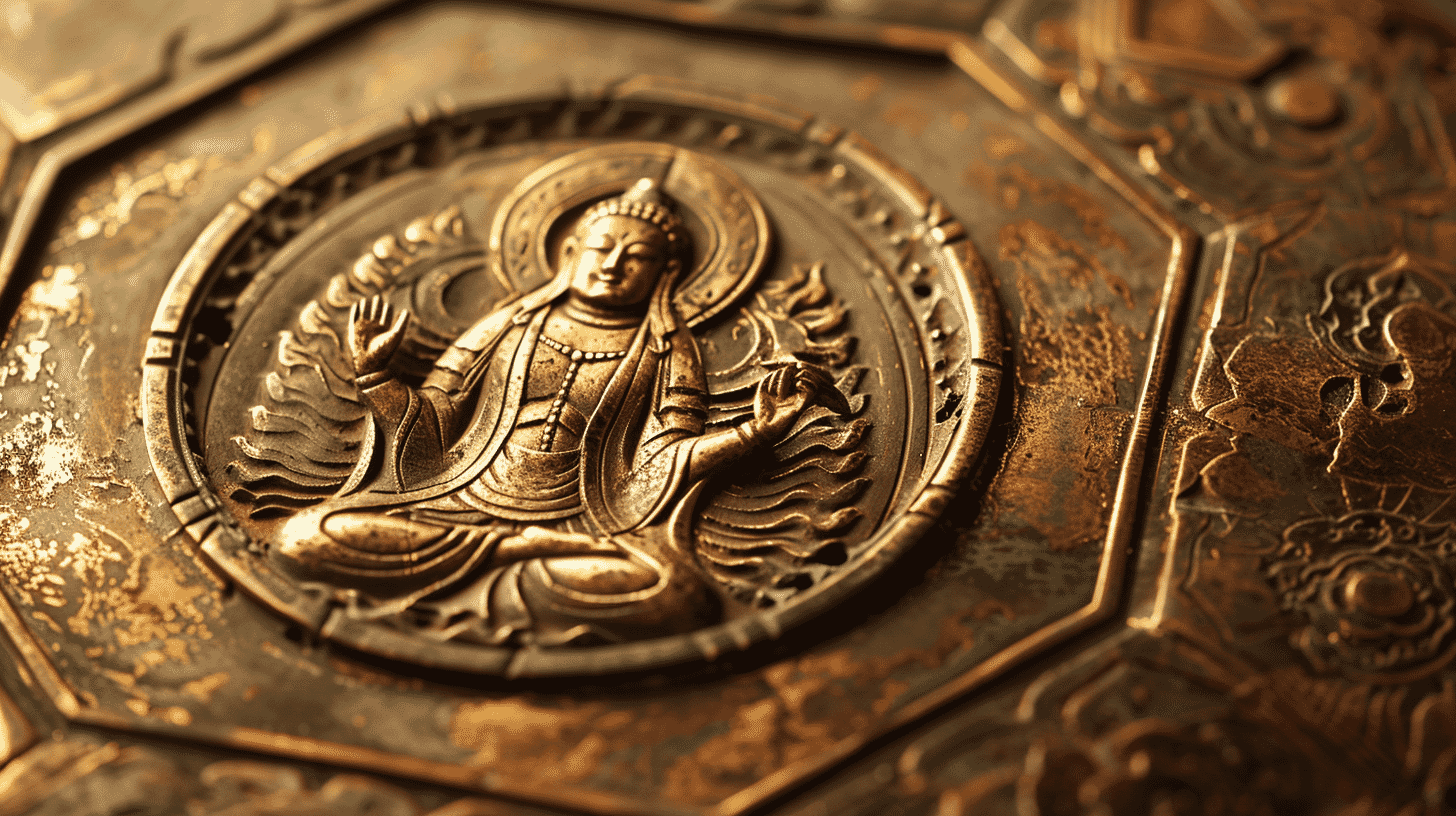
On a mirror face not even fifteen centimetres across, the record says, the full features of the Thousand-Armed Kannon are worked in fine chased lines, with a pedestal suggesting shaded colour, giving a delicacy like that of a Buddhist painting; among engraved mirror images it is a work of value.
The actual diameter is 13.9 centimetres. Not even fifteen, in those words.
Osasahara Shrine Main Hall conceded that the building was small before its details were praised. The Hosoge sutra box set a condition, granting that the pattern was scrollwork, before turning to its merits.
This follows the same shape: the smallness is stated, and then what it holds is listed.
What it holds is a good deal. A Thousand-Armed Kannon at the centre, an ascetic sage at the lower left, a goddess of merit at the lower right, and four heavenly figures above them: seven figures within 13.9 centimetres.
Seeing It
The mirror belongs to Suijinja. The address field in the Agency's database is blank, though it is recorded as being in Akita Prefecture.
The back is described: a plain round boss, a rounded rim, flowering scrollwork set above, below and to either side of the cord hole, and butterflies between the flowers toward the rim.
That flower pattern is the one on the Hosoge sutra box. There it covers the outside of a box; here it covers the back of a mirror.
An inscription is recorded as well: characters concerning the making of the image are engraved toward the left of the back.
Related entries include other engraved mirror images with the Buddha and attendant figures, twelve deities, and an eleven-headed Kannon. It is a shrine holding, not kept on permanent display. Check before travelling.
- 📍 Plan Your Visit to Akita
- Find tours, activities & transport passes near Mirror Image with a Line-Engraved Thousand-Armed Kannon and Other Figures
- [ Kakunodate Samurai District & Lake Tazawa Tours ]
Q&A
- When was the mirror designated?
- It became an Important Cultural Property on 4 July 1938 and a National Treasure on 14 November 1953. The quantity is one mirror and the owner Suijinja.
- How was it found?
- The Agency records that it was dug up in 1677 during work to open an irrigation channel, and that the local people built a small shrine and came to worship it as the deity of the weir.
- Is it damaged?
- Yes. The Agency records that it passed through a fire at some point and that scorching and darkening can be seen along the rim of its back. Nothing was mended.
- How large is it?
- 13.9 centimetres across and 0.6 centimetres thick. The Agency opens its assessment with the words not even fifteen centimetres across, conceding the size first.
- What is engraved on it?
- A Thousand-Armed Kannon at the centre, an ascetic sage at the lower left, a goddess of merit at the lower right, and four heavenly figures above: seven figures within 13.9 centimetres.
Basic Information
| Name | Mirror Image with a Line-Engraved Thousand-Armed Kannon and Other Figures (線刻千手観音等鏡像, Senkoku Senju Kannon-to Kyozo) |
|---|---|
| Location | The address field in the Agency's database is blank; the owner is given as Suijinja |
| Designation | National Treasure (craft) |
| Year Designated | 1938 (4 July), Important Cultural Property; 1953 (14 November), National Treasure |
| Quantity | 1 mirror |
| Dimensions | 13.9 centimetres across and 0.6 centimetres thick. An 8-lobed mirror of white bronze, its face engraved with a Thousand-Armed Kannon on a lotus seat, with an ascetic sage, a goddess of merit and 4 heavenly figures. The back carries flowering scrollwork with butterflies and an inscription toward the left. Marks of a fire remain along the rim. The period is Heian |
| Owner | Suijinja |
| Public Access | A shrine holding, not on permanent display |
References
- Cultural Heritage Online: the engraved mirror image at Suijinja
- https://bunka.nii.ac.jp/db/heritages/detail/159335
- Daisen City: cultural properties
- https://www.city.daisen.lg.jp/docs/2013111300479/
- Akita Prefecture: cultural properties
- https://www.pref.akita.lg.jp/
- Agency for Cultural Affairs, National Cultural Properties Database
- https://kunishitei.bunka.go.jp/
Last verified: 2026.09.06