
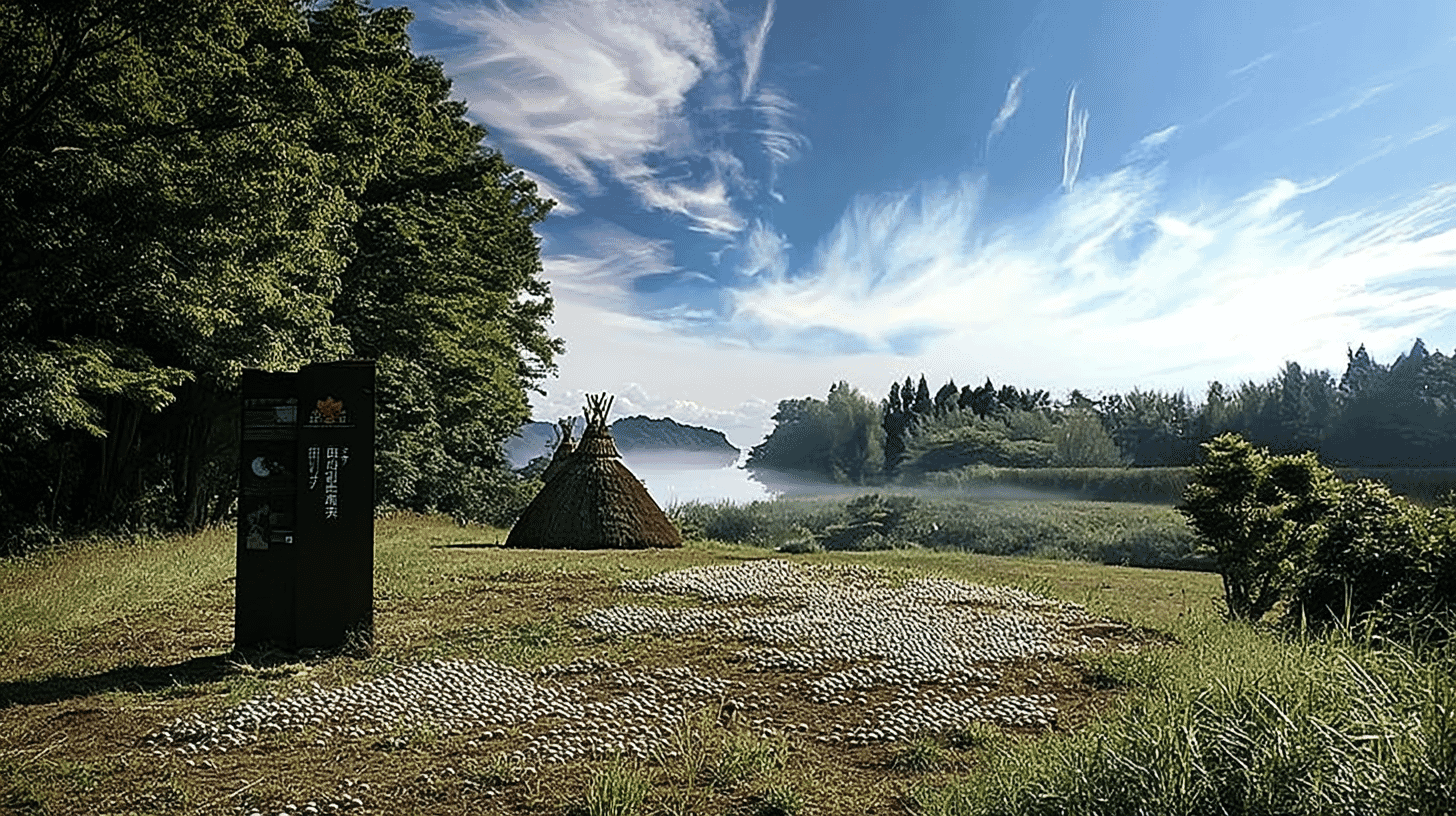
One Shell Mound, Designated by the State in 1944
Tagoyano Shell Mound (田小屋野貝塚, Tagoyano Kaizuka) lies at Tagoyano, Tateoka, Kizukuri, Tsugaru City, Aomori Prefecture, the site of a Jomon settlement with a shell mound, designated by the state on 26 June 1944. Its category is that of historic sites.
It is also one of the component sites of the Jomon Prehistoric Sites in Northern Japan.
The office for the Jomon sites records that it stands on a hill 10 to 15 metres above sea level along the Iwaki River, facing an inner bay formed when the sea stood higher. The site is dated from 4000 BCE to 2000 BCE.
Unfinished Shell Bracelets Show a Place of Making
What has been found is not finished work but work stopped partway.
The office for the Jomon sites records that many unfinished bracelets of a large bivalve shell were found, showing that bracelets were made within the settlement.
All the bracelets found are unfinished or broken, and a workshop for making them is thought to have been here.
At Tomo, the tools of making and the things made survive together.
Here the half-made and broken pieces themselves show that making went on. The finished bracelets left the settlement.
Bracelets of the same shell from the same period have been found in Hokkaido, and obsidian from Hokkaido has been found here, the record continues, which tells of trade across the strait.
Brackish-Water Shells Show the Shore of an Inner Bay
The contents of the mound show what the waters were like.
The office for the Jomon sites records that the mound yields chiefly shells such as a brackish-water clam, along with fish bones such as carp and mackerel and bird bones such as geese and ducks.
Brackish water is where river water and sea water mix. The kind of shell shows that the mound, now on an inland hill, once stood on the shore of an inner bay.
The settlement has pit dwellings, graves, the shell mound, a refuse area and storage pits, showing the typical layout of a settlement of this period.
The refuse area was also a place of everyday rites, and besides pottery and stone tools it has yielded tools made from the bones of whales, dolphins and other large mammals.
Shellfish from the bay, fish from the river, birds from the sky and beasts from the sea come together in the remains of one settlement.
A Pelvis Shows a Woman Who Had Given Birth
From the bones of one buried person, something of her life is read.
The office for the Jomon sites records that the burial of a woman who had borne children was found in a pit grave; the state of the pelvis shows she was an adult woman who had given birth.
A pit grave lays the body in a hole dug in the ground.
At the Kanenokuma site, contact with the Korean peninsula is supposed from the average height and face shape of the skeletons.
Here the form of one person's bones shows that she bore a child.
The city records that the Tagoyano corner of its Jomon dwelling museum shows finds from the site and the skeleton of an adult woman of the Early Jomon.
Visiting
The site lies at Tagoyano, Tateoka, Kizukuri, Tsugaru City, Aomori Prefecture.
The office for the Jomon sites calls it a settlement with a shell mound from the first half of the period of developed sedentism, important for showing livelihood and settlement life in an inner-bay district.
The site is said to be closed in winter. Finds can be seen at the city's Jomon dwelling museum. Conditions may change. Check before travelling.
The national online heritage database has no entry for this site. This article rests on the records of the office for the Jomon sites and the city.
The designation came in 1944, during the war.
Q&A
- When was the site designated?
- On 26 June 1944, by the state, as a historic site.
- What has been found?
- Pit dwellings, graves, the shell mound, a refuse area and storage pits, with unfinished shell bracelets, bone tools and human remains.
- What do the bracelets show?
- That bracelets were made in the settlement, and, since the same bracelets are found in Hokkaido, that there was trade across the strait.
- What shells were found?
- Chiefly a clam of brackish water. The settlement faced an inner bay.
- Where can the finds be seen?
- At the city's Jomon dwelling museum, which shows finds from the site and the skeleton of an adult woman.
Basic Information
| Name | Tagoyano Shell Mound (田小屋野貝塚, Tagoyano Kaizuka) |
|---|---|
| Location | Tagoyano, Tateoka, Kizukuri, Tsugaru City, Aomori Prefecture |
| Designation | Historic site; designated as an archaeological site rather than as a building or a work of art |
| Year Designated | 1944 (26 June), designated |
| Quantity | 1 settlement site with a shell mound |
| Dimensions | On a hill 10 to 15 metres above sea level along the Iwaki River. Pit dwellings, graves, shell mound, refuse area and storage pits. The site is dated from 4000 BCE to 2000 BCE |
| Owner | Not stated in the record |
| Public Access | An open-air site closed in winter; finds are shown at the city's Jomon dwelling museum |
References
- Jomon Prehistoric Sites: Tagoyano Shell Mound
- https://jomon-japan.jp/learn/jomon-sites/tagoyano
- Tsugaru City: the Jomon dwelling museum
- https://www.city.tsugaru.aomori.jp/soshiki/kyoiku/bunkazai/sihakukan/6521.html
- Agency for Cultural Affairs, National Cultural Properties Database
- https://kunishitei.bunka.go.jp/
- Tsugaru City
- https://www.city.tsugaru.aomori.jp/
Last verified: 2026.09.22