
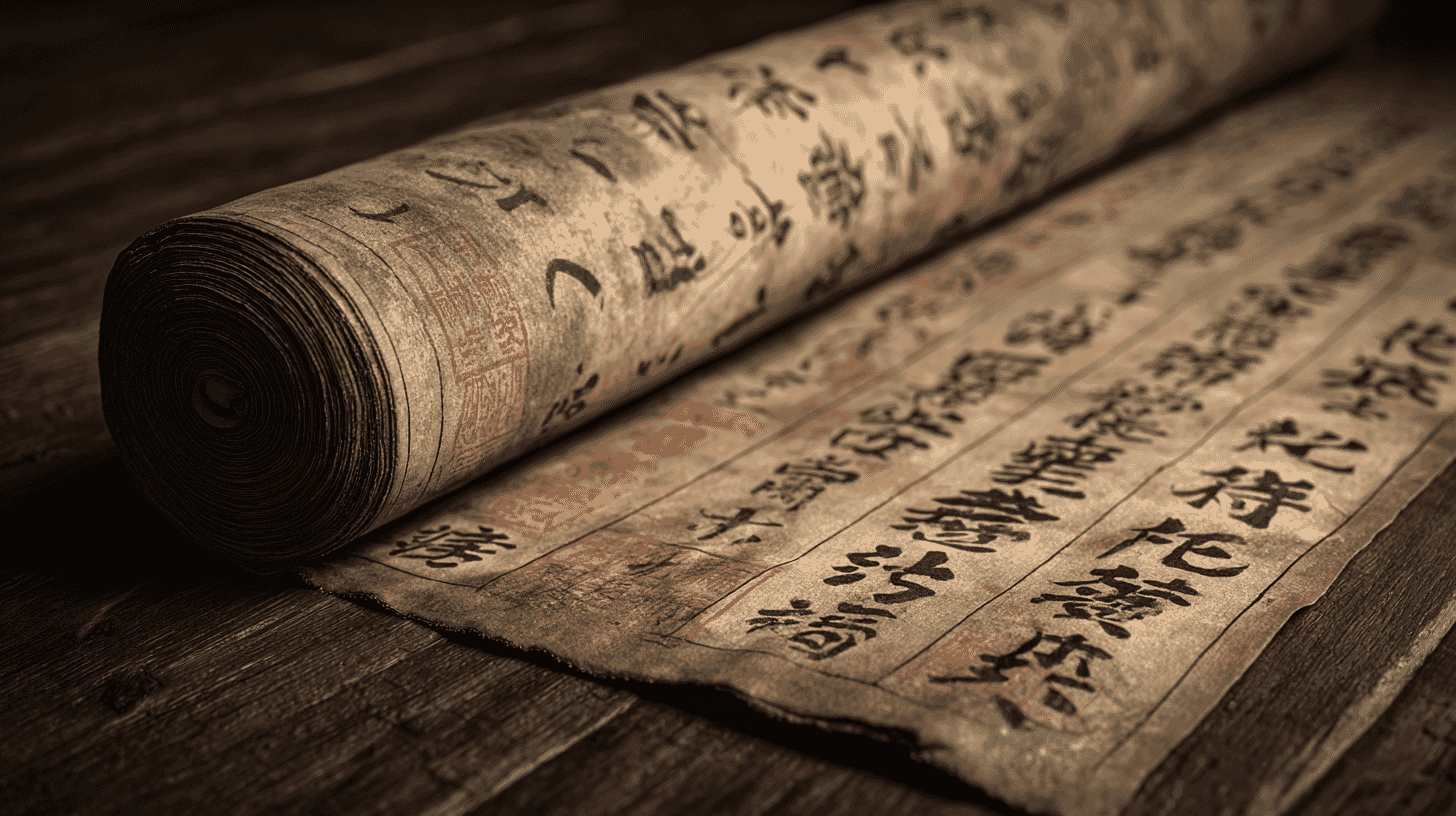
An Important Cultural Property since 1941
Emperor's Family Tree Written in Ink on Paper (紙本墨書帝系図, Shihon Bokusho Teikeizu) is a document at the National Museum of Japanese History, 117 Jonai-cho, Sakura City, Chiba Prefecture, designated an Important Cultural Property on 3 July 1941. The owner is the National Institutes for the Humanities, an inter-university research corporation.
A listing in 1941 is among the earlier dates encountered here, after Kitano Tenmangu in 1897, the four commanders and the Ippen biography in 1900, and the Taima Mandara Engi in 1908.
Most of the properties covered here have been paintings; this is a document. Ink on paper means writing brushed in ink on a paper support.
An Inter-University Research Corporation as Owner
The owner field carries a category that has not appeared before: an inter-university research corporation.
Owners among the properties covered here have been temples and shrines, religious corporations, individuals, a public-interest foundation, the state through the Agency for Cultural Affairs, the National Institutes for Cultural Heritage, and a joint-stock company. A body of this kind is new.
An inter-university research corporation runs research institutes used jointly by several universities. The National Museum of Japanese History is one of them.
The property covered immediately before, the Nezame handscroll, is owned by a listed company. Two new categories of owner have now come in succession.
The system for protecting cultural properties does not restrict who may own them. Temples, companies and research institutes alike hold listed works.
Two Prefectures in One Field, for the Third Time
The prefecture field in the database holds two values, Chiba and Tokyo. The address is the National Museum of Japanese History at Sakura City, Chiba.
The Nezame handscroll held Osaka and Nara, and the Twelve Devas held Tokyo and Kyoto. This is the third such case running.
In every instance the Agency's own field for prefecture of location gives one value. Where the second comes from cannot be told from the record.
It may reflect the head office of the owner, but that cannot be confirmed, so this article offers no conjecture and notes only that two values stand.
Where ownership and keeping fall in different places, discrepancies of this kind keep arising.
How Genealogies Are Recorded
An individual record for this document could not be confirmed through Cultural Heritage Online. This article is built from the values in the database and from records for other genealogies.
The record for a set of genealogies of the priests of the Kamo shrines, sixteen scrolls made an Important Cultural Property on 20 June 1969, is instructive.
Its commentary closes: on this occasion, as further surviving examples of old genealogies, a scroll of the Fujiwara line held at Muishinji in Niigata Prefecture and a scroll of the Watarai line handed down at the Ise shrines were also designated, both rare works copied in the Nanbokucho period.
Surviving old genealogies are few, and copies of the Nanbokucho period are rare: both points are stated in the Agency's own record.
A privately run aggregation site dates this document to the Nanbokucho period, 1371. That could not be confirmed in the Agency's record, so no year is given here.
Consulting It
The document is at the National Museum of Japanese History, 117 Jonai-cho, Sakura City, Chiba Prefecture. It is a museum holding, not an object kept on permanent display.
Work on paper is vulnerable to light, so periods on view are limited.
Since the owner is a research body, consultation and study follow procedures the museum sets.
Exhibition plans can change, so check the museum's information before travelling.
Q&A
- When was the document designated?
- On 3 July 1941, as an Important Cultural Property. It is at the National Museum of Japanese History, and the owner is the National Institutes for the Humanities.
- What kind of body owns it?
- An inter-university research corporation, which runs research institutes used jointly by several universities. Owners covered here have been temples, religious corporations, individuals, a foundation, the state, a national institute and a company; this category is new.
- Why are two prefectures given?
- The database holds Chiba and Tokyo, while the address is in Sakura City, Chiba. Where the second value comes from cannot be told from the record, so this article notes only that two values stand.
- When was it written?
- No year is given here, because none could be confirmed in the Agency's record. A privately run aggregation site gives the Nanbokucho period, 1371, but that is unverified.
- Can it be consulted?
- It is a museum holding and not on permanent display. Work on paper is vulnerable to light, so periods on view are limited, and consultation follows procedures the museum sets.
Basic Information
| Name | Emperor's Family Tree Written in Ink on Paper (紙本墨書帝系図, Shihon Bokusho Teikeizu) |
|---|---|
| Location | National Museum of Japanese History, 117 Jonai-cho, Sakura City, Chiba Prefecture |
| Designation | Important Cultural Property |
| Year Designated | 1941 (3 July), Important Cultural Property |
| Quantity | Not stated, as it could not be confirmed in the Agency's record |
| Dimensions | Not stated, as they could not be confirmed in the Agency's record. Ink on paper means writing brushed in ink on a paper support |
| Owner | National Institutes for the Humanities |
| Public Access | A museum holding, not on permanent display; consultation follows procedures the museum sets |
References
- Cultural Heritage Online: genealogies of the Kamo priests, with remarks on surviving old genealogies
- https://online.bunka.go.jp/heritages/detail/158851
- National Museum of Japanese History official site
- https://www.rekihaku.ac.jp/
- Agency for Cultural Affairs, National Cultural Properties Database
- https://kunishitei.bunka.go.jp/
- Agency for Cultural Affairs: introduction to fine arts and crafts
- https://www.bunka.go.jp/seisaku/bunkazai/shokai/bijutsu_kogei/
Last verified: 2026.09.05