
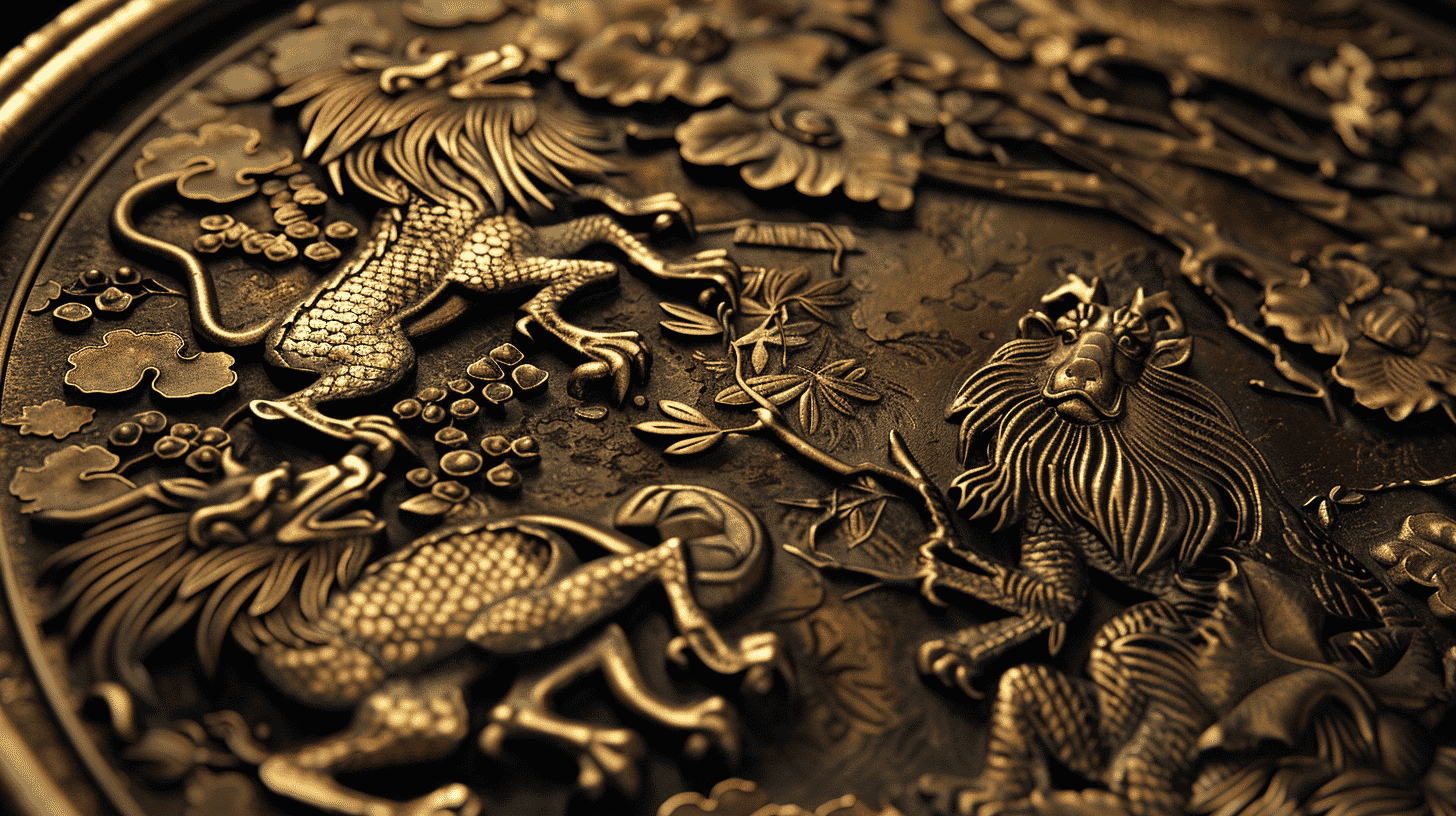
One Mirror, National Treasure since 1953
Mirror with Sea Beasts and Grapevines (海獣葡萄鏡, Kaiju Budo Kyo) is a craft object owned by Katori Jingu at Katori City, Chiba Prefecture, made an Important Cultural Property on 18 February 1904 and designated a National Treasure on 31 March 1953. The quantity is one mirror.
Chiba Prefecture gives the date of listing as 18 February 1904. What the Agency's data record as the date of the earlier step, the prefecture presents as the date of listing, with the National Treasure designation noted separately as 1953.
31 March 1953 is the day of the Jodoji pagoda, Sofukuji Daiyuhoden, the rhinoceros-horn knife and the ivory comb.
A Mirror from the Same Mould Is in the Shosoin
Two mirrors came from one mould.
The prefecture records that among the Shosoin treasures is a mirror made from the same mould, and calls this a typical fine example of the type that flourished in Tang China.
It continues that the mirrors were brought from China in the eighth century, and that one came down as a possession of Emperor Shomu in the Shosoin while the other was handed down as a secret treasure of Katori Jingu.
Two mirrors cast from one mould passed separately, one as an emperor's possession and one as a shrine's treasure.
With the Taisanji main halls, National Treasures of one name stood in Hyogo and Ehime; with the black-laced domaru, in Hiroshima and Nara. Those are different objects sharing a name.
Here the objects come from the same mould. The agreement is not in the name but in the making.
Weight Recorded to a Tenth of a Gram
The figures are given closely.
It measures 29.5 centimetres across, with a rim 2 centimetres high, and weighs 537.5 grams.
The weight is given to the first decimal place.
With the Shirataki finds, the total weight came as about twelve tonnes, a round figure to convey scale.
This is a single mirror, and the record leans toward precision instead. The two ways of recording weight stand at opposite ends.
The thickness is not even either: the face carries a slight warp, thin at the centre and growing thicker toward the rim.
Three Bands, Each with Its Own Creatures
The design divides into concentric bands, and the creatures change from band to band.
At the centre sits a knob in the form of a beast, its mane in curls, prey in its jaws, crouched on all four legs.
The inner field has grapes and leaves set alternately with trailing vines as its ground, across which eight beasts, large and small, are shown in motion.
The narrow band outside it has grapevine scrollwork as its ground, with butterflies, dragonflies, mantises and small birds among it.
The outer band carries lions, horses, deer and unicorns among the running beasts, paired with peacocks, mandarin ducks, phoenixes and cockerels among the birds.
Beasts at the centre, insects and small birds between, running beasts and birds at the rim, four of each paired in the outer band. With the engraved mirror at Suijinja, seven figures sat within 13.9 centimetres. Here the creatures are sorted into layers.
Seeing It
The mirror is at 1697 Katori, Katori City, Chiba Prefecture, owned by Katori Jingu.
How it came to be seen is recorded: until the Meiji era it was kept hidden as a sacred mirror within the inner sanctuary of the main hall.
It lay long out of sight. With the Nasu stele, a shunned stone reached a monk's ear and moved toward recognition.
Here something carefully hidden became known from the Meiji era onward.
The prefecture adds that together with a Shosoin treasure and the sacred mirror of Oyamazumi Shrine in Ehime, it is counted among three celebrated mirrors of Japan. It is a shrine holding, not kept on permanent display. Check before travelling.
Q&A
- When was the mirror designated?
- It became an Important Cultural Property on 18 February 1904 and a National Treasure on 31 March 1953. Chiba Prefecture records the earlier date as the date of listing.
- Is there another mirror like it?
- Yes. The prefecture records that a mirror made from the same mould is among the Shosoin treasures. One came down as an emperor's possession, the other as this shrine's secret treasure.
- What size and weight is it?
- 29.5 centimetres across with a rim 2 centimetres high, weighing 537.5 grams. The weight is given to a tenth of a gram.
- What is the design?
- Three concentric bands. The inner field has eight beasts, the middle band butterflies, dragonflies, mantises and small birds, and the outer band four running beasts paired with four kinds of bird.
- Could it be seen before?
- No. The prefecture records that until the Meiji era it was kept hidden as a sacred mirror within the inner sanctuary of the main hall.
Basic Information
| Name | Mirror with Sea Beasts and Grapevines (海獣葡萄鏡, Kaiju Budo Kyo); a mirror from the same mould is among the Shosoin treasures |
|---|---|
| Location | 1697 Katori, Katori City, Chiba Prefecture |
| Designation | National Treasure (craft) |
| Year Designated | 1904 (18 February), Important Cultural Property; 1953 (31 March), National Treasure |
| Quantity | 1 mirror |
| Dimensions | 29.5 centimetres across, the rim 2 centimetres high, weighing 537.5 grams. A round mirror of white bronze, its face slightly warped, thin at the centre and thicker toward the rim. A beast-shaped knob sits at the centre, with 8 beasts in the inner field, insects and small birds in the middle band, and 4 running beasts paired with 4 kinds of bird in the outer band |
| Owner | Katori Jingu |
| Public Access | A shrine holding, not on permanent display; until the Meiji era it was kept within the inner sanctuary |
References
- Chiba Prefecture: the mirror with sea beasts and grapevines
- https://www.pref.chiba.lg.jp/kyouiku/bunkazai/bunkazai/n140-001.html
- Katori Jingu: treasures
- https://katori-jingu.or.jp/about/treasure/
- Agency for Cultural Affairs, National Cultural Properties Database
- https://kunishitei.bunka.go.jp/
- Cultural Heritage Online
- https://bunka.nii.ac.jp/
Last verified: 2026.09.06