
Artifacts Excavated from the Naraharayama Sutra Mound in Iyo
The Artifacts Excavated from the Naraharayama Sutra Mound in Iyo (伊予国奈良原山経塚出土品) are a late Heian-period group of objects, including a bronze pagoda and a bronze sutra container, recovered from a sutra mound on the summit of Mount Narahara in Imabari City, Ehime Prefecture, and were designated a National Treasure in 1956.
A sutra mound (kyozuka) is a buried deposit of Buddhist scriptures, sealed in containers and covered with a mound. From the late Heian period, people across Japan built them in the belief that the teachings needed to be preserved through an age of decline.
According to Ehime Prefecture's heritage notes, this mound lay on the 1,042-metre summit of Mount Narahara, next to the buildings of Narahara Shrine. The owner is Narahara Shrine, the managing body is Imabari City, and the collection is kept at the Tamagawa Museum of Modern Art in Tamagawa, Imabari. It was designated an Important Cultural Property on 4 July 1938 and a National Treasure on 28 June 1956.
How It Was Found and Why It Matters
The objects were dug up in August 1934. According to the finder, the mound was faced with stones. On a stone floor stood a jar holding the bronze sutra container, with a bluish-white porcelain box inside it; around it lay a mirror with cherry, chrysanthemum and paired sparrows, a gilt-bronze hairpin and an intact cypress fan. Apart from knives, everything else came from two jars placed mouth to mouth over the bronze pagoda.
The designation lists a bronze pagoda, a gilt-bronze hairpin, jars and fragments representing three vessels, two porcelain boxes, a bundle of bronze coins, five bronze bells, an iron bell, a gong, five bronze mirrors (two of them fragments), a bowl-shaped earthenware vessel, the bronze sutra container, a set of knives and two cypress fans (one fragmentary), together with every other item found with them.
None of the Artifacts Excavated from the Naraharayama Sutra Mound in Iyo carries a date, but all are considered to belong to the twelfth century, at the end of the Heian period. What makes the group one of the finest archaeological finds in Japan is that its arrangement in the ground is known from the finder's account and that pagoda, sutra container, mirrors, fans and Chinese ceramics all survive together.
What to Look For
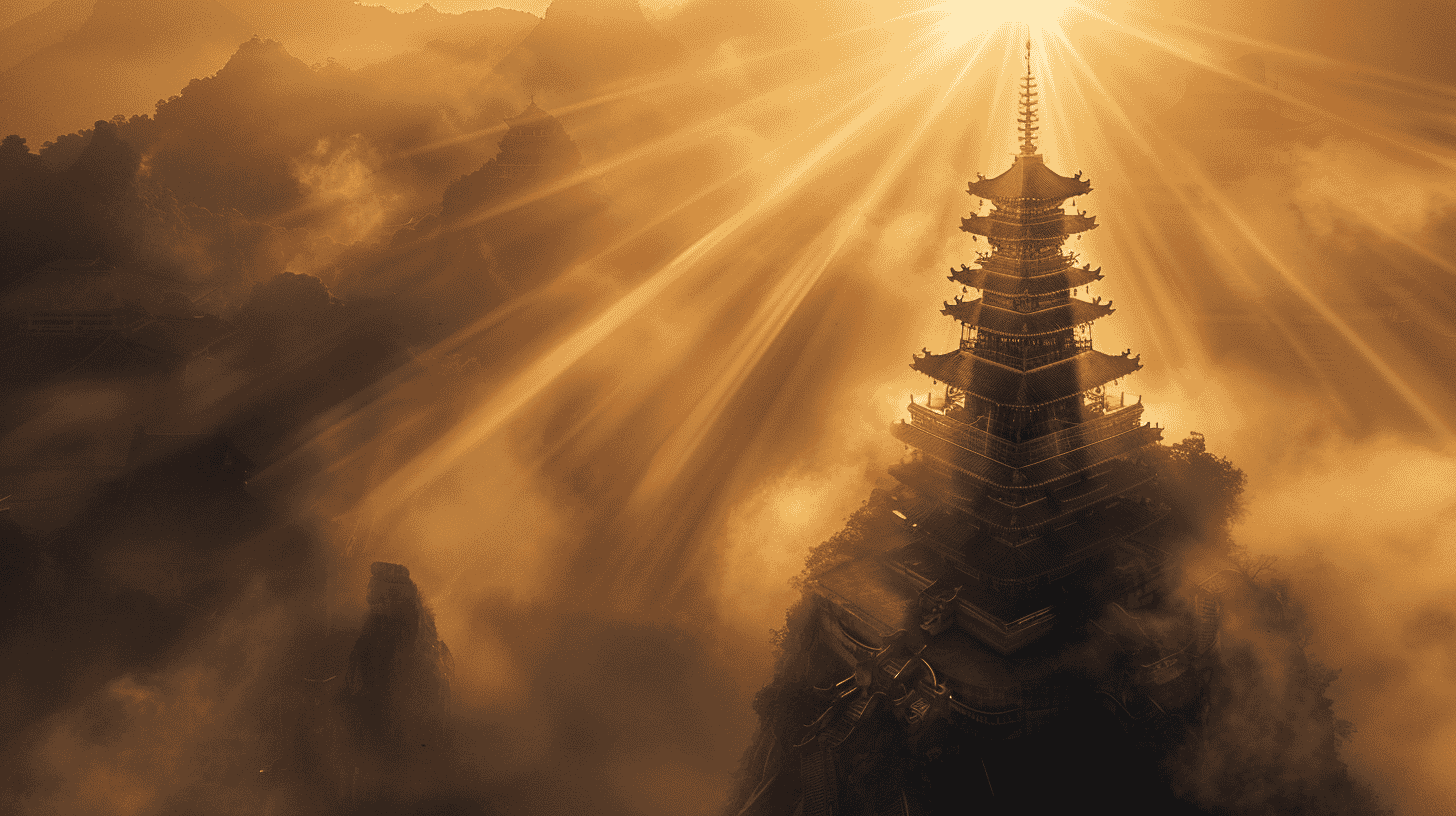
The bronze pagoda stands 71.5 centimetres tall, not counting a recently added base, with body, roof and finial all complete. The body is cast bronze with a wooden lotus collar at the bottom. On the front of the shaft is a mandala of Sanskrit seed syllables, and on the back are incised mantras of Dainichi. The roof is cast bronze, and the finial is built up from bronze parts threaded onto an iron core.
The bronze sutra container is 30.2 centimetres tall overall, a classic cast example with a strongly domed lid and a jewel-shaped knob. At its base, a mirror decorated with flowers, butterflies and birds was placed with its back facing into the tube.
One cypress fan measures 30.3 centimetres long and 3.3 centimetres wide, with two guard sticks of white bronze and 21 cypress slats, all intact. The other survives as fragments of the top and pivot, painted on both sides with flowering trees and figures drawn in the Heian manner, with slit eyes and hooked noses. Painted Heian fans are rare, so do not miss it if it is on display.
The bluish-white porcelain boxes are qingbai ware from Song-dynasty China, evidence that vessels carried across the sea ended up buried on a mountaintop in Iyo.
Visiting the Tamagawa Museum of Modern Art
The collection is held at the Tamagawa Museum of Modern Art, 86-4 Ono-ko, Tamagawa-machi, Imabari. According to Imabari City, take an express bus bound for Matsuyama-shi Station from JR Imabari Station, get off at Tamagawa Shisho-mae, and walk about 8 minutes.
Opening hours are 9:00 a.m. to 5:00 p.m. The museum is closed on Mondays (or the following day when Monday is a holiday), from December 29 to January 3, and for exhibition changes. Admission is 520 yen for adults, 260 yen for students, and free for high school students and younger or anyone under 18.
No official schedule showing which items are on display could be found. If you want to see a particular piece, contact the museum in advance at 0898-55-2738. The galleries are on two floors with no elevator. Follow the museum's signs on photography.
- 📍 Plan Your Visit to Ehime
- Find tours, activities & transport passes near Artifacts Excavated from the Naraharayama Sutra Mound in Iyo
- [ Dogo Onsen & Matsuyama Castle Relaxation Tour ]
Q&A
- Where can I see the Artifacts Excavated from the Naraharayama Sutra Mound in Iyo?
- They are held at the Tamagawa Museum of Modern Art in Tamagawa, Imabari. Check with the museum (0898-55-2738) about what is currently on display.
- When were the Naraharayama sutra mound artifacts found?
- They were excavated in August 1934 from a mound on the 1,042-metre summit of Mount Narahara.
- What do the Artifacts Excavated from the Naraharayama Sutra Mound in Iyo include?
- A bronze pagoda, a bronze sutra container, bronze mirrors, cypress fans, Chinese porcelain boxes, a gilt-bronze hairpin, a gong, bells and all related finds, dating to the late Heian period.
- When were the artifacts designated a National Treasure?
- On 28 June 1956. They had been designated an Important Cultural Property on 4 July 1938.
- What are the opening hours and fees of the Tamagawa Museum of Modern Art?
- 9:00 a.m. to 5:00 p.m., closed Mondays. Adults 520 yen, students 260 yen, free for high school students and younger or under 18.
Basic Information
| Name | Artifacts Excavated from the Naraharayama Sutra Mound in Iyo |
|---|---|
| Location | Tamagawa Museum of Modern Art, 86-4 Ono-ko, Tamagawa-machi, Imabari City, Ehime Prefecture |
| Designation | National Treasure (Archaeological Materials) |
| Year Designated | Designated National Treasure 1956/06/28 (Showa 31); Important Cultural Property 1938/07/04 (Showa 13) |
| Quantity | 1 set (bronze pagoda, bronze sutra container, 5 bronze mirrors, 2 cypress fans and others) |
| Dimensions | Bronze pagoda 71.5 cm high; bronze sutra container 30.2 cm high |
| Owner | Narahara Shrine (managed by Imabari City) |
| Public Access | Held at the Tamagawa Museum of Modern Art. 9:00 a.m. to 5:00 p.m., adults 520 yen |
References
- Ehime Prefecture: Artifacts from the Naraharayama Sutra Mound (heritage notes, Japanese)
- https://ehime-c.esnet.ed.jp/bunkazai/kennobunkazai/shiteibunkazai/kouko/pdf-files/kuni/1-7-01naraharayamakyozuka.pdf
- Imabari City, Tamagawa Museum of Modern Art: Visitor Information
- https://www.city.imabari.ehime.jp/museum/tamagawa/info/
- Imabari City, Tamagawa Museum of Modern Art: Access
- https://www.city.imabari.ehime.jp/museum/tamagawa/access/
- Imabari City, Tamagawa Museum of Modern Art: About the Museum
- https://www.city.imabari.ehime.jp/museum/tamagawa/about/
- Agency for Cultural Affairs, Database of National Cultural Properties
- https://kunishitei.bunka.go.jp/
Last verified: 2026.09.27