
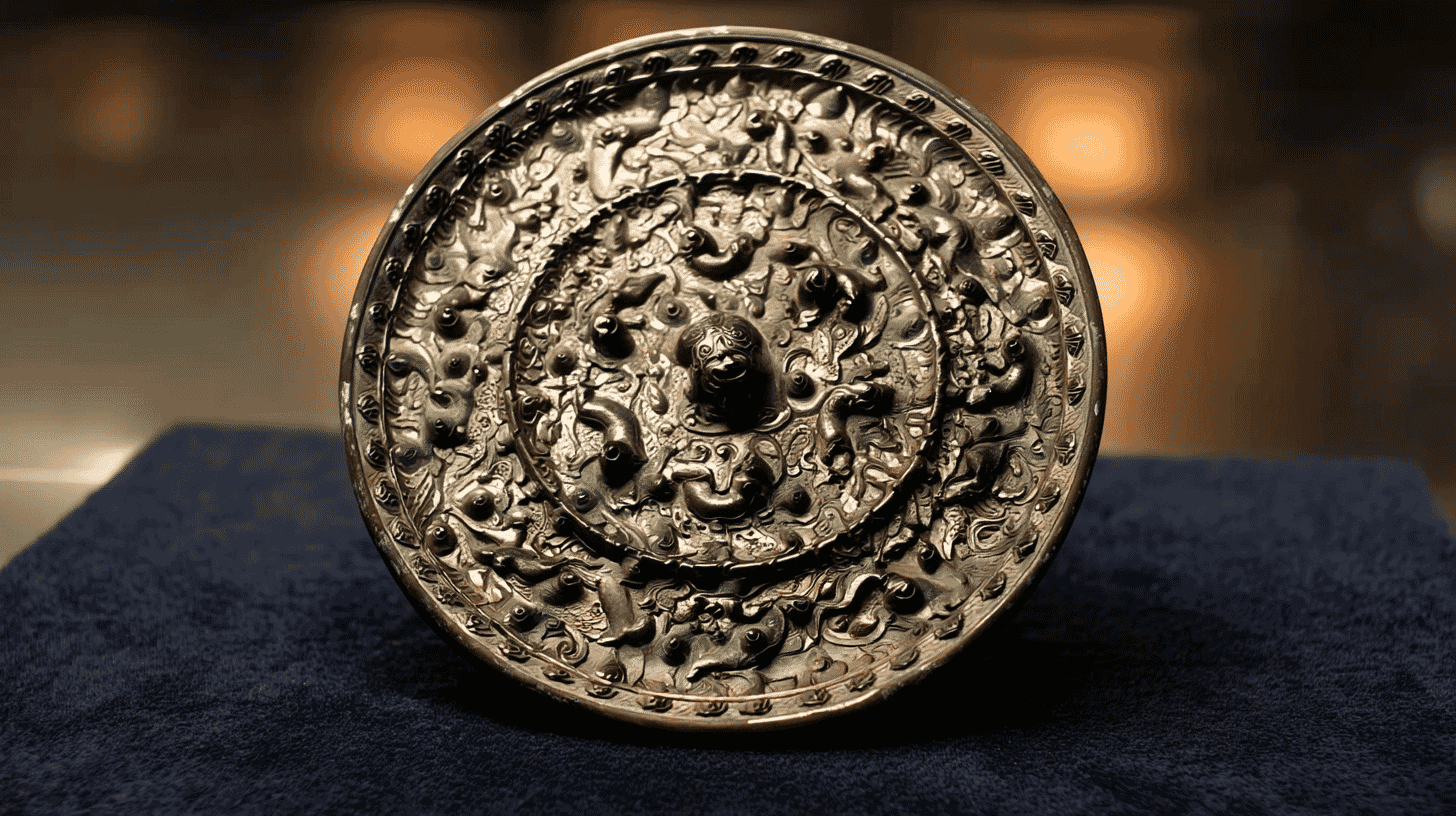
A Tang Bronze Mirror, National Treasure since 1953
The Mirror with Birds, Beasts and Grapevines (禽獣葡萄鏡, Kinju Budo Kyo) is a Tang-period mirror held by Oyamazumi Shrine in Ehime Prefecture, designated a National Treasure in 1953, on 31 March. It had become an Important Cultural Property on 27 March 1901. The quantity is one mirror, the category applied arts, and the designation number 00109.
The Agency for Cultural Affairs gives the country as China and the period as Tang. It was not made in Japan. Both year fields are blank.
It measures 26.8 centimetres across with a rim 1.7 centimetres thick: a large disc close to 27 centimetres in diameter, thick in the body, with a slight curve to the reflecting face.
The Vine Becomes the Ground
The Agency's description builds the ornament up in stages.
On the back, in both the inner and outer zones, a single grapevine curves in waves around the outer edge with fruit and leaves set alternately along it, and that vine extends further into the zones to form the ground pattern.
One vine runs in waves around the edge and then reaches inward to become the ground. Fruit and leaves alternate along it, so a regular repetition follows the vine.
The back divides into an inner and an outer zone, and the same grapevine is laid as ground in both. The ornament works in two layers, with figures set over the ground.
Inner and Outer Zones Move Differently
The figures over the ground are handled differently in the two zones.
In the inner zone, around a boss in the form of a sea beast, peacocks, phoenixes and lions are set opposite one another over the ground, with small birds and beasts playing among the tendrils that reach out from the vine.
The boss is the pierced knob at the centre of a mirror, here shaped as a sea beast. Around it the peacocks, phoenixes and lions face each other, set opposite one another meaning arranged symmetrically.
The outer zone, by contrast, shows small birds and beasts alternating as they fly and run clockwise over the ground. The outer zone moves in one direction.
Still symmetry within, directed movement without: two different arrangements sit in concentric rings on the same face.
The Assessment Turns on Balance
The Agency writes: well cast, with the orderly, continuous grape scroll and the lightly moving birds and beasts in good balance, giving an impression of refinement throughout. With the mirror at Katori Jingu it is one of the two representative surviving examples of the sea-beast-and-grape mirror.
Balance is where the assessment turns. A regular, continuous grape scroll and figures full of movement are opposite in character, and the judgment rests on their holding together on one face.
The second point is comparative: with the mirror at Katori Jingu, two examples are set side by side as representative of the type.
The designated name reads mirror with birds, beasts and grapevines, but the Agency's commentary uses the term sea-beast-and-grape mirror. The designated name and the general name for the type differ; the latter refers to a group of mirrors made in numbers during the Tang period.
Seeing It
Oyamazumi Shrine owns the mirror. The shrine holds a large body of arms, armour and mirrors, shown in its treasure hall.
Opening days and charges can change, so check the shrine's information before travelling. If the object itself is the purpose of the visit, confirm that it is on show.
What repays looking at is the ornamented back. Ground and figures are set in two layers across a face 26.8 centimetres wide, so the detail does not read from a distance.
Oyamazumi Shrine is on Omishima in Imabari City, Ehime Prefecture, reached by bus from Imabari or by car along the Setouchi Shimanami Kaido.
Q&A
- When was the mirror designated?
- On 31 March 1953, having become an Important Cultural Property on 27 March 1901. It is listed as one mirror in the applied arts category under designation number 00109 and belongs to Oyamazumi Shrine.
- Was it made in Japan?
- No. The Agency for Cultural Affairs gives the country as China and the period as Tang, with both year fields blank. It is a large cast disc of white bronze, 26.8 centimetres across with a rim 1.7 centimetres thick.
- How is the ornament arranged?
- A single grapevine curves in waves around the outer edge with fruit and leaves set alternately along it, and extends into the zones to form the ground pattern. The back divides into an inner and an outer zone, both laid with the same vine as ground and carrying figures over it in two layers.
- How do the two zones differ?
- The inner zone sets peacocks, phoenixes and lions opposite one another around a boss shaped as a sea beast, with small birds and beasts playing among the tendrils. The outer zone shows small birds and beasts flying and running clockwise. Still symmetry within, directed movement without.
- Why was it designated?
- The Agency finds it well cast, with the orderly grape scroll and the lightly moving birds and beasts in good balance and an impression of refinement throughout, and names it with the mirror at Katori Jingu as one of the two representative surviving examples of the type.
Basic Information
| Name | Mirror with Birds, Beasts and Grapevines (禽獣葡萄鏡, Kinju Budo Kyo); the Agency's commentary calls it a representative sea-beast-and-grape mirror |
|---|---|
| Location | Miyaura, Omishima-cho, Imabari City, Ehime Prefecture (Oyamazumi Shrine) |
| Designation | National Treasure (applied arts), designation no. 00109 |
| Year Designated | 1901 (27 March), Important Cultural Property; 1953 (31 March), National Treasure |
| Quantity | 1 mirror |
| Dimensions | 26.8 cm across, rim 1.7 cm thick. A large cast disc of white bronze, thick in the body, with a slight curve to the face. The back divides into inner and outer zones over a grapevine ground, with a sea-beast boss, peacocks, phoenixes and lions within and small birds and beasts without. Chinese, Tang period |
| Owner | Oyamazumi Shrine |
| Public Access | Shown in the treasure hall of Oyamazumi Shrine. Opening days and charges can change |
References
- Agency for Cultural Affairs, National Cultural Properties Database: Mirror with Birds, Beasts and Grapevines
- https://kunishitei.bunka.go.jp/bsys/maindetails/201/402
- Cultural Heritage Online: Mirror with Birds, Beasts and Grapevines
- https://bunka.nii.ac.jp/heritages/detail/130904
- Oyamazumi Shrine official site
- https://oomishimagu.jp/
- Agency for Cultural Affairs: introduction to cultural properties
- https://www.bunka.go.jp/seisaku/bunkazai/shokai/
Last verified: 2026.09.04