
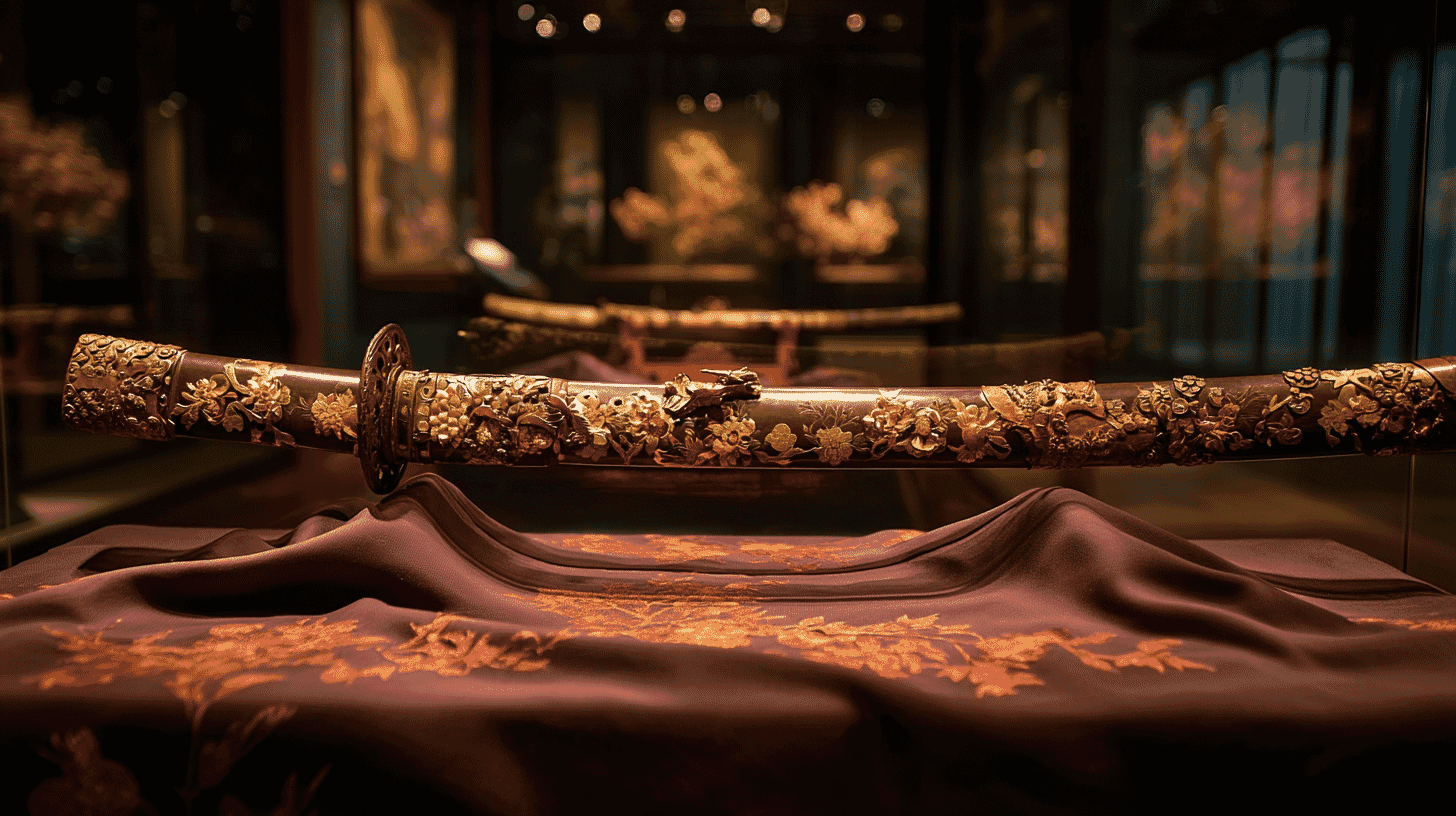
A Mounting 96.3 Centimetres Long, National Treasure since 1955
Hyogo Kusari Tachi Sword Mounting with Peony and Arabesque (牡丹唐草文兵庫鎖太刀拵, Botan Karakusa-mon Hyogo-gusari Tachi Koshirae) is a Kamakura-period sword mounting held by Oyamazumi Shrine in Ehime Prefecture, designated a National Treasure in 1955, on 22 June. It had become an Important Cultural Property on 27 March 1901. The quantity is one mounting, the category applied arts, and the designation number 00181.
What is designated is the mounting, not the blade. A mounting comprises the scabbard, hilt and metal fittings; the blade that goes inside is treated as a separate object. That the mounting alone carries National Treasure status is what marks this entry.
It measures 96.3 centimetres overall. The Agency for Cultural Affairs carries no commentary, so no words of assessment are recorded, and both year fields are blank with the period given only as Kamakura.
A Different Cut for Each Part
The Agency's description of material and form sets out the technique part by part.
The metal fittings throughout are gilt bronze carved with peony arabesque. The flat boards of the scabbard carry the same pattern in fine line engraving. The long rim is plain. The binding of the hanger fittings and the chape carry the same pattern in relief. The rim moulding is peony arabesque cut away from the ground. The ornamental rivets are four pairs of peony sprays carved in the round. The raised edge carries peonies in relief. The large seppa washer is peony in pierced relief, and the small seppa washer is chrysanthemum-shaped.
One peony arabesque is cut in five different ways according to the part: fine line engraving, relief, ground-cutting, carving in the round and piercing. Line engraving cuts thin lines; relief raises the metal; ground-cutting removes the field around the design; carving in the round shapes the form itself; piercing cuts the field away entirely.
One pattern rendered by five methods. The technique is chosen to suit the nature of the part and the size of the surface. The hilt is covered with white ray skin.
Five Later Replacements Are Recorded
The Agency's record marks the parts supplied later.
The mouth fitting, the collar, six of the ornamental rivets, one large seppa washer and one small seppa washer are all noted as later work. Five places carry that note.
Later work means a part lost and replaced in a subsequent age. That the mounting is not wholly original is set down in the official record. It carries National Treasure status all the same, because the assessment rests on the design and technique of the whole.
The ornamental rivets number four pairs, that is eight, of which six are later. Only two of the originals remain.
As with the losses on the Omodaka-laced armour and the kiln cracks on the Koetsu tea bowl, the record of damage or replacement and the designation stand together.
What Hyogo Chain Means
A hyogo-chain tachi is a mounting in which the sword hangs from the belt on chains.
An ordinary tachi hangs on leather or braided cord; this form uses metal chains instead. Making the hanging elements metal increases the surface available for ornament, which is why the binding of the hanger fittings and the chape carry relief work.
Peony arabesque links peony flowers and leaves along a running vine. An arabesque is a continuous pattern and suits a long narrow surface, which is why the flat boards of the scabbard carry it in line engraving.
The name is built from three elements: the pattern, the manner of hanging, and the fact that this is a mounting. Pattern, suspension and class of object sit in the name itself.
Seeing It
Oyamazumi Shrine owns the mounting. The shrine holds a large body of arms and armour, shown in its treasure hall.
Opening days and charges can change, so check the shrine's information before travelling. If the object itself is the purpose of the visit, confirm that it is on show.
A mounting is the exterior of a sword, so what repays looking at is the carving of the fittings. Five ways of cutting are set within 96.3 centimetres.
Oyamazumi Shrine is on Omishima in Imabari City, Ehime Prefecture, reached by bus from Imabari or by car along the Setouchi Shimanami Kaido.
Q&A
- When was the mounting designated?
- On 22 June 1955, having become an Important Cultural Property on 27 March 1901. It is listed as one mounting in the applied arts category under designation number 00181 and belongs to Oyamazumi Shrine.
- Does it include a blade?
- No. What is designated is the mounting, not the blade. A mounting comprises the scabbard, hilt and metal fittings, while the blade that goes inside is treated as a separate object. The mounting alone carries the designation.
- What techniques were used?
- One peony arabesque is cut in five ways according to the part: fine line engraving, relief, ground-cutting, carving in the round and piercing. Line engraving cuts thin lines, relief raises the metal, ground-cutting removes the field, carving in the round shapes the form, and piercing cuts the field away entirely.
- Is any of it later work?
- The Agency notes the mouth fitting, the collar, six of the ornamental rivets and one washer of each size as later work. The rivets number eight in four pairs, of which six are later, so only two originals remain. That the mounting is not wholly original is set down in the official record.
- What does hyogo chain mean?
- A mounting in which the sword hangs from the belt on metal chains rather than on leather or braided cord. Making the hanging elements metal increases the surface available for ornament, which is why the hanger fittings and the chape carry relief work.
Basic Information
| Name | Hyogo Kusari Tachi Sword Mounting with Peony and Arabesque (牡丹唐草文兵庫鎖太刀拵) |
|---|---|
| Location | Miyaura, Omishima-cho, Imabari City, Ehime Prefecture (Oyamazumi Shrine) |
| Designation | National Treasure (applied arts), designation no. 00181 |
| Year Designated | 1901 (27 March), Important Cultural Property; 1955 (22 June), National Treasure |
| Quantity | 1 mounting |
| Dimensions | 96.3 centimetres overall. Gilt bronze fittings carved with peony arabesque throughout; the scabbard boards in fine line engraving, the rim moulding cut from the ground, the chape and raised edge in relief, the ornamental rivets carved in the round, the large washer in pierced relief and the small washer chrysanthemum-shaped. Hilt covered in white ray skin. Mouth fitting, collar, some rivets and washers are later work. Kamakura period |
| Owner | Oyamazumi Shrine |
| Public Access | Shown in the treasure hall of Oyamazumi Shrine. Opening days and charges can change |
References
- Agency for Cultural Affairs, National Cultural Properties Database: the peony arabesque hyogo-chain tachi mounting
- https://kunishitei.bunka.go.jp/bsys/maindetails/201/472
- Cultural Heritage Online: the peony arabesque hyogo-chain tachi mounting
- https://bunka.nii.ac.jp/db/heritages/detail/125867
- Oyamazumi Shrine official site
- https://oomishimagu.jp/
- Agency for Cultural Affairs: introduction to cultural properties
- https://www.bunka.go.jp/seisaku/bunkazai/shokai/
Last verified: 2026.09.04