
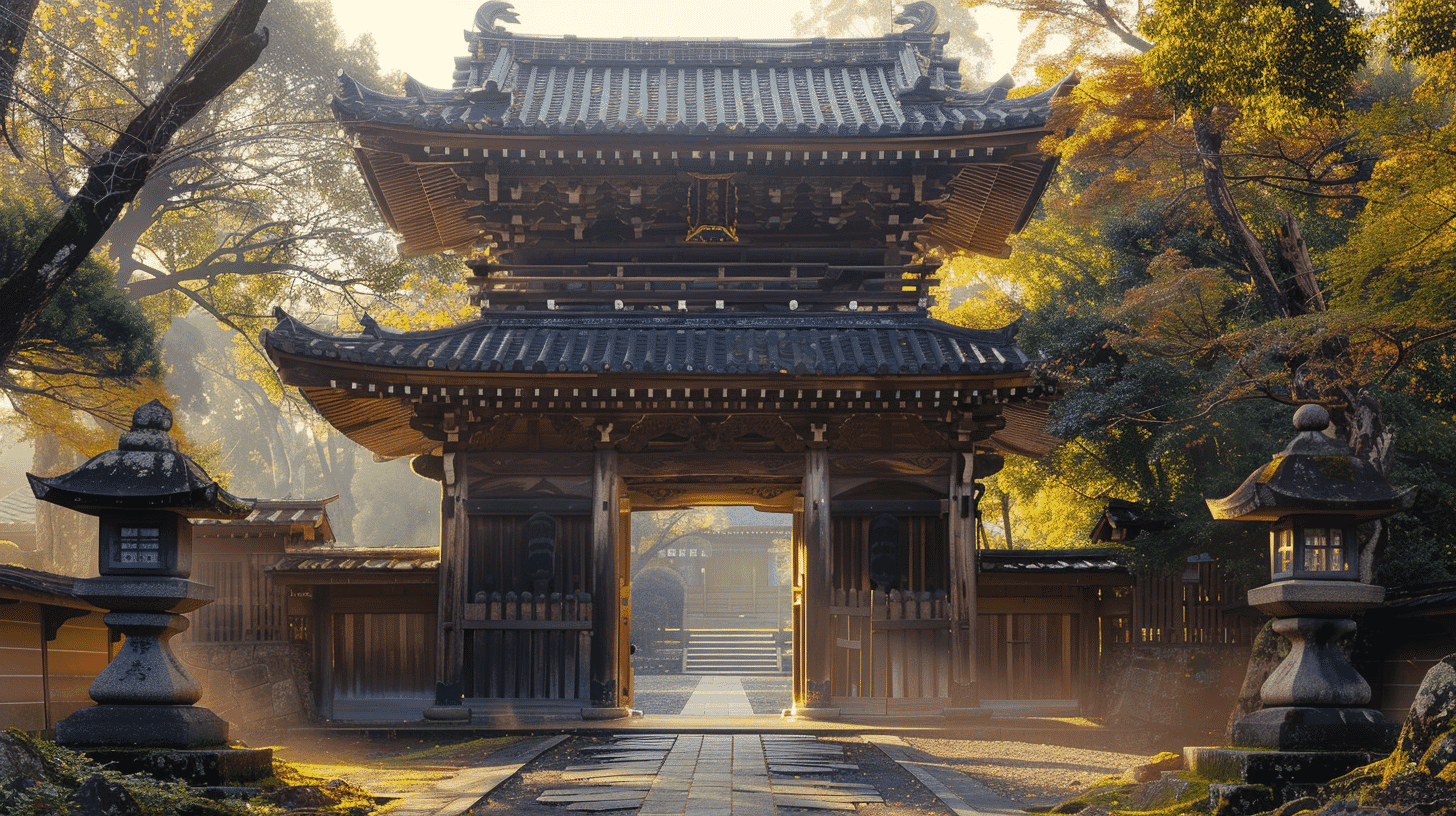
Raised in 1318, National Treasure since 1952
Ishiteji Temple Niomon (石手寺二王門) is a two-storeyed gate at Ishiteji, 2-9-21 Ishite, Matsuyama City, Ehime Prefecture, designated a National Treasure in 1952, on 22 November. It had become an Important Cultural Property on 27 May 1907. The quantity is one building, and it belongs to Ishiteji.
Matsuyama City records that the Iyo Koseki-shi contains an entry stating that Kono Michitsugu raised this gate in 1318. The year and the patron are given in a written source, though that source is a later local gazetteer.
Its form is a three-bay gate with one opening, hip-and-gable roof, double eaves, tiled, with no floor laid at the upper level. A two-storeyed gate with no floor above is one of the marks of this building.
Three-Stepped Brackets, Twice Over
Matsuyama City sets out the bracketing precisely: the manner is the native style, with three-stepped bracket sets on round columns carrying the encircling veranda, and the eaves received on three-stepped sets as well.
A three-stepped set projects forward in three stages. Below they carry the veranda and above they carry the eaves, both in the same form. In a two-storeyed gate there are two things to support, and the bracketing answers to that.
Intermediate members sit between the bracket sets. On the front and back these are frog-leg struts; on the sides they are block-on-strut members. In the eaves the intermediate members are block-on-strut throughout. The treatment differs by face.
A frog-leg strut has an outline opening like the legs of a frog; a block-on-strut is a squared post with a bearing block on top. The first is ornamental, the second plain. Frog-leg struts go on the front and back where the eye falls, block-on-struts to the sides.
The Assessment Turns on the Frog-Leg Struts
Matsuyama City writes: with the sweep and swell of the eaves and the balance of the building as a whole, it is held one of the finest two-storeyed gates in the country, and above all its frog-leg struts have won a name as masterpieces carrying the character of the Kamakura period.
Above all places the weight of the assessment on those struts. The balance of the whole is praised first, and within that the struts are singled out.
They sit as intermediate members in the bracketing that carries the veranda, on the front and back. That is under the upper-level veranda, above eye level. Look up while passing through the gate and they can be seen.
The year 1318 falls at the end of the Kamakura period, so the date and the manner agree, which is what the city means by carrying the character of the Kamakura period.
The Figures Inside Are a Separate Matter
In the chambers to left and right stand figures of the guardian kings, said to be the work of the Unkei school.
Said to be marks the attribution as unsettled. Matsuyama City does not assert it. It stands as a view that has been held, no more.
The figures fall under a separate framework from the building. What is designated a National Treasure is the gate, not the figures. Accounts elsewhere run the two together; the classes should be kept apart.
Ishiteji is an old temple of the Buzan branch of Shingon and the fifty-first station on the Shikoku pilgrimage. Temple tradition holds that the precinct was founded in 728 by Ochi no Tamasumi at imperial command. Some 590 years separate that tradition from the raising of the gate in 1318.
Visiting
The Niomon stands at the entrance to Ishiteji, so it is passed through on the way into the precinct. The precinct is open.
As a station on the Shikoku pilgrimage the temple sees pilgrims daily. It is a place of worship before it is a sight, and worth approaching on that footing.
The gate stands in the open and its exterior can be seen at any time. The three-stepped bracketing and the frog-leg struts are easiest to make out by looking up from beneath the gate.
From Dogo Onsen Station on the Iyotetsu line it is about fifteen minutes on foot.
Q&A
- When was the gate built and designated?
- Matsuyama City records an entry in the Iyo Koseki-shi stating that Kono Michitsugu raised it in 1318. It became an Important Cultural Property on 27 May 1907 and a National Treasure in 1952, on 22 November. It counts as one building and belongs to Ishiteji.
- What form does it take?
- A three-bay gate with one opening, hip-and-gable roof, double eaves, tiled, with no floor laid at the upper level. The manner is the native style, with three-stepped bracket sets on round columns carrying the encircling veranda and the eaves received on three-stepped sets as well.
- What is most valued in it?
- Matsuyama City holds it one of the finest two-storeyed gates in the country for the sweep of its eaves and the balance of the whole, and adds that above all its frog-leg struts have won a name as masterpieces carrying the character of the Kamakura period. The weight of the assessment falls on those struts.
- Are the figures inside designated too?
- Figures of the guardian kings, said to be the work of the Unkei school, stand in the chambers to left and right, but what is designated a National Treasure is the gate, not the figures. Said to be marks the attribution as unsettled, and Matsuyama City does not assert it.
- Can the gate be seen?
- It stands at the entrance to Ishiteji and is passed through on the way in. The precinct is open and the gate stands outdoors, so it can be seen at any time. As a station on the Shikoku pilgrimage the temple sees pilgrims daily, so approach it as a place of worship.
Basic Information
| Name | Ishiteji Temple Niomon (石手寺二王門) |
|---|---|
| Location | 2-9-21 Ishite, Matsuyama City, Ehime Prefecture (Ishiteji) |
| Designation | National Treasure (structure) |
| Year Designated | 1907 (27 May), Important Cultural Property; 1952 (22 November), National Treasure |
| Quantity | 1 building |
| Dimensions | A 3-bay gate with 1 opening, hip-and-gable roof, double eaves, tiled, with no floor laid at the upper level. Native style, with 3-stepped bracket sets on round columns carrying the encircling veranda and the eaves received the same way. Intermediate members are frog-leg struts on the front and back, block-on-strut members on the sides. Raised 1318 by tradition |
| Owner | Ishiteji |
| Public Access | The precinct is open. The gate stands outdoors and its exterior can be seen at any time |
References
- Matsuyama City: Ishiteji Niomon, one building
- https://www.city.matsuyama.ehime.jp/kanko/kankoguide/rekishibunka/bunkazai/kuni/isiteji_nioumon.html
- Matsuyama City: nationally designated cultural properties
- https://www.city.matsuyama.ehime.jp/kanko/kankoguide/rekishibunka/bunkazai/kuni/
- Agency for Cultural Affairs, National Cultural Properties Database
- https://kunishitei.bunka.go.jp/
- Agency for Cultural Affairs: introduction to cultural properties
- https://www.bunka.go.jp/seisaku/bunkazai/shokai/
Last verified: 2026.09.04