
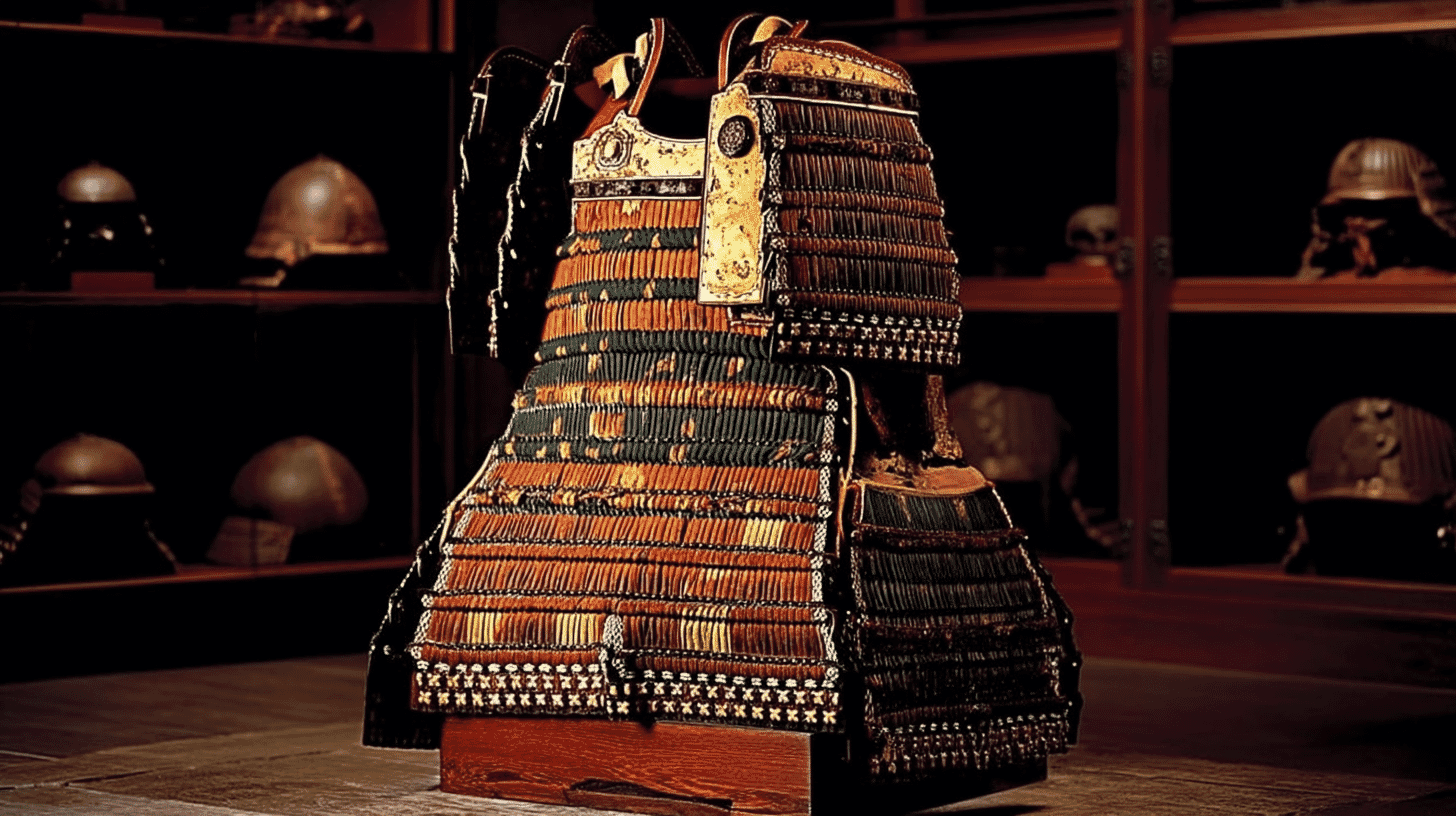
The Oldest Surviving Armour, National Treasure since 1954
The Omodaka-Laced Armour with Helmet and Large Sleeves (沢瀉威鎧〈兜、大袖付〉, Omodaka Odoshi Yoroi) is a Heian-period great armour held by Oyamazumi Shrine in Ehime Prefecture, designated a National Treasure in 1954, on 20 March. The quantity is one suit, the category applied arts, and the designation number 00156.
The Important Cultural Property designation carries the same date, 20 March 1954. Most National Treasures pass through the earlier status years or decades before; here both are recorded on one day.
The Agency for Cultural Affairs writes: the method of lacing vertically with narrow three-strand cord has points in common with fragments of lamellar armour excavated from burial mounds and with those handed down in the Shosoin; but among Heian-period survivals only a model preserved at Horyuji and this armour exist, and it is the oldest surviving armour.
Tradition and Estimate Disagree on the Date
On the date the Agency sets out two accounts side by side.
The shrine hands it down as an armour of the Engi era, but it is estimated to have been made between the Tengyo disturbance and the Earlier Nine Years' War.
The Engi era runs from 901 to 923, the Tengyo disturbance from 939 to 941, and the Earlier Nine Years' War from 1051 to 1062. Tradition puts it at the start of the tenth century and the estimate between the mid-tenth and mid-eleventh, more than a century apart. The Agency leaves both year fields blank and records the period only as Heian.
This article does not choose between them and records that tradition and estimate differ. The phrasing the shrine hands it down confines the tradition to its holder.
Three Colors Forming the Arrowhead Plant
The name refers to how the colors of the lacing are arranged.
The Agency's record runs: leather scales pierced with three rows of holes are bound in threes, and the lightly lacquered binding plates are laced vertically with narrow three-strand cord in yellow-green, yellow and red, forming the shape of the arrowhead plant.
The arrowhead plant grows at the water's edge and carries leaves shaped like arrowheads. Yellow-green, yellow and red are set together to draw that leaf across the face of the armour. The arrangement of color is itself the pattern.
The edge cords, the cross-stitching and the diamond stitching are all in red cord of the same make. The edges are not laced in three colors but held to red alone, so patterned areas and edges are handled differently.
The Agency links this narrow three-strand vertical lacing to lamellar armour from burial mounds and from the Shosoin because the method belongs to an older line.
Much of It Is Missing
The Agency's description of material and form lists what has been lost.
The skirts and side guard run four sections in five tiers, but the fourth tier at the bow side, the first tier at the rear and the fourth tier of the side guard are missing. The leather areas of the metal mounts, the hem pattern and the fittings are all missing. The helmet's neck guard has five tiers, but the crown fitting, the peak and the leather wrapping of the turnbacks are gone as well.
Almost everything ornamental has been lost. It carries National Treasure status all the same, because the assessment rests on the age of the lacing rather than on ornament.
The measurements that survive: the scales are 6.3 centimetres high and 2.9 centimetres wide; the helmet bowl is 11.5 centimetres high, 22.1 centimetres front to back and 20.3 centimetres side to side.
The helmet bowl is of iron, twelve plates joined with eight raised ridges. Twelve iron plates joined and eight ridges standing on them. The sleeve plates run six tiers.
Seeing It
Oyamazumi Shrine owns the armour. The shrine holds a large body of arms and armour, shown in its treasure hall.
Opening days and charges can change, so check the shrine's information before travelling. If the object itself is the purpose of the visit, confirm that it is on show.
Other laced armours are also held at the same shrine, so tell them apart by the bracketed part of each name: whether a helmet is included or only the large sleeves, and what color the lacing is.
Oyamazumi Shrine is on Omishima in Imabari City, Ehime Prefecture, reached by bus from Imabari or by car along the Setouchi Shimanami Kaido.
Q&A
- When was this armour designated?
- On 20 March 1954. The Important Cultural Property designation carries the same date, so both are recorded on one day. It is listed as one suit in the applied arts category under designation number 00156 and belongs to Oyamazumi Shrine.
- Why was it designated?
- The Agency for Cultural Affairs finds that its narrow three-strand vertical lacing has points in common with lamellar armour from burial mounds and from the Shosoin, and that among Heian survivals only a model at Horyuji and this armour exist, making it the oldest surviving armour.
- When was it made?
- The Agency records that the shrine hands it down as an armour of the Engi era, 901 to 923, but that it is estimated to have been made between the Tengyo disturbance of 939 to 941 and the Earlier Nine Years' War of 1051 to 1062. Tradition and estimate lie more than a century apart.
- What does the name mean?
- It refers to how the lacing colors are arranged. Narrow three-strand cord in yellow-green, yellow and red forms the shape of the arrowhead plant, a waterside plant with leaves shaped like arrowheads. The arrangement of color is itself the pattern.
- Is anything missing from it?
- A great deal. Tiers of the skirts and side guard are missing, and the leather areas of the metal mounts, the hem pattern and the fittings are all gone, as are the helmet's crown fitting, peak and turnback wrapping. Almost everything ornamental has been lost, but the assessment rests on the age of the lacing.
Basic Information
| Name | Omodaka-Laced Armour with Helmet and Large Sleeves (沢瀉威鎧〈兜、大袖付〉, Omodaka Odoshi Yoroi) |
|---|---|
| Location | Miyaura, Omishima-cho, Imabari City, Ehime Prefecture (Oyamazumi Shrine) |
| Designation | National Treasure (applied arts), designation no. 00156 |
| Year Designated | 1954 (20 March), Important Cultural Property and National Treasure on the same day |
| Quantity | 1 suit |
| Dimensions | Scales 6.3 cm high and 2.9 cm wide. Helmet bowl 11.5 cm high, 22.1 cm front to back, 20.3 cm side to side. Leather scales bound in threes, laced vertically in yellow-green, yellow and red to form the arrowhead plant. Helmet bowl of iron, 12 plates with 8 raised ridges. Sleeve plates in 6 tiers. Heian period |
| Owner | Oyamazumi Shrine |
| Public Access | Shown in the treasure hall of Oyamazumi Shrine. Opening days and charges can change |
References
- Agency for Cultural Affairs, National Cultural Properties Database: Omodaka-Laced Armour with Helmet and Large Sleeves
- https://kunishitei.bunka.go.jp/bsys/maindetails/201/450
- Cultural Heritage Online: Omodaka-Laced Armour with Helmet and Large Sleeves
- https://bunka.nii.ac.jp/db/heritages/detail/159375
- Oyamazumi Shrine official site
- https://oomishimagu.jp/
- Agency for Cultural Affairs: introduction to cultural properties
- https://www.bunka.go.jp/seisaku/bunkazai/shokai/
Last verified: 2026.09.05