
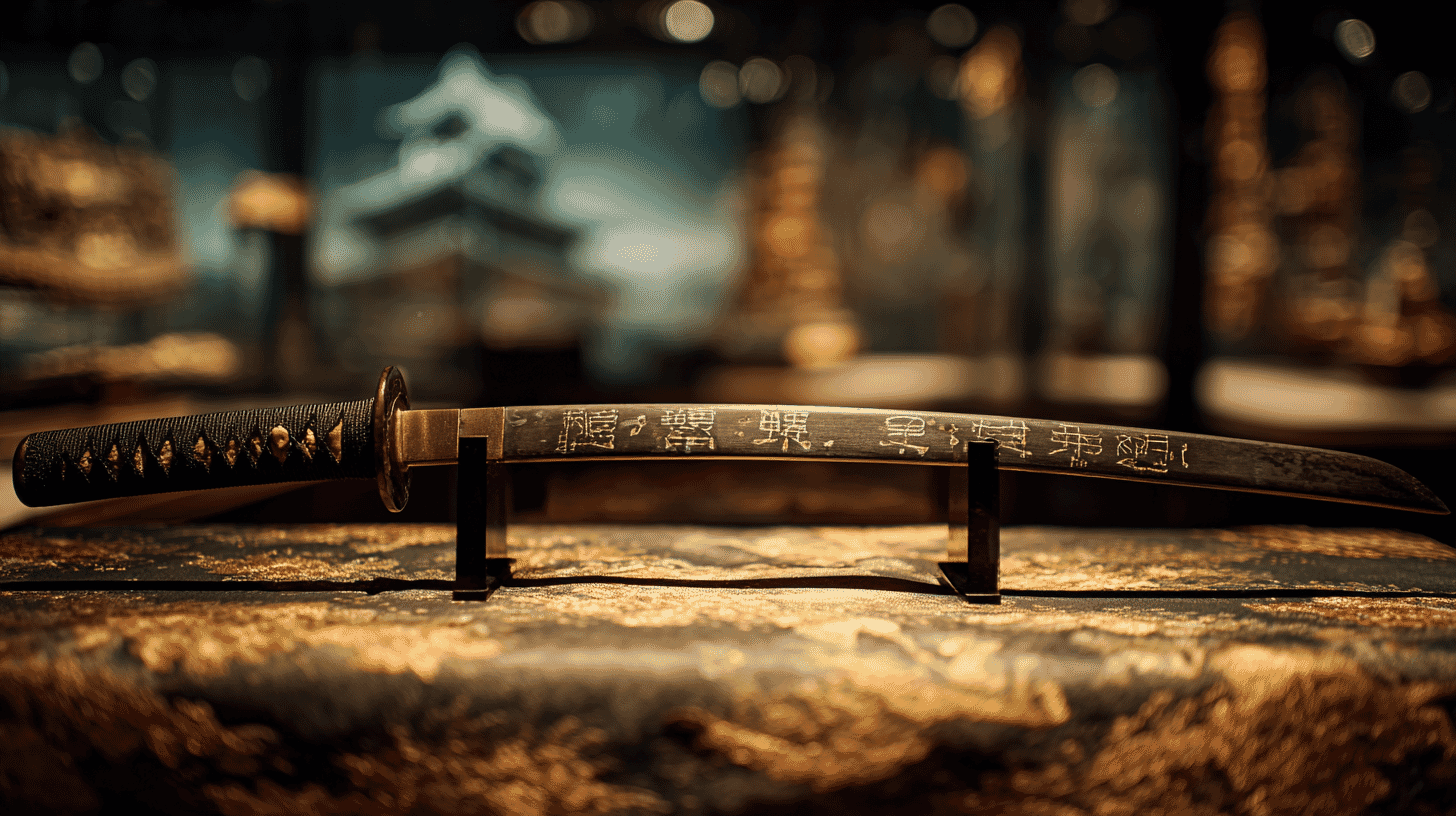
A Nanbokucho Dagger, Designated in 1918
Short Sword (signed Kunihiro) (短刀〈銘国弘作〉, Tanto mei Kunihiro saku) is a Nanbokucho-period dagger kept at the Ehime Prefectural Museum of Art, Horinouchi, Matsuyama City, Ehime Prefecture, designated an Important Cultural Property on 8 April 1918. The quantity is one blade, the category applied arts, and the designation number 01514. It belongs to Shinonome Shrine.
The Agency for Cultural Affairs writes: a work of the Nanbokucho period by Kunihiro, a noted smith of the Chikuzen Sa school, said to have been presented by the Matsudaira family, lords of the Matsuyama domain.
Said to have applies to the presentation. That the maker is Kunihiro and that he belonged to the Chikuzen Sa school are stated outright; the gift by the Matsudaira is recorded as tradition.
Thin, Flat and Sharp
The Agency's description of the form runs: flat-sided, with a three-faceted back, thin in section, little flesh on the flat, the point drawn thin, a strong shape.
Flat-sided means made without a ridge line, a construction common in daggers. A three-faceted back describes the section of the spine. Thin in section with little flesh on the flat means the blade is made without bulk.
The curve at the tip of a blade is drawn thin here, meaning that swelling has been pared away, bringing the tip closer to a straight line.
Together these earn the phrase a strong shape. Reducing thickness and paring away the swelling is what makes the sharpness stand out. The blade is 29.2 centimetres long with a curvature of 0.5 centimetres.
The Two Faces Differ
The record of the edge pattern and the point notes differences between the two faces.
The edge runs straight in tendency with legs entering well and fine crystals gathering, and on the reverse a doubled edge line is mixed in. The doubled line appears only on the reverse, not on the front.
The point is the edge pattern at the tip. On the front it tends to a peak; on the reverse it turns back in a small round. The shape differs from one face to the other.
On one blade the two faces read differently. This follows from the hardening and is not necessarily a deliberate contrast.
The forging shows a wood-grain pattern running in streaks with the surface standing, and crystals gather well on the ground.
Carvings and Tang
The carvings are twin grooves and a Sanskrit character.
The twin grooves are two narrow channels cut side by side, named for the tongs used in esoteric fire rites. The Sanskrit character stands for a buddha. Both are carvings tied to religious practice.
The tang is unaltered with a rounded end, the file marks straight across, and two peg holes. Unaltered means the tang has not been worked on; it has not been shortened, which is why the signature survives.
The signature reads Kunihiro saku, three characters. Adding made by to the maker's name is a form distinct from a plain two-character signature.
Designation number 01514 falls high among the applied arts. Numbers for Important Cultural Properties run in a series of their own.
Seeing It
Shinonome Shrine owns the blade and the Ehime Prefectural Museum of Art keeps it. Owner and holding institution are different: a shrine owns it, a museum holds it.
It is not necessarily on permanent display, and whether and when it is shown depends on the museum's programme. Hours and admission vary with the exhibition, so check before travelling.
Swords are readily rotated in and out of display, so confirm that it is on show if the object itself is the purpose of the visit.
The museum is at Horinouchi, south of Matsuyama Castle, about three minutes on foot from the Minami-Horibata tram stop on the Iyotetsu line.
Q&A
- When was this dagger designated?
- On 8 April 1918, as an Important Cultural Property. It is listed as one blade in the applied arts category under designation number 01514, with the period given as Nanbokucho and the maker as Kunihiro. It belongs to Shinonome Shrine.
- Who made it?
- The Agency records it as the work of Kunihiro, a noted smith of the Chikuzen Sa school. The signature reads Kunihiro saku, and the tang is unaltered so the signature survives. The blade is said to have been presented by the Matsudaira family, though that is recorded as tradition.
- What is its shape?
- Flat-sided with a three-faceted back, thin in section, little flesh on the flat, the point drawn thin, and a strong shape. The blade is 29.2 centimetres long with a curvature of 0.5 centimetres. Reducing thickness and paring away swelling is what makes the sharpness stand out.
- Do the two faces differ?
- Yes. The edge runs straight in tendency, but a doubled edge line is mixed in on the reverse only. The point tends to a peak on the front and turns back in a small round on the reverse. On one blade the two faces read differently.
- Where can it be seen?
- Shinonome Shrine owns it and the Ehime Prefectural Museum of Art keeps it. It is not necessarily on permanent display, and whether and when it is shown depends on the museum's programme. Swords are readily rotated in and out of display.
Basic Information
| Name | Short Sword (signed Kunihiro) (短刀〈銘国弘作〉, Tanto mei Kunihiro saku) |
|---|---|
| Location | Horinouchi, Matsuyama City, Ehime Prefecture (Ehime Prefectural Museum of Art) |
| Designation | Important Cultural Property (applied arts), designation no. 01514 |
| Year Designated | 1918 (8 April), Important Cultural Property |
| Quantity | 1 blade |
| Dimensions | Blade 29.2 cm long, curvature 0.5 cm. Flat-sided, three-faceted back, thin in section, little flesh on the flat, point drawn thin, a strong shape. The edge runs straight in tendency with a doubled line on the reverse; the point tends to a peak on the front and turns in a small round on the reverse. Carved with twin grooves and a Sanskrit character. Tang unaltered with 2 peg holes. Nanbokucho period |
| Owner | Shinonome Shrine (kept at the Ehime Prefectural Museum of Art) |
| Public Access | Not necessarily on permanent display; whether and when it is shown depends on the museum's programme |
References
- Agency for Cultural Affairs, National Cultural Properties Database: Short Sword signed Kunihiro
- https://kunishitei.bunka.go.jp/bsys/maindetails/201/6376
- Cultural Heritage Online: Short Sword signed Kunihiro
- https://bunka.nii.ac.jp/db/heritages/detail/183972
- Matsuyama City: Short Sword signed Kunihiro
- https://www.city.matsuyama.ehime.jp/kanko/kankoguide/rekishibunka/bunkazai/kuni/sinonome_tantou.html
- Ehime Prefectural Museum of Art official site
- https://www.ehime-art.jp/
Last verified: 2026.09.04