
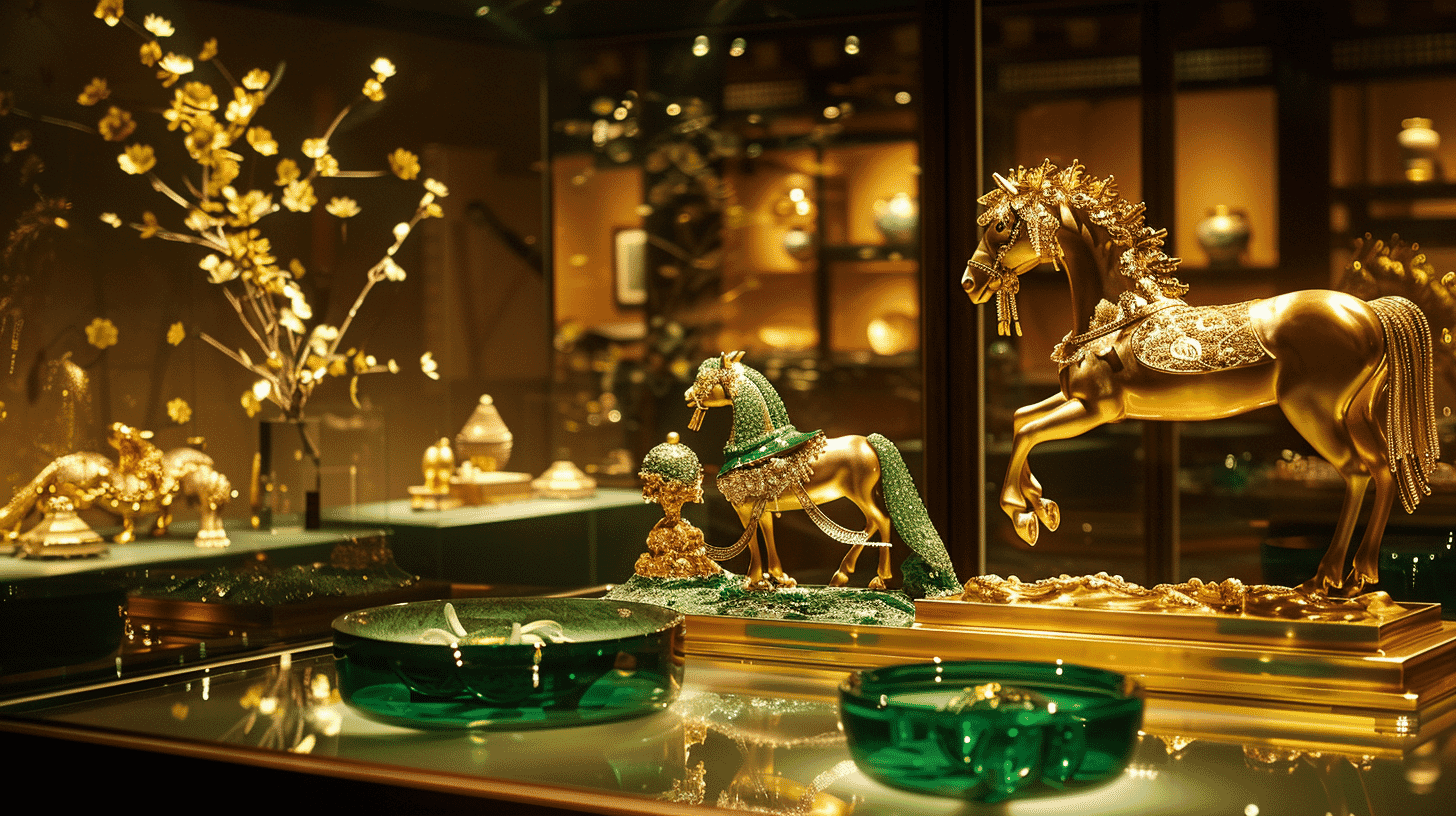
Grave Goods from a Seventh-Century Mound, National Treasure since 1952
Excavated Items from Miyajidake Kofun (宮地嶽古墳出土品, Miyajidake Kofun Shutsudohin) are the grave goods from the Miyajidake tomb within the precinct of Miyajidake Shrine at Fukutsu City, Fukuoka Prefecture, designated a National Treasure in 1952, on 29 March. They had become an Important Cultural Property on 18 September 1936. The category is archaeological materials.
The Fukuoka prefectural record describes the finds. Miyajidake Kofun is a great stone tomb whose chamber runs about 22 metres. Many fine objects were recovered, chief among them gilt bronze horse trappings, gilt bronze sword fittings, green glass plates and an openwork gilt bronze crown. The gilt bronze trappings are richly ornamented, their patterns carved in low relief; the form of the stirrup with its honeysuckle pattern is without equal for elegance. The great sword with a rounded pommel is estimated at 2.8 metres in length. The crown, hung with pendants, sets a dragon among cloud scrolls in openwork of the utmost precision.
The designated items include fragments of a gilt bronze saddle, gilt bronze stirrups, a gilt bronze bit with cheekpieces, fragments of gilt bronze harness pendants, a bronze chain, fragments of two great swords with rounded pommels, fragments of the openwork gilt bronze crown, a gold ring, green glass beads, a lidded bronze bowl, fragments of a bronze dish, Haji ware and fragments of green glass plate. That so many are fragments follows from how the chamber was opened.
The Second Longest Stone Chamber in Japan
Miyajidake Kofun is a round mound of about the early seventh century with a corridor-style stone chamber inside. The chamber is given as about 22 to 24 metres long, second in Japan after the Gojono-Maruyama tomb in Nara Prefecture.
Accounts of the mound's diameter vary. Some give about 30 metres and others a larger figure. This article follows neither and records only that the figures differ.
A round mound of this size is large for the seventh century, and the scale of the chamber bears that out. The richness of the grave goods matches the size of the chamber.
A Chamber Opened Long Ago
The chamber appears to have stood open from an early date, and from the Edo period a shrine to Fudo Myoo, the Fudo Shrine or cave Fudo, was maintained within it.
A chamber opened early usually loses its grave goods. Here much of what came from it was handed down without being scattered. Continued use as a place of worship is what preserved the objects.
When the tomb was found at the end of the Edo period, more than 300 grave goods including horse trappings and ornaments came to light, and part of these hold National Treasure status. That many designated items are fragments follows from the long years since the chamber was opened.
The chamber still serves as the Fudo Shrine, the third of the eight inner shrines of Miyajidake Shrine, where Fudo Myoo is enshrined. A tomb that continues to function as part of a shrine is what marks this site.
Who Was Buried Here Is Not Known
No object identifying the person buried at Miyajidake has been found.
A chief of the Munakata no Kimi, the ancient clan of the Munakata region, is supposed, and Munakata no Kimi Tokuzen has been proposed. This remains a supposition and is not established.
Among the finds, the great sword with a rounded pommel belongs to a type centred on the Kanto region, yet in Kyushu it clusters in the Munakata area of the north. Other finds show the same concentration, which suggests that the grouping later formalised as Munakata district had taken shape by the sixth century.
The finds include glass plate of a kind not found in the Kinai region, suggesting that the local chieftains held contacts with the continent of their own.
Seeing Them
Miyajidake Shrine owns the finds, which passed through the Tokyo National Museum and are now deposited at the Kyushu National Museum. Whether and when they are displayed depends on the museum's programme, so check before travelling.
The tomb itself stands in the precinct of Miyajidake Shrine and can be visited as the Fudo Shrine. Among tombs whose chambers can be entered, its chamber is the longest in Japan. The objects are at a museum and the chamber at a shrine, so the two are seen in different places.
The finds are sometimes brought together for special exhibitions, as at the Onojo Shinkoro Museum, where the National Treasures were shown as a group.
From Fukuma Station on the JR Kagoshima Main Line the bus takes about seven minutes to the Miyajidake Jinja-mae stop.
Q&A
- When were the Miyajidake finds designated?
- They became an Important Cultural Property on 18 September 1936 and a National Treasure in 1952, on 29 March. The category is archaeological materials, and the tomb is dated to about the early seventh century.
- What objects are designated?
- Fragments of a gilt bronze saddle, gilt bronze stirrups, a bit with cheekpieces, harness pendant fragments, a bronze chain, fragments of two great swords with rounded pommels, fragments of an openwork gilt bronze crown, a gold ring, green glass beads, a lidded bronze bowl, a bronze dish, Haji ware and green glass plate. Fukuoka Prefecture calls the form of the honeysuckle stirrup without equal.
- How large is the stone chamber?
- About 22 to 24 metres long, second in Japan after the Gojono-Maruyama tomb in Nara. The mound is a round one of about the early seventh century with a corridor-style chamber. Accounts of the diameter differ, some giving about 30 metres and others a larger figure.
- Why did the grave goods survive?
- The chamber seems to have stood open from an early date, but from the Edo period a shrine to Fudo Myoo was maintained inside it, and continued use as a place of worship preserved the objects. That many designated items are fragments follows from the long years since the chamber was opened.
- Where can the finds be seen?
- Miyajidake Shrine owns them and they are deposited at the Kyushu National Museum; whether they are on display depends on the museum's programme. The tomb itself is in the shrine precinct and can be visited as the Fudo Shrine. It is about seven minutes by bus from JR Fukuma Station.
Basic Information
| Name | Excavated Items from Miyajidake Kofun (宮地嶽古墳出土品, Miyajidake Kofun Shutsudohin) |
|---|---|
| Location | 4-7-2 Ishizaka, Dazaifu City, Fukuoka Prefecture (Kyushu National Museum; owned by Miyajidake Shrine, on deposit) |
| Designation | National Treasure (archaeological materials) |
| Year Designated | 1936 (18 September), Important Cultural Property; 1952 (29 March), National Treasure |
| Quantity | A single lot |
| Dimensions | Fragments of a gilt bronze saddle, gilt bronze stirrups, a bit with cheekpieces, harness pendant fragments, a bronze chain, fragments of 2 great swords with rounded pommels, an openwork gilt bronze crown, a gold ring, green glass beads, a lidded bronze bowl, a bronze dish, Haji ware and green glass plate. The great sword is estimated at 2.8 m. Kofun period, early 7th century |
| Owner | Miyajidake Shrine |
| Public Access | Deposited at the Kyushu National Museum; display depends on the museum's programme. The tomb chamber can be visited as the Fudo Shrine in the precinct of Miyajidake Shrine |
References
- Fukuoka Prefecture cultural properties database: the Miyajidake Kofun finds
- https://www.fukuoka-bunkazai.jp/frmDetail.aspx?db=1&id=45
- Agency for Cultural Affairs, National Cultural Properties Database: the Miyajidake Kofun finds
- https://kunishitei.bunka.go.jp/heritage/detail/201/841
- Miyajidake Shrine official site
- https://www.miyajidake.or.jp/
- Kyushu National Museum official site
- https://www.kyuhaku.jp/
Last verified: 2026.09.03