
A Designation Marked "Attributed", National Treasure since 1962
Excavated Items Attributed to the Okitsumiya Ritual Site of Munakata Taisha, Fukuoka Prefecture (伝福岡県宗像大社沖津宮祭祀遺跡出土品) are objects said to have come from the ritual site at the Okitsumiya on Okinoshima, designated a National Treasure in 1962, on 21 June. They had become an Important Cultural Property on 27 June 1959. The quantity is recorded as a single lot, the category archaeological materials.
The word den at the head of the name, rendered here as attributed, marks material said to come from the Okitsumiya ritual site but not confirmed as doing so. It is designated separately from the material of certain provenance, which was made a National Treasure on the same day under the name Excavated Items from the Okitsumiya Ritual Site of Munakata Taisha, Fukuoka Prefecture.
The two names differ by a single character and share their designation dates. Check for the word attributed when consulting sources. The Agency for Cultural Affairs holds them under separate designation numbers.
Why the Provenance Is Unconfirmed
Among the finds from Okinoshima are objects taken from the island otherwise than by excavation. Academic investigation was carried out in the Showa period, but material had left the island before that.
Where the find spot and the circumstances of discovery were not recorded, an object cannot be confirmed as coming from the site even when it is said to have done so. The presence or absence of a record is what divides the two designations.
The Agency adds den and designates separately so that confirmed information is not mixed with reported information. The material may be valued equally; the certainty of its history is treated apart. That distinction is carried in the name itself.
Offerings That Change with the Period
The Fukuoka prefectural record sets out how the ritual finds from Okinoshima change over time.
In the fourth and fifth centuries, mirrors, weapons and personal ornaments were offered. In the sixth, cut glass, horse trappings and gold rings arrived from abroad, alongside replicas in talc and iron. In the seventh, pottery and gilt bronze miniatures predominate, with imports from China including a Tang three-color long-necked bottle and a gilt bronze dragon head of the Eastern Wei. By the eighth century, at open-air ritual grounds, pottery and talc effigies are the main offerings.
The movement is from offering the real object to offering a model of it. An age that gave gold and glass gives way to one that gives effigies cut from talc, and the form of the ritual changes with it.
The Agency's own commentary concludes that the finds convey well the state of ancient ritual from the Kofun period through to the Heian period, standing out remarkably even beside other ritual finds.
Ritual Grounds on and Beside the Rocks
The prefectural record notes that the site lies on the mid-slope of the island, its ritual grounds set mainly on top of and beside great rocks.
No building was raised for worship; the rocks themselves served as the ground of the rite. Objects were laid on the rock or placed in its shadow. Ritual without a building leaves only the rocks and the arrangement of the finds as remains.
That the ritual grounds moved into the open in the eighth century marks a movement away from the rocks. The place of the rite itself shifts with time.
Okinoshima was upheld by the faith of those who sailed between ancient Japan, Korea and China and of the fishermen nearby, and later protected as the sacred ground where the three goddesses reside. The quantity of imported material follows from its position on that sea route.
Seeing Them
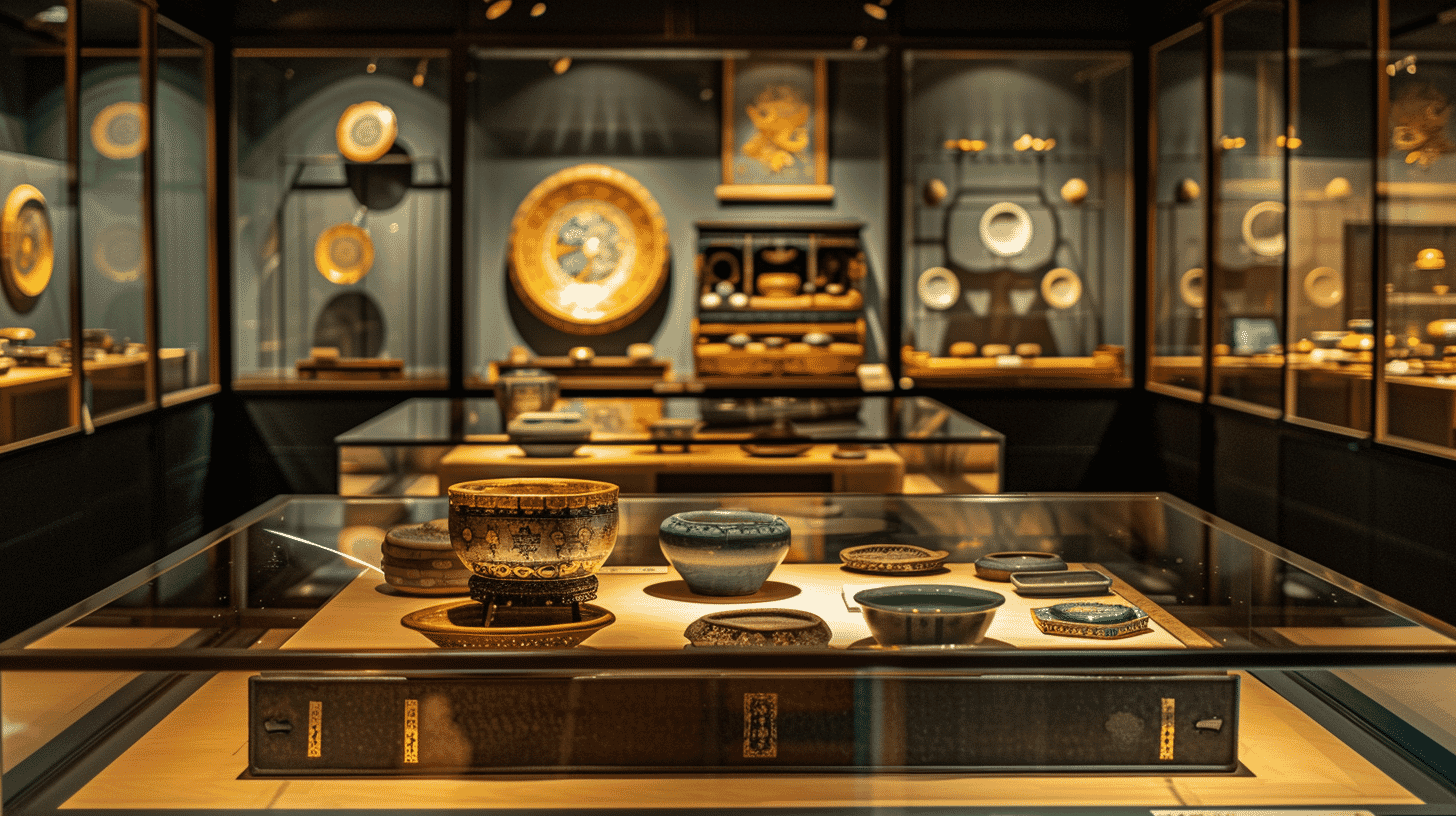
The finds are kept and displayed at the Shinpokan treasure hall of Munakata Taisha. Hours and charges change from time to time, so check the shrine's information before travelling.
Because the designation covers a single lot, what is displayed is part of the whole. Objects under the attributed designation are not necessarily distinguished from the others in the display, so check the captions to see which designation an object belongs to.
Okinoshima itself is the sacred body of Munakata Taisha and the public cannot land on it. Removing so much as a tree, a blade of grass or a stone from the island remains forbidden. That prohibition is what kept the material on the island.
From Togo Station on the JR Kagoshima Main Line the bus takes about 12 minutes to the Munakata Taisha-mae stop.
Q&A
- When were the attributed finds designated?
- They became an Important Cultural Property on 27 June 1959 and a National Treasure in 1962, on 21 June. The quantity is recorded as a single lot, in the category of archaeological materials.
- What does the word attributed mean here?
- That the material is said to come from the Okitsumiya ritual site but is not confirmed as doing so. The material of certain provenance was designated on the same day under a name differing by a single character, so check for the word when consulting sources.
- Why is the provenance unconfirmed?
- Because some objects left Okinoshima otherwise than by excavation, without record of the find spot or the circumstances. The presence or absence of a record divides the two designations, so that confirmed information is not mixed with reported information.
- How do the offerings change over time?
- The prefectural record gives mirrors, weapons and ornaments in the fourth and fifth centuries; cut glass, horse trappings and gold rings with talc and iron replicas in the sixth; pottery and gilt bronze miniatures with Chinese imports in the seventh; and pottery and talc effigies at open-air grounds in the eighth. The movement is from offering the object to offering a model of it.
- Where can the finds be seen?
- At the Shinpokan treasure hall of Munakata Taisha. Only part of the lot is displayed, and objects under this designation are not necessarily distinguished in the display, so check the captions. The public cannot land on Okinoshima. It is about 12 minutes by bus from JR Togo Station.
Basic Information
| Name | Excavated Items Attributed to the Okitsumiya Ritual Site of Munakata Taisha, Fukuoka Prefecture (伝福岡県宗像大社沖津宮祭祀遺跡出土品) |
|---|---|
| Location | 2331 Tashima, Munakata City, Fukuoka Prefecture (Shinpokan treasure hall, Munakata Taisha) |
| Designation | National Treasure (archaeological materials); Okinoshima, the reported find site, is a component of the World Heritage site Sacred Island of Okinoshima and Associated Sites in the Munakata Region |
| Year Designated | 1959 (27 June), Important Cultural Property; 1962 (21 June), National Treasure |
| Quantity | A single lot |
| Dimensions | Ritual finds from Okinoshima: mirrors, weapons and ornaments in the 4th and 5th centuries; cut glass, horse trappings and gold rings with talc and iron replicas in the 6th; pottery and gilt bronze miniatures with Tang three-color ware and a gilt bronze dragon head in the 7th; pottery and talc effigies in the 8th. Kofun to Heian period |
| Owner | Munakata Taisha |
| Public Access | Kept and displayed at the Shinpokan treasure hall. Only part is shown at a time. The public cannot land on Okinoshima |
References
- Fukuoka Prefecture cultural properties database: the Okitsumiya ritual site finds and the attributed finds
- https://www.fukuoka-bunkazai.jp/frmDetail.aspx?db=1&id=44
- Agency for Cultural Affairs, National Cultural Properties Database: the Okitsumiya ritual site finds
- https://kunishitei.bunka.go.jp/heritage/detail/201/862
- Sacred Island of Okinoshima and Associated Sites official site
- https://www.okinoshima-heritage.jp/
- Munakata Taisha: the Shinpokan treasure hall
- https://munakata-taisha.or.jp/shinpoukan.html
Last verified: 2026.09.05