
A Single Lot of Finds, an Important Cultural Property since 2004
Excavated Items from the Kuma and Nishioda Sites, Fukuoka Prefecture (福岡県隈・西小田遺跡群出土品) are Yayoi-period archaeological materials held at 1-9-1 Futsukaichi-minami, Chikushino City, Fukuoka Prefecture, listed as an Important Cultural Property on 8 June 2004. The listing is as an Important Cultural Property, and the owner is Chikushino City.
The quantity reads as a single lot: not a number with a measure, but a grouping. This follows the Imojiya site finds as the second such case.
The reading field carries the centre dot of the name as well, separating the two site names.
One Excavation, Split Between National and Prefectural Listings
What came out of a single dig was divided between two systems.
Chikushino City records that beyond the nationally listed items, a further 166 pieces are listed by the prefecture: shell bracelets of two kinds, iron arrowheads and other ironwork, bronze arrowheads, polished stone arrowheads, stone halberds and swords, curved and tubular beads, small glass beads, and human bone with a bronze sword still embedded in it.
Adding the nationally listed items comes to 78 pieces. The prefectural listing holds 166, so the prefecture's share is the larger.
The names differ too. The national listing speaks of finds from the site group; the prefectural one names the district and the jar burials specifically.
At the Seianji guest hall, the building was listed nationally and the garden by the prefecture, two separate objects.
Here the finds of one excavation are divided, with different counts and different names.
Three Locations Standing for Three Phases
The listing covers three places, each of a different date.
The Agency describes the lot as covering finds from a jar burial at one location, from ritual features at another, and from a jar burial at a third. The numbers of the locations and the burials are written in Chinese numerals.
By the city's account, the first jar burial held a slender bronze sword and eight shell bracelets of one type, dating from the earlier part of the middle Yayoi.
The second held an iron halberd, an iron sword, a Former Han mirror and forty-one shell bracelets of another type, from the later part of that phase. The city reads this as reflecting a change of generation among the chieftains.
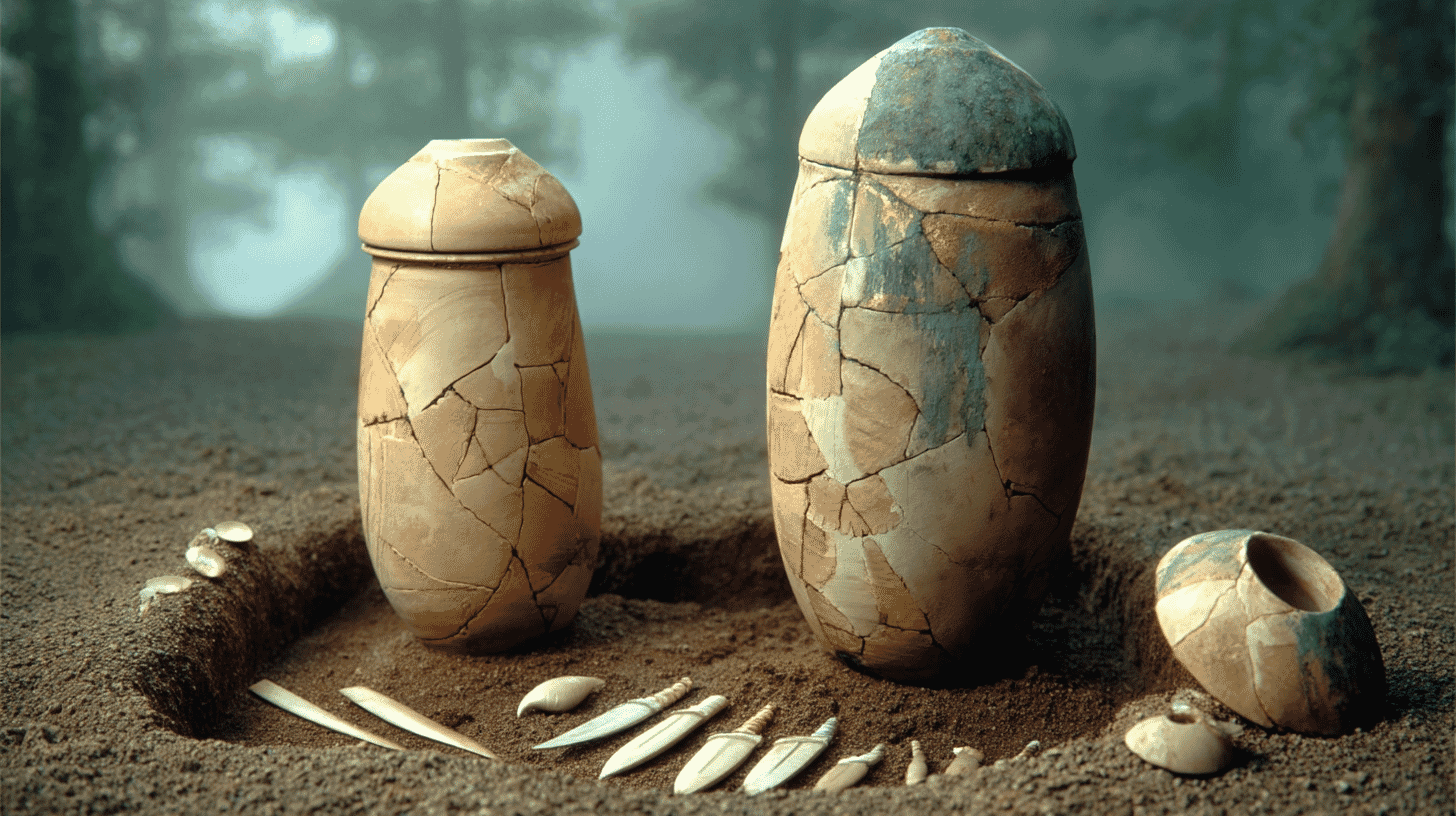
The third location yielded twenty-three bronze halberds buried together with two lidded jars, from the end of the middle Yayoi into the early late Yayoi, which the city calls an instance of unusual ritual.
Together they show how ritual and chieftains' burials changed across the middle Yayoi. Three places within one site group trace a sequence.
The Type of Shell Bracelet Changes with the Phase
The same class of object appears in different types at different dates.
The earlier jar burial yielded eight bracelets of one recognised type.
The later one yielded forty-one of another.
The type changes from one to the other, and the number rises from eight to forty-one.
With the boar-shaped clay object, such objects were noted across a wide region in the late and final Jomon, and that piece stood out among them. That is a comparison with contemporaries elsewhere.
Here the comparison runs through time within one site group. The contents of the burials mark the difference in date directly.
Seeing Them
The finds are at 1-9-1 Futsukaichi-minami, Chikushino City, Fukuoka Prefecture, owned by the city.
The commentary carries a reading gloss in lenticular brackets on the term for jar burial, following the gilded staff head, the Gekimosho and the Jokomyoji site map as the fourth such case.
How they were found is recorded. Chikushino City notes that they came from rescue excavation carried out ahead of a new town development in the south of the city.
The Imojiya site finds also came from excavation ahead of work on an industrial estate. Material recovered before development is listed again and again.
The listing of 8 June 2004 falls on the same day as the tsujigahana haori. The finds are a city holding, not kept on permanent display. Check before travelling.
Q&A
- When were the finds listed?
- On 8 June 2004, as an Important Cultural Property. The owner is Chikushino City.
- How many pieces are there?
- The quantity field gives no number, only that they form one lot. The city's itemised counts come to 78 pieces. A further 166 from the same excavation carry a prefectural listing.
- What do they consist of?
- Finds from three locations: a bronze sword with 8 bracelets; an iron halberd, an iron sword, a mirror and 41 bracelets; and 23 bronze halberds with 2 lidded jars.
- How does the prefectural listing differ?
- In name and in count. The prefectural listing names the district and the jar burials specifically, and covers 166 pieces.
- What do they show?
- Chikushino City describes them as material showing how ritual and chieftains' burials changed across the middle Yayoi. The three locations stand for three phases.
Basic Information
| Name | Excavated Items from the Kuma and Nishioda Sites, Fukuoka Prefecture (福岡県隈・西小田遺跡群出土品); the prefectural listing uses a different name |
|---|---|
| Location | 1-9-1 Futsukaichi-minami, Chikushino City, Fukuoka Prefecture |
| Designation | Important Cultural Property (fine arts, archaeological material); other finds from the same site group carry a prefectural listing |
| Year Designated | 2004 (8 June), Important Cultural Property |
| Quantity | One lot, with no number given. The city's itemised counts come to 78 pieces |
| Dimensions | Location 3, jar burial 109, held 1 slender bronze sword and 8 shell bracelets of one type, from the earlier middle Yayoi. Location 13, jar burial 23, held 1 iron halberd, 1 iron sword, 1 Former Han mirror and 41 bracelets of another type, from the later middle Yayoi. Location 7 yielded 23 bronze halberds buried together with 2 lidded jars, from the end of the middle Yayoi into the early late Yayoi |
| Owner | Chikushino City |
| Public Access | A city holding, not on permanent display |
References
- Chikushino City: the Kuma and Nishioda finds
- https://www.city.chikushino.fukuoka.jp/soshiki/38/1844.html
- Cultural Heritage Online: the same finds
- https://bunka.nii.ac.jp/heritages/detail/135917
- Chikushino City: cultural properties
- https://www.city.chikushino.fukuoka.jp/soshiki/48/3550.html
- Agency for Cultural Affairs, National Cultural Properties Database
- https://kunishitei.bunka.go.jp/
Last verified: 2026.09.10