
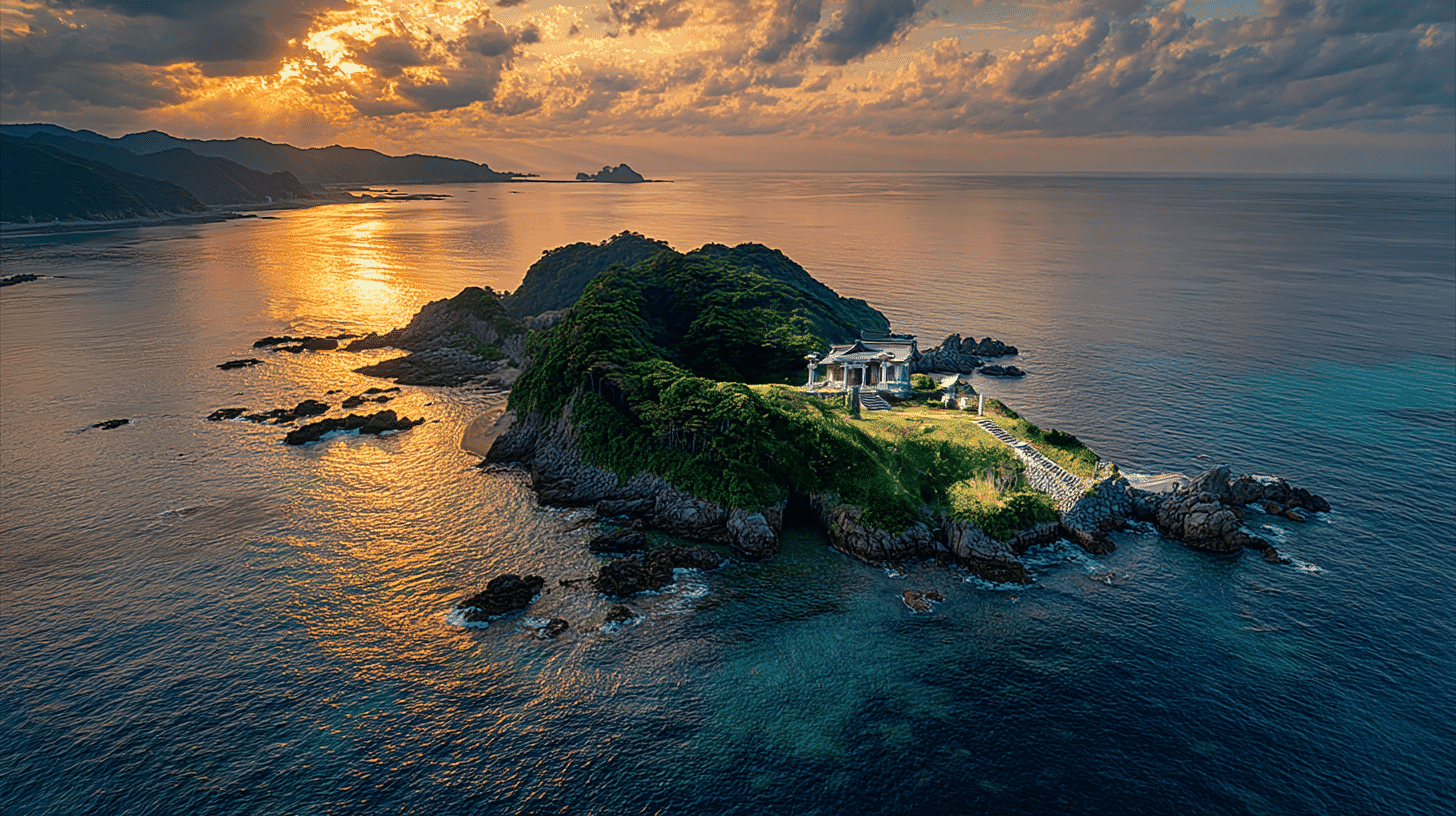
A World Heritage Site of Eight Components
The Sacred Island of Okinoshima and Associated Sites in the Munakata Region (「神宿る島」宗像・沖ノ島と関連遺産群) is a World Cultural Heritage site spanning Munakata City and Fukutsu City in Fukuoka Prefecture, inscribed in July 2017 at the 41st session of the World Heritage Committee held at Krakow in Poland. It is Japan's twenty-first World Cultural Heritage site.
Eight components make up the property: Okinoshima itself, with the Okitsumiya of Munakata Taisha; the rocks Koyajima, Mikadobashira and Tengu-iwa; the distant worship site of the Okitsumiya; the Nakatsumiya of Munakata Taisha; the Hetsumiya of Munakata Taisha; and the Shinbaru-Nuyama burial mound group.
Koyajima, Mikadobashira and Tengu-iwa are rocks standing in the sea around Okinoshima. That bare rock, neither building nor archaeological site, is counted among the components marks the make-up of this property. The three served as marks for approaching the island and have been read as a gateway to it.
Two Criteria
The criteria applied at inscription were (ii) and (iii).
Criterion (ii) concerns an interchange of values over a span of time or within a cultural area. Finds from the ritual site on Okinoshima include material originating in China and on the Korean peninsula, showing that the rites were carried on within the exchanges of East Asia.
Criterion (iii) requires unique testimony to a cultural tradition or civilisation, living or vanished. Ancient rites continuing into present belief while changing in form is what answers to it.
What is inscribed is the site, the island and the shrine buildings, not the excavated material. Those finds carry their own separate designations, as the Excavated Items from the Okitsumiya Ritual Site of Munakata Taisha and the items attributed to that site. Inscription on the World Heritage list and the designation of the finds are different mechanisms and should not be confused.
No One Lands on Okinoshima
Okinoshima is the sacred body of Munakata Taisha. The public cannot land on it, and the exclusion of women continues.
Prohibitions remain in force. Removing so much as a tree, a blade of grass or a stone is forbidden, and there is a custom of not speaking of what is seen or heard on the island. Anyone landing performs ablutions in the sea first.
Formerly about 200 men were allowed ashore on 27 May each year, but since 2018 no one but the priesthood has been permitted to land. Inscription as World Heritage tightened access rather than opening it.
Okinoshima lies about 60 kilometres off the Kyushu mainland. It is about four kilometres around, and its highest point stands at about 244 metres.
Worship from a Distance
How is an island that cannot be entered worshipped? The answer is itself one of the components.
The distant worship site of the Okitsumiya, on the north shore of Oshima, exists so that Okinoshima can be worshipped from afar. In clear weather the island can be seen from here, about 49 kilometres away. The building faces its object, and the object lies at the end of the sightline.
Munakata Taisha comprises three shrines. Tagorihime is enshrined at the Okitsumiya on Okinoshima, Tagitsuhime at the Nakatsumiya on Oshima, and Ichikishimahime at the Hetsumiya on the Kyushu mainland. The three goddesses stand in a line running from the mainland out to sea, matching the sailing route across the Genkai Sea.
The Shinbaru-Nuyama burial mounds in Fukutsu City are the graves of the Munakata clan, raised in the fifth and sixth centuries. Forty-one survive: five keyhole-shaped mounds, thirty-five round and one square. They attest to the clan that carried on the rites at Okinoshima.
Visiting
Okinoshima is out of reach, but the other components can be visited.
The Hetsumiya stands at Tashima in Munakata City, about 12 minutes by bus from Togo Station on the JR Kagoshima Main Line; its Shinpokan treasure hall holds and displays the excavated material. The Nakatsumiya and the distant worship site are on Oshima, reached by ferry or passenger boat from the Konominato ferry terminal. Oshima needs a schedule built around the boats, so check the timetable.
The Shinbaru-Nuyama mounds are at Katsuura in Fukutsu City, with a viewpoint from which the group can be seen at once. Farmland surrounds them, and some areas can be walked among while others cannot.
Opening hours at each component and the boat services change from time to time, so check before travelling.
Q&A
- When was the property inscribed as World Heritage?
- In July 2017, at the 41st session of the World Heritage Committee held at Krakow in Poland. It is Japan's twenty-first World Cultural Heritage site, made up of eight components spanning Munakata City and Fukutsu City in Fukuoka Prefecture.
- What are the components?
- Okinoshima with the Okitsumiya; the rocks Koyajima, Mikadobashira and Tengu-iwa; the distant worship site of the Okitsumiya; the Nakatsumiya; the Hetsumiya; and the Shinbaru-Nuyama burial mounds. The three rocks stand in the sea around Okinoshima, so bare rock, neither building nor site, is counted among the components.
- Can Okinoshima be visited?
- No. The public cannot land and the exclusion of women continues. Removing a tree, a blade of grass or a stone is forbidden, and there is a custom of not speaking of what is seen there. About 200 men were formerly allowed ashore each 27 May, but since 2018 only the priesthood may land.
- What is the distant worship site?
- A facility on the north shore of Oshima built so that Okinoshima, which cannot be entered, can be worshipped from afar. In clear weather the island is visible about 49 kilometres away. The building faces its object, and it is itself one of the eight components.
- Are the excavated finds part of the inscription?
- No. What is inscribed is the site, the island and the shrine buildings. The finds carry their own separate designations, as the Excavated Items from the Okitsumiya Ritual Site of Munakata Taisha and the items attributed to that site. Inscription and designation are different mechanisms.
Basic Information
| Name | Sacred Island of Okinoshima and Associated Sites in the Munakata Region (「神宿る島」宗像・沖ノ島と関連遺産群) |
|---|---|
| Location | Munakata City and Fukutsu City, Fukuoka Prefecture |
| Designation | World Cultural Heritage; criteria (ii) and (iii); 8 components |
| Year Designated | 2017 (July), inscribed by the World Heritage Committee at Krakow |
| Quantity | 8 components (Okinoshima, Koyajima, Mikadobashira, Tengu-iwa, the distant worship site of the Okitsumiya, the Nakatsumiya, the Hetsumiya, and the Shinbaru-Nuyama burial mounds) |
| Dimensions | Okinoshima lies about 60 kilometres off the Kyushu mainland, about 4 kilometres around, highest point about 244 metres. The island is about 49 kilometres from the distant worship site. The Shinbaru-Nuyama group has 41 surviving mounds |
| Owner | Munakata Taisha and others |
| Public Access | Okinoshima cannot be landed on and excludes women. The other components can be visited; Oshima is reached by boat from Konominato |
References
- Sacred Island of Okinoshima and Associated Sites official site
- https://www.okinoshima-heritage.jp/
- Cultural Heritage Online: World Heritage and Intangible Cultural Heritage
- https://bunka.nii.ac.jp/special_content/hlinkH
- Fukutsu City: World Heritage
- https://www.city.fukutsu.lg.jp/soshiki/bunkazai/sekaiisan/
- Munakata Taisha official site
- https://munakata-taisha.or.jp/
Last verified: 2026.09.28