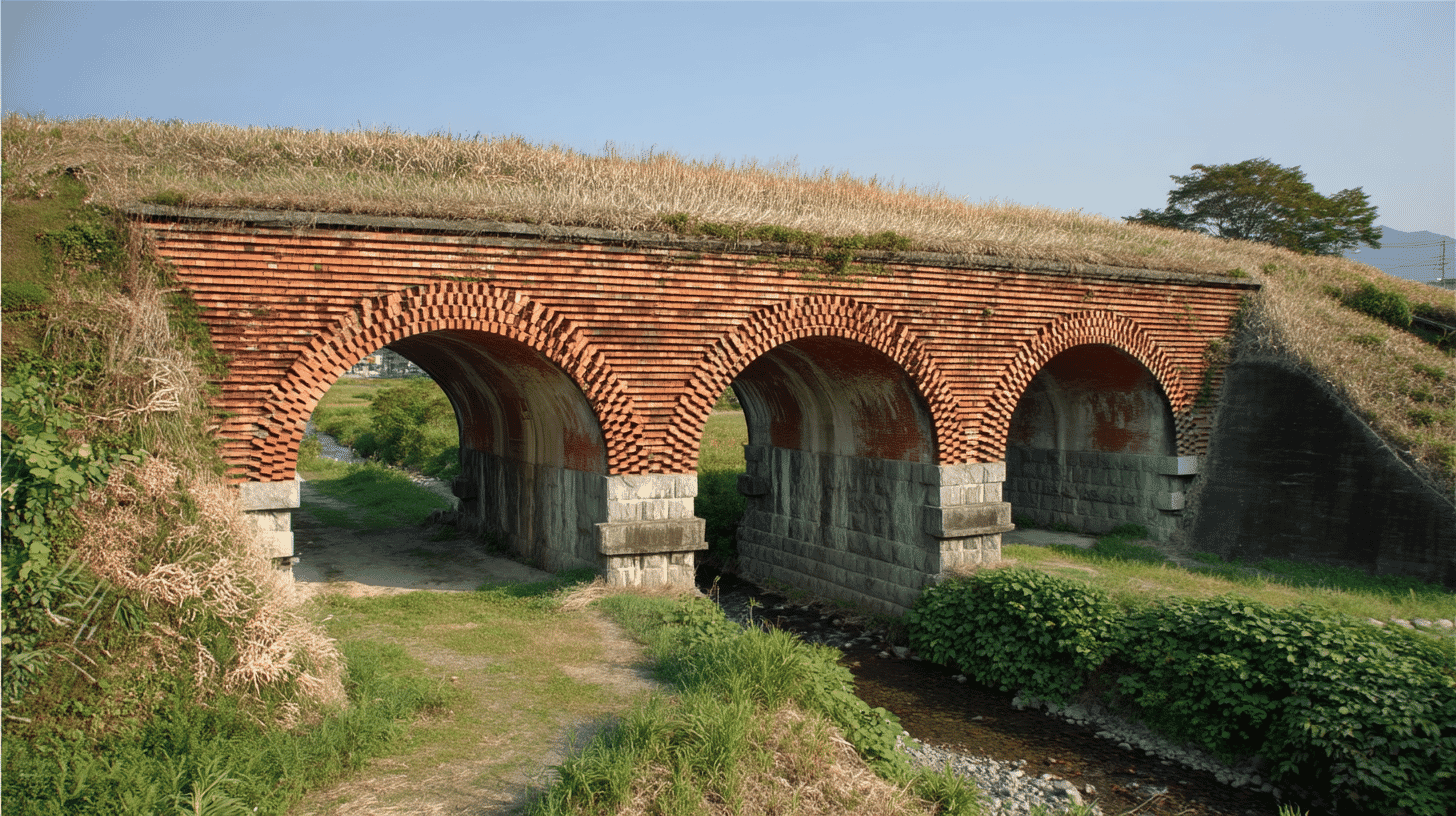
Uchida Triple Bridge: A Masterpiece of Meiji-Era Railway Engineering
Hidden in the tranquil countryside of Aka Village in Fukuoka Prefecture lies one of Japan's most remarkable railway heritage sites—the Uchida Triple Bridge (内田三連橋梁, Uchida Sanren Kyōryō). This elegant three-arch bridge, completed in 1895, stands as a testament to the engineering prowess of Japan's early modernization period and the fascinating international collaboration that helped build the nation's railway network.
A Bridge with Two Faces: Understanding Its Unique Design
What makes the Uchida Triple Bridge truly exceptional is its dual personality. Stand on one side of the bridge, and you'll witness a warm, reddish-brown brick façade arranged in mesmerizing striped and checkerboard patterns. Walk around to the other side, and you'll encounter an entirely different structure—a dignified wall of precisely cut gray stone.
This architectural duality wasn't an aesthetic choice but rather a pragmatic engineering decision. The downstream (western) side was constructed with bricks arranged in a distinctive "geta-ba" (下駄歯, meaning "clog-tooth") pattern, where alternating bricks protrude from the wall surface. This ingenious design was intended to facilitate future expansion: when the railway was eventually double-tracked, new brickwork could interlock seamlessly with the existing structure. The upstream (eastern) side, built with cut stone, was designed to withstand flooding—notice how the stone pillars project forward in a boat-shaped profile to deflect water pressure during high flows.
The fact that the double-tracking never occurred means we can still appreciate this beautiful preparatory brickwork in its original form today—an unintended gift from history.
The Engineers Behind the Bridge
The Uchida Triple Bridge was designed by Nobuchi Hisakuki (野辺地久記), a Japanese engineer, with technical guidance from Hermann Rumschöttel, a German railway engineer who played a pivotal role in developing Kyushu's railway network. Rumschöttel arrived in Japan in 1887 at the invitation of the Kyushu Railway Company and introduced German engineering principles that would influence Japanese railway construction for decades.
Under Rumschöttel's guidance, Kyushu's railways adopted the metric system—a notable departure from the British-influenced yard-pound system used elsewhere in Japan at the time. His legacy can be seen not only in the Uchida Triple Bridge but throughout the region's historic railway infrastructure. A bronze relief honoring Rumschöttel's contributions can still be found at JR Hakata Station.
The Coal Railway Heritage
The bridge was originally built for the Hōshū Railway Company (豊州鉄道), which was established to transport coal from the rich Chikuhō coalfields to ports for shipping. The Chikuhō region was once Japan's most productive coal-mining area, and the railways built to serve these mines were the arteries through which the fuel of Japan's industrial revolution flowed.
Throughout its history, the bridge has passed through many hands—from the Hōshū Railway to the Kyushu Railway, then to the nationalized Japanese National Railways (JNR), JR Kyushu, and finally to the current operator, Heisei Chikuhō Railway. Despite these ownership changes and the decline of the coal industry, the bridge has remained in continuous service for over 130 years.
Cultural Heritage Designation
In 1999, the Uchida Triple Bridge was designated as a Registered Tangible Cultural Property by the Japanese government, recognizing its historical and architectural significance. It has also been certified as a Modern Industrial Heritage site by the Ministry of Economy, Trade and Industry.
The bridge earned these designations for several reasons: its exceptional preservation state, the unique dual-construction technique representing forward-thinking engineering, and its role as a physical link to Japan's industrial modernization. Standing beneath its arches, visitors can literally touch the bricks that were laid when Japan was transforming from a feudal society into a modern industrial nation.
Visiting the Bridge
The Uchida Triple Bridge is located between Aka Station and Uchida Station on the Heisei Chikuhō Railway Tagawa Line. The bridge is visible from Prefectural Road 418 and can be appreciated from several vantage points along the road and riverbank.
The best way to experience the bridge is to take the Heisei Chikuhō Railway—a charming single-car diesel train that provides a nostalgic journey through rural Fukuoka. As your train crosses the bridge, you become part of its continuing story, joining the countless passengers who have traversed these arches since 1895.
For photographers, the bridge offers excellent opportunities throughout the year. The contrast between the red brick and surrounding greenery is particularly striking in spring and summer, while autumn colors provide a warm backdrop. The "geta-ba" brickwork pattern is best photographed in warm afternoon light when the shadows accentuate the protruding bricks.
Combining Your Visit with Regional Attractions
Aka Village and the surrounding area offer several attractions that complement a visit to the Uchida Triple Bridge. Genjii no Mori (源じいの森) is a nature retreat featuring hot spring baths, camping facilities, log cabins, and a riverside setting perfect for relaxation. The hot spring facility, shaped like a turtle (a symbol of longevity), offers both public baths and private family baths surrounded by bamboo groves.
Railway enthusiasts should also visit the Second Ishizaka Tunnel (第二石坂トンネル), located nearby on the same Tagawa Line. Completed in the same year as the Uchida Triple Bridge, it is the oldest railway tunnel in Kyushu and was also designated as a Registered Tangible Cultural Property in 1999.
The village also operates a tourist trolley on the abandoned Yusuhara Line, offering a unique opportunity to ride along tracks that were built but never saw regular service—a fascinating footnote in railway history.
Practical Tips for Visitors
The Heisei Chikuhō Railway offers a one-day unlimited ride pass called "Chikumaru Kippu" (ちくまるキップ) for 1,000 yen (adults) or 500 yen (children), which provides excellent value for exploring the line's historic sites. If you use the railway to visit the area, present your ticket at Genjii no Mori Hot Spring for a 100-yen discount on admission.
While the bridge is always visible from public areas, please remember that the railway tracks are private property. Never enter the tracks or obstruct train operations. The best viewing and photography spots are along the road and riverbank below the bridge.
- 📍 Plan Your Visit to Fukuoka
- Find tours, activities & transport passes near Uchida Triple Bridge
- [ Dazaifu Tenmangu Shrine & Hakata Food Tours ]
Q&A
- Why does the bridge have two different construction styles?
- The downstream brick side was built with protruding bricks ("geta-ba" pattern) to allow easy connection for future double-tracking. The upstream stone side was designed to resist flood damage. Since double-tracking never happened, both styles remain visible today.
- Is the bridge still in active use?
- Yes! The Uchida Triple Bridge has been in continuous service since 1895 and is currently used by the Heisei Chikuhō Railway Tagawa Line. Trains cross it regularly throughout the day.
- How do I get to the bridge?
- Take the Heisei Chikuhō Railway Tagawa Line to either Aka Station or Uchida Station. The bridge is located between these two stations and is accessible via Prefectural Road 418. It's about a 20-minute walk from Uchida Station.
- What is the local nickname for this bridge?
- Local residents affectionately call it "Mitsu-ankyō" (みつあんきょ), meaning "three arches," which refers to its distinctive three-arch design.
- Are there any other historic railway structures nearby?
- Yes, the Second Ishizaka Tunnel (第二石坂トンネル), also on the Tagawa Line, is the oldest railway tunnel in Kyushu and was registered as a Cultural Property in the same year as the bridge. The Nakatsuhara Bridge, another historic structure, features similar geta-ba brickwork.
Basic Information
| Official Name | Uchida Sanren Kyōryō (内田三連橋梁) |
|---|---|
| Local Nickname | Mitsu-ankyō (みつあんきょ) |
| Location | Ōaza Uchida 1804-1, Aka Village, Tagawa District, Fukuoka Prefecture |
| Completion Date | August 1895 (Meiji 28) |
| Designer | Nobuchi Hisakuki (with technical guidance from Hermann Rumschöttel) |
| Structure Type | Three-arch brick bridge (煉瓦造3連アーチ橋) |
| Bridge Length | Approximately 17 meters |
| Span Length | 3.35 meters per arch |
| Railway Line | Heisei Chikuhō Railway Tagawa Line |
| Cultural Designation | Registered Tangible Cultural Property (1999), Modern Industrial Heritage |
| Access | Between Aka Station and Uchida Station; approximately 20 minutes walk from Uchida Station |
| Admission | Free (visible from public road) |
| Contact | Aka Village Board of Education: 0947-62-3003 |
References
- 内田三連橋梁 - Wikipedia
- https://ja.wikipedia.org/wiki/%E5%86%85%E7%94%B0%E4%B8%89%E9%80%A3%E6%A9%8B%E6%A2%81
- 内田三連橋梁 - 文化遺産オンライン
- https://bunka.nii.ac.jp/heritages/detail/137228
- 土木遺産 in 九州:内田川橋梁 - 九州地域づくり協会
- https://dobokuisan.qscpua2.com/heritage/fukuoka/fuk22_uchidakawabashi/
- ヘルマン・ルムシュッテル (鉄道技術者) - Wikipedia
- https://ja.wikipedia.org/wiki/ヘルマン・ルムシュッテル_(鉄道技術者)
- 平成筑豊鉄道田川線 - Wikipedia
- https://ja.wikipedia.org/wiki/平成筑豊鉄道田川線
- 源じいの森 - 赤村役場
- https://www.akamura.net/government/genjii.html
- 内田三連橋梁 - 福岡県町村会
- https://www.f-chousonkai.gr.jp/sight/detail213.html
Last verified: 2026.01.29
Nearby heritages
- Ishizaka Tunnel (Second Tunnel)
- Fukuoka Prefecture, Tagawa District, Aka Village, Aka 6938-2 - Miyako Town, Kyoto District, Sakiyama, Ishizaka 1506-2
- Former Mitsui Tagawa Mine Ita Shaft No. 1 Chimney
- 2734-1 Ita, Tagawa City, Fukuoka Prefecture
- Former Mitsui Tagawa Mine Ita Shaft No. 2 Chimney
- 2734-1 Ita, Tagawa City, Fukuoka Prefecture
- Former Mitsui Tagawa Mine Ita Shaft Tower
- 2734-1 Ita, Tagawa City, Fukuoka Prefecture
- Kure River Megane Bridge
- 1113, 1497 Kagamiyama, Kahara Town, Tagawa County, Fukuoka Prefecture
- Former Hayashida Harujiro Family Residence Bookstore
- 3330-1 Shinmachi, Tagawa City, Fukuoka Prefecture, and other locations
- Former Hayashida Shunjiro Family Residence Guest House
- 3330-1 Shinmachi, Tagawa City, Fukuoka Prefecture, and other locations
- Nakajima Family Residence (Soeda Town, Tagawa District,
- 1860 Soeda, Soeda-machi, Tagawa-gun, Fukuoka Prefecture
- Nakai Tunnel
- Fukuoka Prefecture, Tagawa District, Kahara Town, Oaza Kagamiyama 1073 ~ Miyako Town, Kyoto District, Oaza Matsuda 2032-6
- Goshogatani Shrine Stone
- Tsuzumi, Yukuhashi City, Miyako Town, Kyoto County