Wakato Bridge: Japan's First Long-Span Suspension Bridge and Gateway to Kitakyushu's Industrial Night Views

Discover Wakato Bridge, a National Important Cultural Property in Kitakyushu, Fukuoka. Once Asia's longest suspension bridge, this stunning crimson landmark offers breathtaking illuminated night views, retro waterfront districts, and unforgettable industrial night cruises.

Wakato Bridge: A Crimson Gateway to Japan's Industrial Heritage

Rising majestically over Dokai Bay in Kitakyushu City, Fukuoka Prefecture, Wakato Bridge stands as a testament to Japan's post-war engineering ambitions and industrial prowess. This striking crimson suspension bridge, connecting Tobata Ward and Wakamatsu Ward, was designated as a National Important Cultural Property in February 2022, recognizing its pivotal role in the history of Japanese bridge engineering.

When it opened in September 1962, Wakato Bridge was celebrated as "Asia's greatest suspension bridge," boasting a total length of 627 meters and a central span of 367 meters—dimensions that far exceeded any bridge previously constructed in Japan. Today, this beloved landmark continues to serve as both a vital transportation artery and an iconic symbol of Kitakyushu, drawing visitors from across the globe to witness its illuminated splendor against the backdrop of one of Japan's premier industrial night view cities.

Historical Background: From Tragedy to Triumph

The story of Wakato Bridge begins with a maritime tragedy. In 1930, a ferry crossing Dokai Bay capsized, claiming 73 lives and galvanizing local residents to demand a safer connection between Tobata and Wakamatsu. Initial plans for an underwater tunnel were approved but shelved due to World War II.

After the war, as Japan entered its period of rapid economic growth, the bridge concept was revived. In 1955, the Ministry of Construction began site surveys, and the newly established Japan Highway Public Corporation took over the project in 1956. After two and a half years of intensive research involving the Public Works Research Institute and Tokyo University researchers, construction began in 1958.

The bridge was modeled after the Walt Whitman Bridge in Philadelphia, USA. Engineers faced unprecedented challenges, including wind load calculations for long-span bridges, cable manufacturing techniques, and the pioneering use of pneumatic caisson construction methods for underwater foundations—work that required laborers to battle high pressure, water intrusion, and the risk of decompression sickness. Approximately 610,000 workers contributed to the project over four years, utilizing 21,000 tons of steel and achieving tolerances of just 8mm across the 85-meter-high main towers.

Why It Became a National Important Cultural Property

Wakato Bridge earned its designation as a National Important Cultural Property for several compelling reasons that underscore its significance in Japanese engineering history.

First, it represents the technical starting point for Japan's long-span suspension bridges. Built upon the experience gained from the Saikai Bridge in Nagasaki Prefecture, Wakato Bridge marked Japan's first truly large-scale suspension bridge project. The engineering innovations developed here—from wind resistance calculations conducted without computers using light refraction measurements to cable design techniques—became the foundation for subsequent iconic bridges including the Kanmon Bridge, Seto Ohashi Bridge, Rainbow Bridge, and the world-famous Akashi Kaikyo Bridge.

Second, the bridge demonstrates remarkable engineering foresight. In 1990, it was successfully widened from two lanes to four lanes without major structural modifications—a first for Japan that required precise monitoring of structural deformation throughout the process.

The designation recognizes both the bridge's historical importance and its continued relevance as a testament to the collaborative achievement of Japanese researchers, engineers, and workers during a transformative era in the nation's development.

Attractions and Highlights

Spectacular Night Illumination

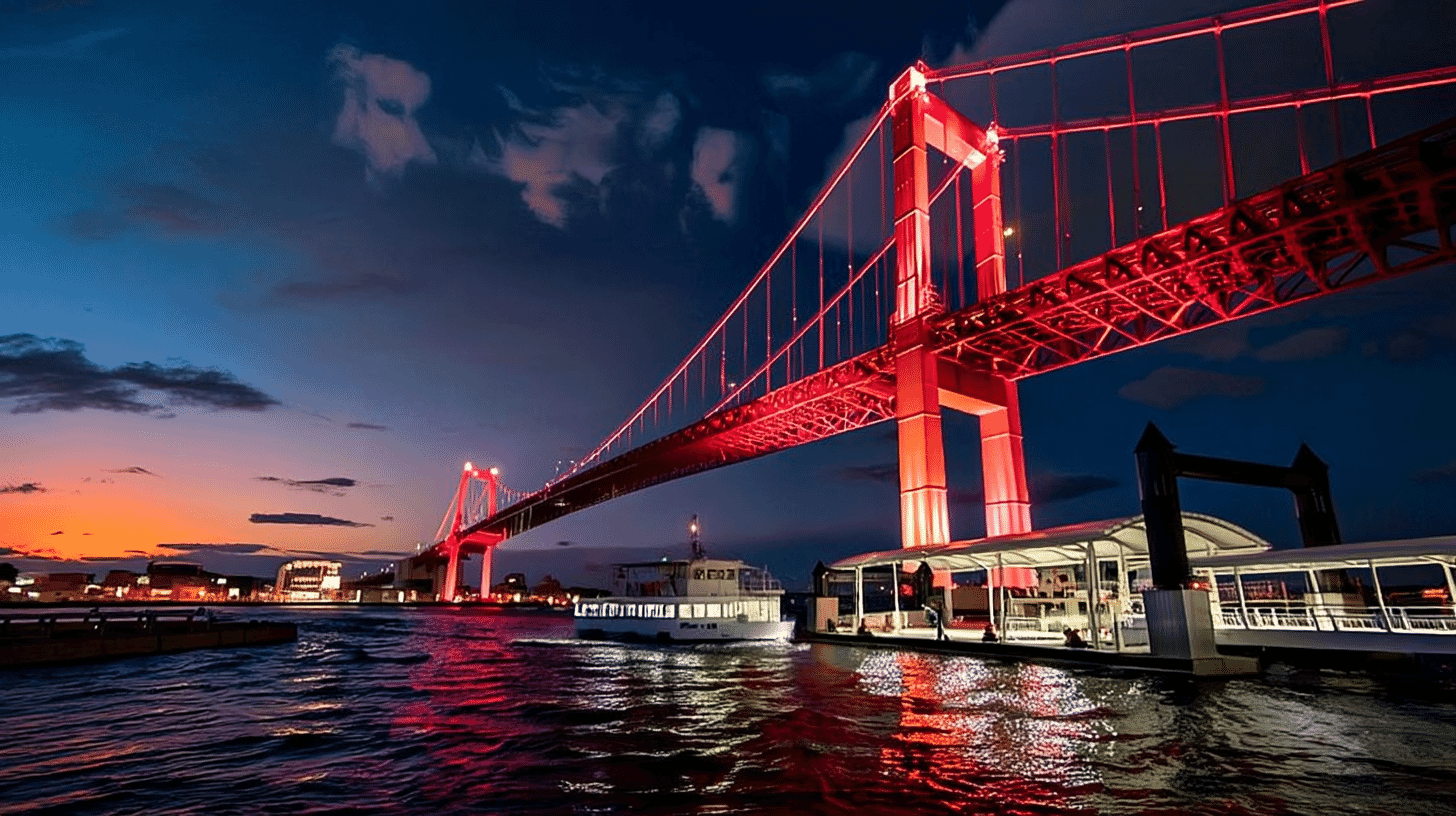
Since 2018, Wakato Bridge has been transformed nightly into a stunning light installation, earning recognition as a Japan Night View Heritage site. The deep crimson bridge structure is bathed in warm light, with the two 85-meter main towers resembling giant burning torches against the night sky. The illumination creates dramatic shadows and a sense of profound weight and presence that has made the bridge a must-see destination for night view enthusiasts.

The best viewing times are from 7:00 PM to 10:00 PM (April through September) and 6:00 PM to 10:00 PM (October through March). Two primary viewpoints offer distinctly different perspectives: the Wakamatsu South Coast provides a romantic waterfront setting with benches and street lamps, while the "Oshioi-kumi-no-ba" on the Tobata side offers dramatic close-up views where visitors feel immersed in the bridge's illuminated presence.

Wakato Ferry: A Three-Minute Cruise Through Time

For a unique perspective of the bridge, take the Wakato Ferry that has connected the two shores since before the bridge existed. This beloved local ferry, affectionately called "pon-pon-bune" (motorboat), offers a nostalgic three-minute crossing directly beneath the bridge. At just 100 yen per adult, it provides an affordable and atmospheric way to experience the bridge's massive scale from water level while enjoying the sea breeze and watching the industrial landscape drift by.

Industrial Night View Cruises

Kitakyushu was selected as Japan's No. 1 New Three Great Night View City in December 2024 for the second consecutive time. The city offers regular night view cruises departing from Kokura Port that pass beneath the illuminated Wakato Bridge before exploring the chemical plants and factories lining Dokai Bay. These 90-minute cruises, operating on weekends, feature knowledgeable "night view navigators" who share stories about the industrial heritage and the bridge's significance.

Kukinoumi Fireworks Festival

Every July, the bridge becomes the stage for a spectacular fireworks display during the Kukinoumi Fireworks Festival. The highlight is the "Niagara Falls" effect—cascading fireworks launched from the bridge itself, creating a waterfall of light that pours into Dokai Bay. This breathtaking spectacle draws crowds from throughout the region.

Surrounding Area: Wakamatsu Retro District

The Wakamatsu South Coast, adjacent to the bridge, preserves a remarkable collection of Taisho and early Showa era architecture that recalls the area's prosperous past as a major coal shipping port. Often called the "Wakamatsu Bund," this waterfront promenade offers a quieter alternative to the more famous Moji Port Retro district, with fewer tourists and a more authentic atmosphere.

Former Furukawa Mining Wakamatsu Building

This elegant Renaissance-style brick building, constructed in 1919, is the crown jewel of the district. Its distinctive corner tower and red-and-white facade have made it a symbol of Wakamatsu. Now a registered tangible cultural property, it houses a community center and small museum showcasing the area's coal mining history. The building is beautifully illuminated at night and offers free admission for visitors wishing to explore its historic interior.

Ueno Building and Historic Architecture

The waterfront features several other notable structures including the Ueno Building, a three-story reinforced concrete building from the early Showa period with distinctive diamond-pattern decorations and lion sculptures. These buildings, together with the bridge, create a unique urban landscape that tells the story of Japan's industrial modernization.

Takatouyama Park

For panoramic views, head to Takatouyama Park on the Wakamatsu side. At 124 meters elevation, this hilltop park offers spectacular vistas of the illuminated Wakato Bridge with the factory night views of steel mills and chemical plants stretching beyond—a truly memorable sight that encapsulates Kitakyushu's industrial identity.

Practical Information for Visitors

Wakato Bridge is easily accessible and free to cross by vehicle since December 2018. For pedestrians, the Wakato Ferry provides the best way to experience the bridge and its surroundings. The ferry departs every 15 minutes from both Tobata and Wakamatsu ferry terminals.

The Tobata Ferry Terminal is approximately 10 minutes on foot from JR Tobata Station's north exit. The Wakamatsu Ferry Terminal is about 11-20 minutes walking from JR Wakamatsu Station. Consider combining your visit with the retro architecture walk along Wakamatsu South Coast for a half-day excursion that captures both historical and industrial aspects of this fascinating area.

For the industrial night view cruise, advance reservations are recommended through Kanmon Kisen (093-331-0222). The cruises operate on weekends, departing at 7:00 PM (April-September) or 6:30 PM (October-March) and lasting approximately 90-110 minutes.

📍 Plan Your Visit to Fukuoka
Find tours, activities & transport passes near Wakato Bridge
[ Dazaifu Tenmangu Shrine & Hakata Food Tours ]

Q&A

QCan I walk across Wakato Bridge?
AUnfortunately, pedestrian access to the bridge was discontinued in 1987 when the bridge was widened to four lanes. However, the Wakato Ferry offers a wonderful alternative, passing directly beneath the bridge for just 100 yen. Special walking events are occasionally held to commemorate anniversaries, such as the 60th-anniversary celebration in 2022 when 8,000 participants walked across.
QWhat is the best time to visit Wakato Bridge?
AThe bridge is beautiful year-round, but evening visits are particularly recommended to experience the illumination. Sunset and blue hour offer magical photo opportunities as the lights come on. The Kukinoumi Fireworks Festival in July provides a spectacular summer experience, while winter nights offer clearer air for viewing the industrial night scenery.
QHow does Wakato Bridge compare to other famous Japanese bridges?
AWakato Bridge holds a special place as the pioneer of Japan's long-span suspension bridges. While it has been surpassed in length by later bridges like Akashi Kaikyo Bridge (the world's longest suspension bridge), Wakato Bridge's engineering innovations made those later achievements possible. Its designation as a National Important Cultural Property recognizes this foundational role.
QIs there an admission fee to see the bridge or surrounding attractions?
AViewing the bridge is completely free. The Wakato Ferry costs 100 yen for adults and 50 yen for children. The Former Furukawa Mining Building offers free admission for viewing. Industrial night view cruises cost approximately 2,500-3,000 yen per adult.
QWhat other attractions can I combine with a visit to Wakato Bridge?
AConsider visiting Mount Sarakura (one of Japan's New Three Great Night Views), Moji Port Retro district, or the UNESCO World Heritage Sites of the Former Imperial Steel Works. The Tobata Gion Oyama Festival (UNESCO Intangible Cultural Heritage) takes place in July if you can time your visit with this spectacular float parade.

Basic Information

Name Wakato Bridge (若戸大橋 / Wakato Ohashi)
Cultural Designation National Important Cultural Property (designated February 9, 2022)
Other Designations Japan Night View Heritage (Lightup Night View Heritage)
Location Spanning Dokai Bay between Tobata Ward and Wakamatsu Ward, Kitakyushu City, Fukuoka Prefecture
Completion Date September 26, 1962
Bridge Length 627.3 meters (total road length: 2,068 meters)
Main Span 367 meters
Tower Height 85 meters (main pylons)
Width 19.6 meters (4 lanes)
Structure Type Steel-stiffened suspension bridge with reinforced concrete abutments
Illumination Hours April-September: 7:00 PM - 10:00 PM / October-March: 6:00 PM - 10:00 PM
Toll Free (since December 1, 2018)
Access (Tobata Side) 10-minute walk from JR Tobata Station North Exit to Tobata Ferry Terminal
Access (Wakamatsu Side) 11-20 minute walk from JR Wakamatsu Station to Wakamatsu Ferry Terminal
Wakato Ferry Adults 100 yen / Children 50 yen / Bicycles 50 yen (operates every 15 minutes, 3-minute crossing)

References

若戸大橋 - 文化遺産オンライン
https://bunka.nii.ac.jp/heritages/detail/523677
若戸大橋 - 日本夜景遺産
https://yakei-isan.jp/spot/detail.php?id=268
とばたと若戸大橋 - 北九州市
https://www.city.kitakyushu.lg.jp/tobata/kw7100006.html
若松南海岸と建物群 - 北九州市
https://www.city.kitakyushu.lg.jp/wakamatsu/file_0015.html
土木遺産 in 九州:若戸大橋 - 九州地域づくり協会
https://dobokuisan.qscpua2.com/heritage/fukuoka/fuk6_wakatooohashi/
若戸大橋 ~洞海湾の赤いかけはし - 北九州平和資料館
https://kitakyushu-peacemuseum.jp/若戸大橋 ~洞海湾の赤いかけはし~/
北九州工場夜景クルーズ - 日本夜景遺産
https://yakei-isan.jp/spot/detail.php?id=297
旧古河鉱業若松ビルについて - 北九州市
https://www.city.kitakyushu.lg.jp/contents/27000095.html
若戸渡船 - 福岡県観光情報 クロスロードふくおか
https://www.crossroadfukuoka.jp/transport/13902

Last verified: 2026.01.14

Nearby heritages