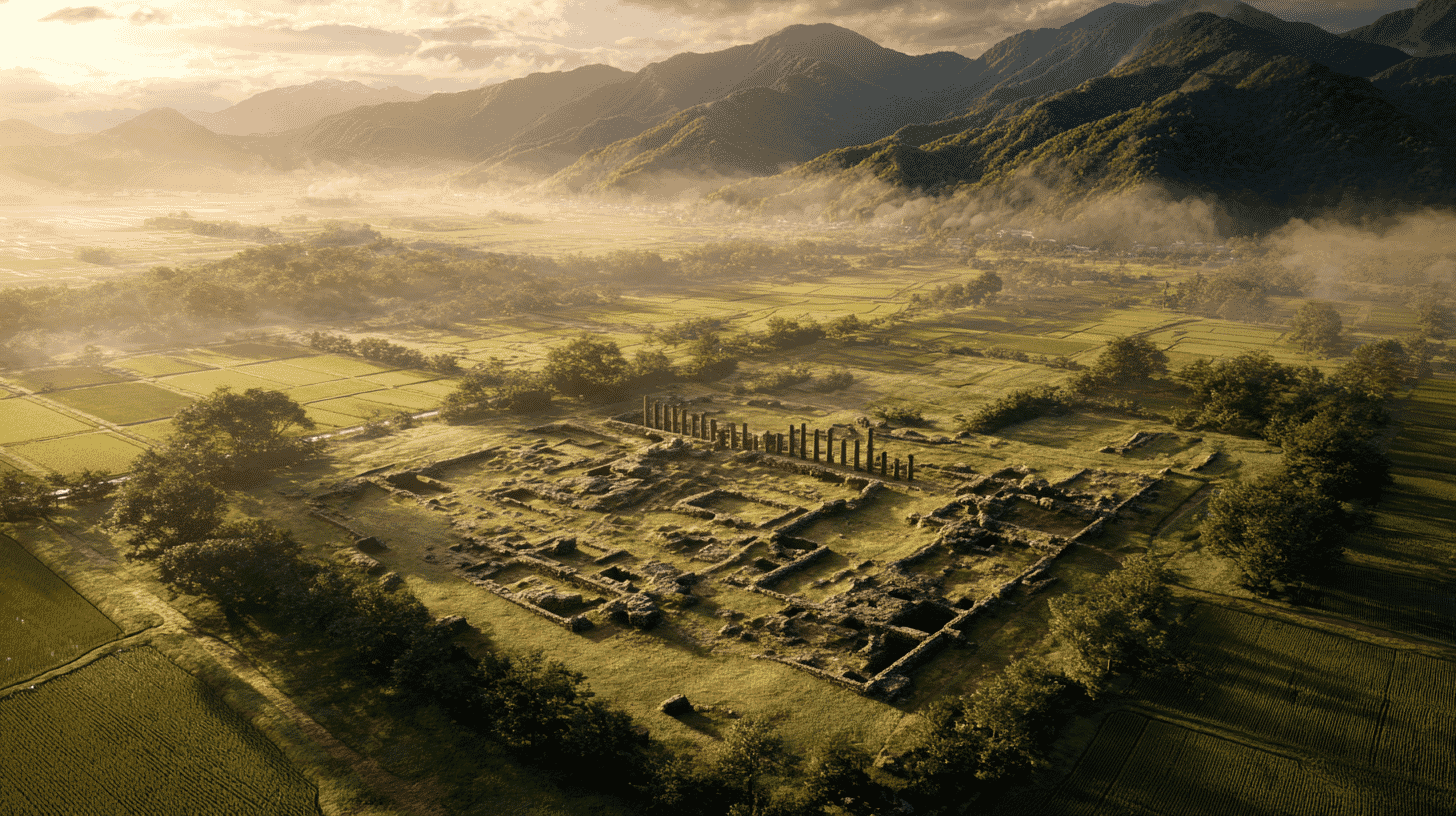
Izumi Kanga Ruins: Discover Japan's Ancient Government Complex in Fukushima | National Historic Site

Explore the Izumi Kanga Ruins in Minamisoma, Fukushima—a National Historic Site revealing Japan's 8th-century district government complex. Discover ancient administrative halls, granaries, and artifacts from the Nara-Heian periods in this hidden archaeological treasure of the Tohoku region.

Izumi Kanga Ruins: A Window into Japan's Ancient Administrative Past

Nestled in the coastal city of Minamisoma in Fukushima Prefecture, the Izumi Kanga Ruins (泉官衙遺跡) stand as one of Japan's most significant archaeological treasures from the ancient Nara and Heian periods. This National Historic Site offers visitors a rare opportunity to walk through the remnants of an 8th-century government complex that once served as the administrative heart of ancient Namekata District in Mutsu Province.

What Are the Izumi Kanga Ruins?

The Izumi Kanga Ruins are the archaeological remains of an ancient provincial government office complex (官衙, kanga) that operated from the late 7th century through the 10th century. Located on a river terrace formed by the Nitta River flowing from the Abukuma Highlands, this expansive site covers approximately 11.5 hectares and represents one of Japan's most completely excavated examples of a district-level government complex (郡衙, gunga).

The complex once served as the administrative center for ancient Namekata District (行方郡), which roughly corresponds to present-day Minamisoma City and Iitate Village. Here, government officials managed local affairs, collected taxes, maintained order, and facilitated communication between the central government in the capital and the local population in this frontier region of ancient Japan.

Why Is This Site Nationally Designated?

The Izumi Kanga Ruins received National Historic Site designation on February 22, 2010, with additional areas added in 2018. The site's exceptional significance stems from several factors.

First, the comprehensive nature of the excavations has revealed the complete layout of a district government complex, including the main administrative hall (郡庁院, gunchōin), granary compound (正倉院, shōsōin), and guest facilities (館院, tachiin). Such complete preservation and documentation of all major components in a single site is extraordinarily rare in Japanese archaeology.

Second, the site demonstrates three distinct construction phases spanning approximately 300 years, allowing researchers to trace the evolution of provincial administration in ancient Japan. The progression from simple wooden structures to more elaborate buildings with roof tiles and stone foundations reflects the growing sophistication of local government during this period.

Third, the excavations have yielded an impressive array of artifacts including roof tiles with distinctive patterns, wooden tablets (木簡, mokkan) with written records, Sue ware and Haji ware pottery, and carbonized rice—physical evidence of daily life and administrative activities in ancient Japan.

Historical Significance and Context

The establishment of the Izumi government complex occurred during a pivotal period in Japanese history. Following the implementation of the Ritsuryō system of centralized government in the late 7th century, Japan's ruling authority sought to extend administrative control throughout the archipelago. In 718, several districts of southern Mutsu Province were briefly reorganized into Iwaki Province, though this arrangement lasted only until 720 or 724.

Historical records, including the Shoku Nihongi (続日本紀), mention a significant fire at the Namekata District office in 774 that destroyed 25,400 koku of stored grain—a testament to the importance of this administrative center and the scale of its operations. Archaeological evidence of extensive carbonized material in the granary area suggests the complex ultimately met its end through fire around the late 10th century.

Highlights and What to See

The Izumi Kanga Ruins offer visitors the opportunity to explore the foundations of an ancient government complex that once stretched approximately one kilometer from east to west. Key areas of interest include:

The Administrative Hall Area (郡庁院) formed the political heart of the complex, featuring a U-shaped arrangement of buildings typical of Nara and Heian period government facilities. The main hall stood at the center, flanked by symmetrical east and west wings, all enclosed within a wooden palisade.

The Granary Compound (正倉院), located approximately 240 meters northwest of the main administrative buildings, once housed the district's tax rice and other collected goods. The remains of multiple raised-floor storehouses with various foundation types—some with buried pillars, others with stone foundations—demonstrate the evolution of construction techniques over the site's three centuries of use.

The Guest Facilities (館院) served as accommodation for traveling officials and visiting dignitaries, highlighting the site's role in the communications network connecting the capital with Japan's northern frontier.

A canal system connected the complex directly to the Nitta River, facilitating water transport of goods and materials—evidence of sophisticated infrastructure planning in ancient Japan.

The Izumi Legend: Tales of the Wealthy Lord

Local folklore adds a romantic dimension to this archaeological site. According to the Ōsōshi (奥相志), a gazetteer of the Nakamura Domain, the legendary "Izumi Chōja" (Izumi Millionaire) once lived in this area and possessed fabulous wealth. The tale relates that when Minamoto no Yoshitsune passed through the region on his way to Hiraizumi during the late 12th century, he sent his retainer Benkei to burn the wealthy lord's mansion, fearing that such concentrated riches might cause future troubles. A centuries-old pine tree in the area, known as the "Benkei's Resting Pine" (弁慶の腰掛松), is said to mark the spot where Benkei sat watching the flames consume the estate.

Nearby Attractions and Related Sites

Visitors to the Izumi Kanga Ruins can enhance their experience by exploring several related sites in the vicinity.

The Minamisoma City Museum displays artifacts excavated from the Izumi Kanga Ruins, including distinctive roof tiles, pottery, and wooden tablets. The museum also features exhibits on the renowned Soma Nomaoi festival and the region's natural and cultural heritage.

The Sakurai Kofun, designated as a National Historic Site, is one of Tohoku's largest keyhole-shaped burial mounds, dating to the 4th century and offering insight into even earlier periods of the region's history.

The Hayama Cave Tomb, another National Historic Site, features rare painted murals from the late Kofun period, depicting human figures, horses, and spiral patterns in red and white pigments.

The Izumi Kannon-dō enshrines a prefecturally-designated Eleven-Faced Kannon statue from the late Kamakura period, traditionally associated with the legendary Izumi Chōja.

For those visiting in late July, the spectacular Soma Nomaoi festival, designated as an Important Intangible Folk Cultural Property, features hundreds of armored horsemen in what is often described as Japan's most dramatic samurai spectacle.

Planning Your Visit

The Izumi Kanga Ruins are accessible year-round, though spring and autumn offer the most pleasant weather for outdoor exploration. The site is currently being developed as a historic park, with ongoing preservation and interpretation work by the Minamisoma City Board of Education.

For the most comprehensive understanding of the site, consider combining your visit with a stop at the Minamisoma City Museum, where excavated artifacts are displayed and contextual information is available. Occasional on-site explanatory events and excavation updates are held, particularly during archaeological survey seasons.

📍 Plan Your Visit to Fukushima
Find tours, activities & transport passes near Izumikanga Ruins
[ Aizu-Wakamatsu Castle & Ouchi-juku Village Tours ]

Q&A

QWhat exactly is a "kanga" site?
AA kanga (官衙) is the Japanese term for an ancient government office complex from the Nara and Heian periods (roughly 7th-10th centuries). These facilities served as administrative centers where officials managed local governance, collected taxes, maintained records, and connected local populations with the central government. The Izumi Kanga Ruins specifically represent a "gunga" (郡衙), or district-level office, which was subordinate to provincial headquarters.
QIs this site suitable for visitors with limited Japanese language ability?
AWhile on-site signage is primarily in Japanese, the archaeological remains are visually accessible to all visitors. The Minamisoma City Museum offers some English materials, and the physical layout of the foundations helps visitors understand the scale and organization of the ancient complex even without extensive explanatory text. Researching the site beforehand or arranging a local guide can enhance your experience.
QHow does this site relate to the 2011 earthquake and tsunami?
AWhile Minamisoma was significantly affected by the 2011 Great East Japan Earthquake and its aftermath, the Izumi Kanga Ruins, located inland from the coast, were not directly damaged. The site has continued to be preserved and developed as a cultural resource, representing the region's deep historical roots and serving as a symbol of cultural continuity and resilience.
QWhat is the best time of year to visit?
ASpring (April-May) and autumn (September-November) offer the most comfortable weather for exploring this outdoor archaeological site. If you can time your visit for late July, you may also experience the spectacular Soma Nomaoi festival. Occasional on-site explanation events are held throughout the year—check with the Minamisoma City Board of Education for schedules.
QAre there any admission fees?
AThe Izumi Kanga Ruins archaeological site itself is open to visitors without charge. The Minamisoma City Museum, where excavated artifacts are displayed, has a modest admission fee. Check current hours and fees with the museum before your visit, as they may vary seasonally.

Basic Information

Official Name Izumi Kanga Ruins (泉官衙遺跡, Izumi Kanga Iseki)
Designation National Historic Site (designated February 22, 2010; expanded 2018)
Period Late 7th century to late 10th century (Nara to Heian periods)
Site Area Approximately 11.5 hectares
Location Izumi, Haramachi-ku, Minamisoma City, Fukushima Prefecture
Access Approximately 15 minutes by car from JR Haranomachi Station on the Joban Line; 10 minutes by car from the Takami-machi intersection on National Route 6
Related Museum Minamisoma City Museum (Tel: 0244-23-6421)
Contact Minamisoma City Board of Education, Cultural Properties Division (Tel: 0244-24-5284)

References

泉官衙遺跡 - 文化遺産オンライン
https://bunka.nii.ac.jp/heritages/detail/225229
泉官衙遺跡(いずみかんがいせき)- うつくしま電子事典
https://www.gimu.fks.ed.jp/plugin/databases/detail/2/18/30
原町区の文化財1 - 南相馬市
https://www.city.minamisoma.lg.jp/portal/sections/61/6150/61501/4/1265.html
泉官衙遺跡史跡公園整備事業基本計画 - 南相馬市
https://www.city.minamisoma.lg.jp/portal/culture/geijutsu_bunka/3/11759.html
Izumi Kanga ruins - Wikipedia
https://en.wikipedia.org/wiki/Izumi_Government_Offices_Site
南相馬に躍動する古代の郡役所・泉官衙遺跡 - 新泉社
https://www.shinsensha.com/books/396/

Last verified: 2026.01.29

Nearby heritages