
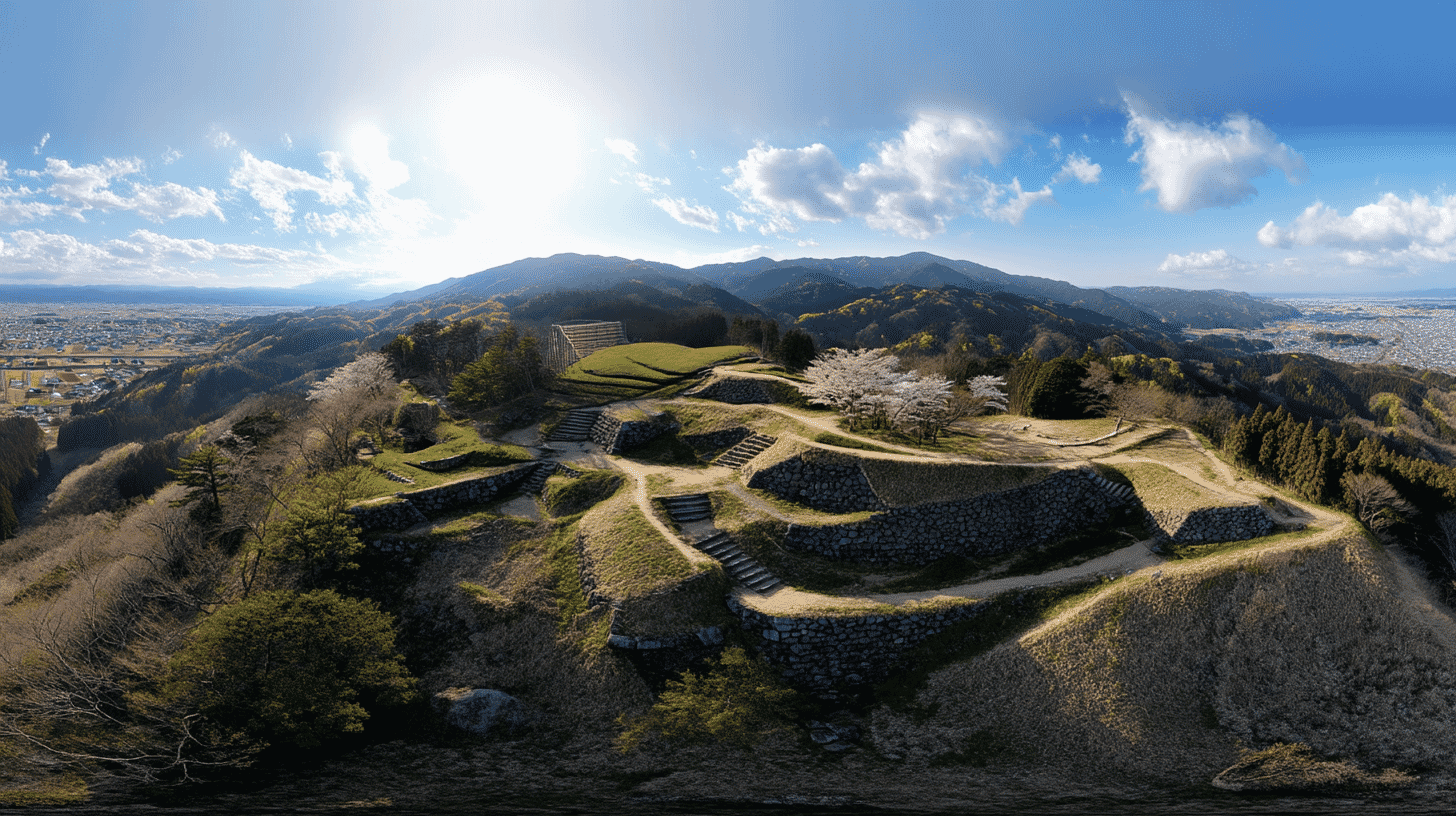
One Castle Site, Designated by the State in 1990
Koori Nishiyama Castle Ruins (桑折西山城跡, Koori Nishiyama Joato) lie in Koori Town, Date District, Fukushima Prefecture, the site of a castle of the Warring States period, designated by the state on 19 February 1990. Its category is that of historic sites.
The field for a managing body stands empty.
The Agency records that Date District is the place from which the Date family, a warlord house, took its name, and that this was their seat, centred on a hill 193 metres high to the west of the town.
The Castle Named in a Law
That the castle stood at the centre of a domain is read from the text of a law.
The Agency records that the lord of the castle issued a domain law code in 1536. Such codes were laws a warlord issued for his own territory.
Its article 71, the record continues, deals with things found by the roadside and directs that a notice be set up at the foot of Nishiyama, which shows well that the castle and its town were the centre of the domain.
A clause on lost property names the foot of the castle hill as the place to post notice. The castle town is named in the law as the place where such matters were made known.
At the Bingo provincial seat, an early dictionary that recorded the seat's location was borne out by excavation: a book that set down a place-name.
Here the text of a law issued for the domain treats the castle town as its centre.
Demolished as a Term of Peace
The castle's end was settled in an agreement to close a conflict.
The Agency records that the lord was suddenly seized by his heir and confined within the castle, setting off an internal war that divided the family and the lords of southern Mutsu in two.
After 6 years of strife, the record continues, the two made peace: the father retired to another castle, the son took the headship and moved to Yonezawa, and as a condition of the peace the castle was demolished.
The castle where the father had been held was pulled down as a term of the peace between father and son. Its role ended with the settling of the quarrel.
The Obaraya shop storehouse was drawn back for a road; the Koshikawa bridge lost piers to a road.
Here demolition came by agreement after war. Even so, the record closes that the remains are well preserved.
Names of Its Parts Kept in Names of People and a Road
What parts of the castle were called became what people living there were called.
The Agency records that two of the lord's consorts are known by the names of enclosures of the castle, and suggests that each lived in the enclosure whose name she bore.
One of those names belongs to an enclosure on the western side of the castle. The woman who lived there is thought to have been called by it.
The road from the castle town to those enclosures, the record continues, is still known by a local place-name meaning the road of adornment.
At the Ogiwara residence, a room is named for its place before the storehouse: a room named by position.
Here the name of an enclosure became the name of a person, and the name of the road leading to it survives as a present-day place-name.
Visiting
The site lies in Koori Town, Date District, Fukushima Prefecture.
The Agency records the main enclosure, the second enclosure and several terraces on the hill, with two enclosures to the west across a saddle facing each other over a straight dry moat. These remains agree well with the castle as shown on an old castle plan.
South-west of the second enclosure lies a gun emplacement from the civil war of the Meiji Restoration. In 1679, a lord newly moved to Fukushima planned to build a castle in the western enclosure, but the plan was not carried out.
The Agency gives the start of the internal war as 1532 for the eleventh year of its era, but that year corresponds to 1542.
This is an open-air hilltop site, so whether and how it may be visited follows the arrangements of the local authority. Check before travelling.
Q&A
- When was the site designated?
- On 19 February 1990, by the state, as a historic site.
- What is the domain law code?
- A law issued by the lord in 1536 for his territory. Its article 71 names the foot of Nishiyama, showing the castle town as the centre of the domain.
- Why was the castle lost?
- It was demolished as a condition of the peace that ended an internal war, which began when the lord was seized by his own heir.
- What is the road of adornment?
- A local place-name for the road from the castle town to the enclosures where the lord's consorts are thought to have lived.
- What remains can be seen?
- The main and second enclosures and terraces on the hill, and two enclosures to the west facing each other across a straight dry moat.
Basic Information
| Name | Koori Nishiyama Castle Ruins (桑折西山城跡, Koori Nishiyama Joato) |
|---|---|
| Location | Koori Town, Date District, Fukushima Prefecture |
| Designation | Historic site; designated as an archaeological site rather than as a building or a work of art |
| Year Designated | 1990 (19 February), designated |
| Quantity | 1 castle site |
| Dimensions | Centred on a hill 193 metres high west of the town: main enclosure, second enclosure and several terraces, with two enclosures across a saddle to the west facing each other over a straight dry moat. A projecting gate enclosure survives in one and hook-shaped earthworks in the other |
| Owner | The field for a managing body stands empty in the record |
| Public Access | An open-air hilltop site; visiting follows the arrangements of the local authority |
References
- Cultural Heritage Online: the castle site
- https://bunka.nii.ac.jp/heritages/detail/160708
- Koori Town: about Nishiyama Castle
- https://www.town.koori.fukushima.jp/kankou/sightseeing/4/yamajirosummit2021_inKoori/about_nishiyama_castle.html
- Agency for Cultural Affairs, National Cultural Properties Database
- https://kunishitei.bunka.go.jp/
- Fukushima Prefecture: cultural properties
- https://www.pref.fukushima.lg.jp/
Last verified: 2026.09.22